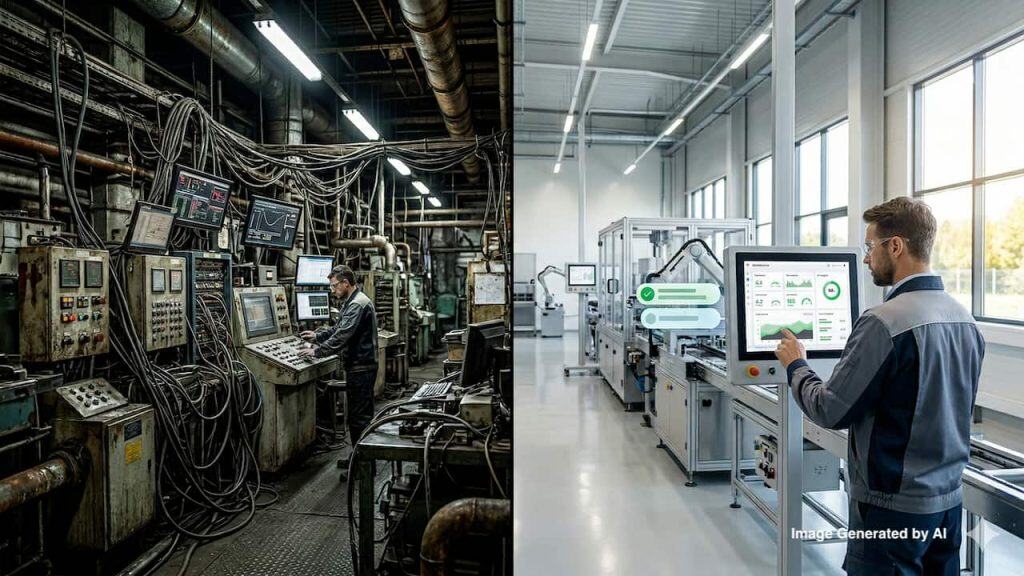
The transition to Industry 4.0 has long been stalled by the “Data Silo” problem. In 2026, the conversation has shifted. Leading manufacturers are synchronizing Atoms (physical goods), Bits (digital data), and Neurons (human intelligence) through a paradigm known as Liquid Computing.
This isn’t just incremental improvement; it is a structural rewiring of how quality is enforced on the factory floor.
The “Wow” Factor: Liquid Computing and Agentic AI
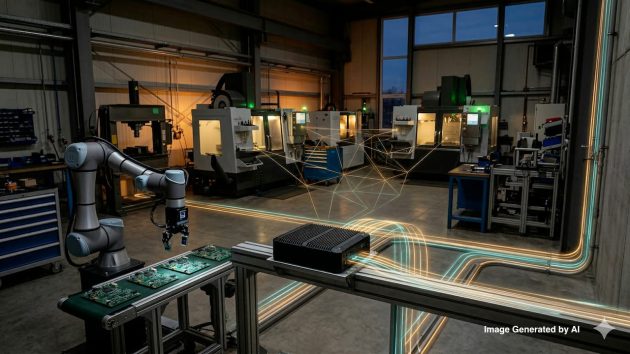
The breakthrough in 2026 is the move away from rigid, cloud-dependent architectures toward Liquid Computing. In this model, intelligence “flows” to where it is needed most.
- Beyond Dashboards: Traditional AI tells you that a defect happened. Agentic AI, a core theme for 2026, actually initiates the correction. It operates within predefined guardrails to adjust machine setpoints or reroute WIP (Work-in-Progress) before a single scrap part is produced.
- The 10-Image Breakthrough: One of the biggest hurdles to AI has been the need for thousands of “bad” images to train a model. New Generative Synthetic Data tools now allow manufacturers to train robust inspection models using as few as 10 clean samples, slashing deployment time from months to hours.
Real-Time Context: The Death of the “6,000-Mile Delay.”
A recurring failure in early AI pilots was the latency of the cloud. If an engine is vibrating at an abnormal frequency, sending that data 6,000 miles away for analysis is useless.
| Feature | Legacy AI | Industrial AI |
|---|---|---|
| Data Source | Retrospective Batch Data | Real-Time Location & Process Context |
| Processing | Centralized Cloud | Liquid/Edge Computing |
| Role of Human | Data Entry / Passive Monitor | Augmented Decision Maker |
| Training | Thousands of Defect Images | Generative Synthetic Models (Minimal Samples) |
The New Workforce: Augmented, Not Replaced
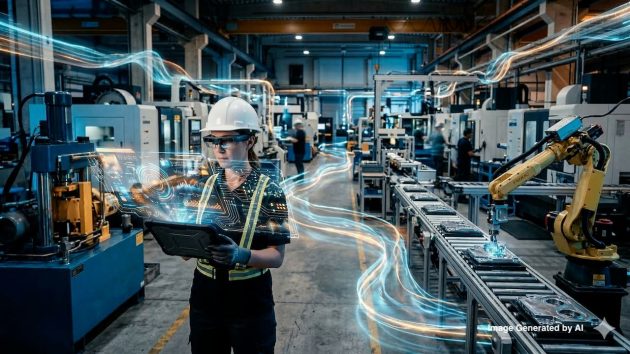
The “Zero Defect” mission is ultimately a human one. The 2026 mandate focuses on Augmented Intelligence, where technology closes the “cognitive distance” for the frontline worker.
- Situational Support: Using AR and mobile-enabled tablets, operators receive “just-in-time” prompts. If a sensor detects a slight drift in pressure, the operator’s wearable provides an immediate visual SOP (Standard Operating Procedure) to calibrate the machine.
- Institutional Knowledge Capture: AI is now used to “harvest” the expertise of retiring veterans. By recording a veteran’s workflow, AI converts those “atoms” of movement into “bits” of digital guidance for the next generation of workers.
In 2026, the metric for success isn’t just OEE (Overall Equipment Effectiveness); it is Time-to-Proficiency. How fast can a new hire achieve zero-defect execution?
Strategy for North American Manufacturers
As reshoring accelerates, the competition is about flow stability.
- Stop “Pilot Purgatory”: Focus on a single flow where spatial bottlenecks occur.
- Verify the Data Fabric: Ensure your SCADA and IIoT systems are not just collecting data, but providing context (e.g., “The pump is off because the line is staged,” not “The pump has failed”).
- Invest in Neurons: Technology investments only pay off if the frontline can act on the insights. Digital upskilling is the prerequisite for AI ROI.
This article explores the shift toward “Liquid Computing” and augmented intelligence, synthesized from the AI-powered Quality Control in Manufacturing: Leveraging IIoT for Zero Defects session at IIoT World Day.
Special thanks to: Dr. Erik Volkerink, Heather Cykoski, Marcia Gadbois, Sarah Morgan, CHISP, Ira Sharp.
FAQ: The 2026 Mandate for Zero-Defect Manufacturing
1. How does Liquid Computing differ from traditional cloud AI in manufacturing?
Traditional industrial AI often suffers from the “6,000-mile delay,” where data is sent to a centralized cloud for analysis, making real-time intervention impossible. Liquid Computing processes data directly at the industrial edge, allowing intelligence to “flow” exactly where it is needed to prevent defects before they occur.
2. Why is Agentic AI critical for North American manufacturers reshoring their operations?
As North American manufacturers reshore operations, they face intense pressure to maintain flow stability despite labor shortages. Agentic AI helps bridge this gap by not just detecting anomalies, but actively initiating corrections, such as adjusting machine setpoints, without waiting for human intervention.
3. Do I need thousands of defect images to train an AI inspection model?
Not anymore. In 2026, the mandate has shifted. Using new Generative Synthetic Data tools, manufacturers can now train robust quality control models using as few as 10 clean samples, reducing deployment time from months to mere hours.
4. Will Agentic AI replace frontline operators on the factory floor?
The goal of the 2026 manufacturing mandate is “Augmented Intelligence.” Instead of replacing workers, technology uses AR and mobile-enabled tablets to provide situational support. The new metric for success is “Time-to-Proficiency”, using AI to help new hires execute with zero defects as quickly as possible.
About the author