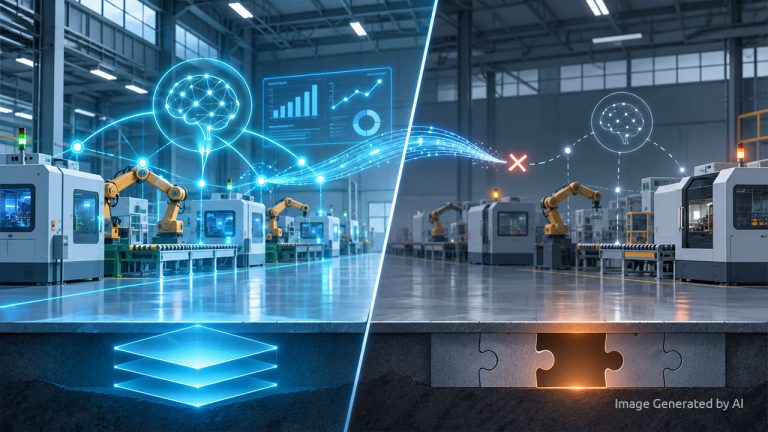
When a predictive maintenance system flags that a machine will fail in two weeks, an engineer still has to open the equipment to find out whether the problem is a misalignment, a cavitation issue, or a worn bearing. Cognitive maintenance eliminates that step. By fusing sound, vibration, and thermal data at the same timestamp, it delivers both the root cause and the failure mode remotely. Leon Lim, CEO and Founder of GroundUp AI, built the approach from a musical background where orchestra training in pitch detection transferred to spotting mechanical faults by ear. A naval defense team achieved 22 consecutive months of zero unplanned downtime after replacing rotational spot-checks with priority-based remote diagnosis. The same sensor-fusion framework now captures retiring technicians’ diagnostic intuition as the average age of experienced maintenance technicians climbs from 48 to 52.
How Does Sensor Fusion Change Machine Diagnosis?
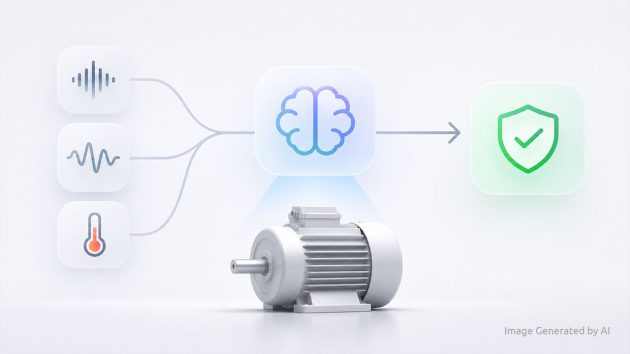
A single vibration sensor produces an FFT chart showing one pattern. A thermal sensor produces another. Neither tells a maintenance team what is actually wrong with the machine. Synchronizing sound, vibration, and thermal readings at the exact same timestamp cross-validates all three signals and reveals the actual root cause, turning isolated symptoms into a confirmed diagnosis.
The approach mirrors how experienced technicians already work. An orchestra musician tuning a French horn to 442 or 444 hertz trains the ear to detect deviations invisible to untrained listeners. That same frequency sensitivity transfers to industrial equipment: a healthy machine operating under standard conditions emits a steady, predictable signal across sound, vibration, and heat. When internal wear begins, the signal shifts before any conventional monitoring threshold triggers an alarm. Before founding GroundUp AI, the company’s CEO managed a Tier 3 data center housing more than 3,000 server racks and could spot early faults by listening for uneven frequencies while walking past equipment. Sensor fusion automates that same multi-modal listening at a scale no individual can sustain.
What Does Cognitive Maintenance Add to Predictive?
Sensor fusion provides the raw diagnostic signal. What the system does with that signal separates predictive maintenance from cognitive maintenance. Predictive maintenance estimates when an asset might fail. The output is a timeline and a severity flag. The root cause stays unknown until someone inspects the machine.
“We don’t just tell you when your machine will spoil. We say why your machine spoils, and how it’s going to spoil,” said Leon Lim, CEO of GroundUp AI.
Cognitive maintenance performs that diagnosis remotely. The results arrive prioritized by severity, and the maintenance team acts on specific failure modes. The field inspection step that made predictive maintenance slow to close the loop from alert to action disappears entirely.
| Capability | Predictive Maintenance | Cognitive Maintenance |
| Core output | Failure timeline estimate | Root-cause diagnosis with failure mode |
| Field inspection | Required to confirm the actual fault | Remote, no on-site verification needed |
| Sensor approach | Single-modality (typically vibration) | Multi-modal: sound + vibration + thermal synced |
| Alert detail | “Will fail in approximately 2 weeks” | “Bearing wear in motor B, cavitation pattern confirmed” |
| Prioritization | Manual triage by operator | Automated severity ranking |
The difference becomes clearest in environments where every hour of downtime carries consequences beyond maintenance costs.
How Did a Naval Team Achieve Zero Unplanned Downtime?
A naval defense ship carries hundreds of machines that cannot fail at sea, and docking windows last only a few hours. Before adopting cognitive maintenance, the crew rotated through groups of roughly ten machines per stop, leaving dozens unchecked between visits. Any machine in an unchecked group could fail before its next scheduled inspection, a rotation that amounted to gambling on which equipment would hold.
After switching to remote cognitive diagnosis, the team stopped scheduling inspections by deck or machine group. Maintenance priorities now come from real-time alerts ranked by severity, each paired with a specific diagnosis. Procurement planning starts from the diagnosed failure mode, and the same crew covers the full fleet because remote diagnosis eliminates the hours previously spent opening equipment to identify the fault. The result: 22 consecutive months of zero unplanned downtime.
The deployment proved that a small engineering team can maintain an entire fleet when the diagnostic workload shifts from physical inspection to remote analysis. That efficiency depends on experienced engineers who know what the diagnosis means and what to do about it, and those engineers are aging out of the workforce.
How Can Manufacturers Preserve Retiring Technicians’ Knowledge?
Five years ago, the average age of an experienced industrial maintenance technician was 48. Today it is 52. Younger workers are not entering mechanical trades fast enough to close the workforce shortage, and each retirement takes decades of unwritten diagnostic instinct with it.
A veteran technician walks past a production line, places a hand on a motor housing, listens to the hum, and predicts a component failure weeks in advance, detecting a cavitation issue or a loose bearing by sound alone. The GroundUp Asset Library captures those fault patterns at the sub-component level and trains on each error type individually. Every new dataset builds on the existing library, deepening the diagnostic coverage over time.
Some senior technicians have been among the library’s strongest advocates because it preserves the knowledge they spent decades building. They describe it as an automated version of the standard operating procedures they had always wanted documented. Once that knowledge is captured digitally, the diagnostic capability that depends on a veteran’s ear today can persist long after the veteran retires.
What Does Physical AI Mean for Manufacturing?
Digitized diagnostic knowledge does not have to stay on a dashboard. The next phase of industrial AI embeds intelligence inside the physical machinery itself, where each machine and robot carries enough onboard reasoning to detect its own faults and coordinate responses with neighboring systems.
In a factory running physical AI, a robot sensing mechanical strain would throttle its own speed, signal a backup unit to absorb the workload, and route itself to a charging or maintenance bay. Building robots is one problem. Making them run reliably around the clock without human monitoring requires the same multi-modal fault detection and root-cause diagnosis that cognitive maintenance already delivers for stationary equipment, a trajectory from a trained ear to fused sensors to machines that listen to themselves.
For the full conversation, watch the CXO Series episode with Leon Lim.
This article is based on a video interview with Leon Lim, CEO and Founder of GroundUp AI, and Lucian Fogoros of IIoT World. AI tools were used to help summarize and organize the content. Reviewed and edited by the IIoT World editorial team.
Related from IIoT World