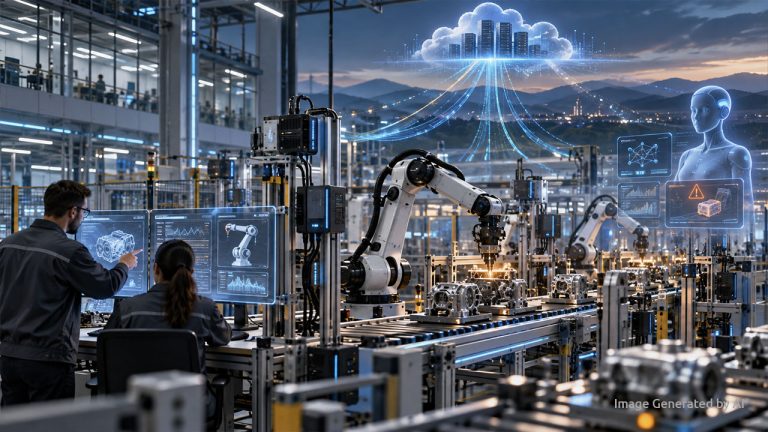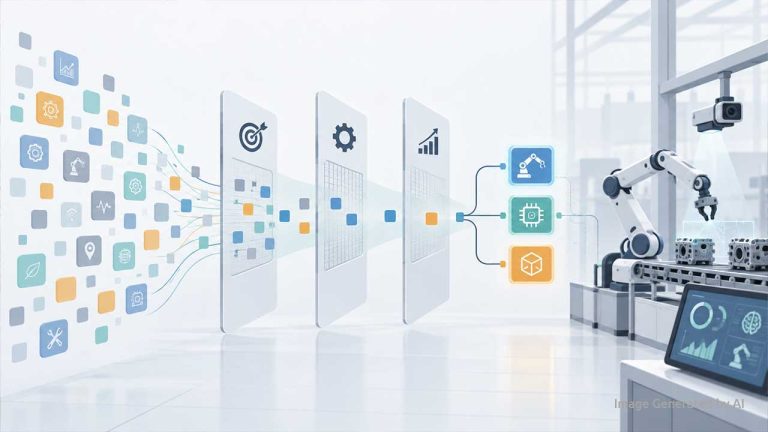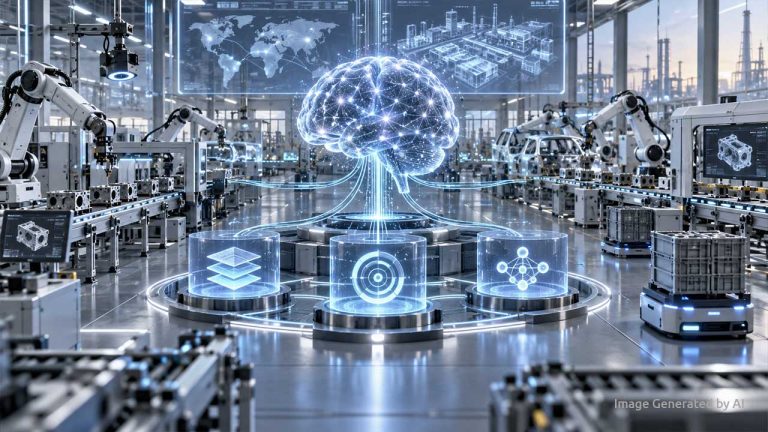
Industrial copilots are AI assistants built for manufacturing, designed to collaborate with workers rather than replace them. At a German automotive plant, a deployed copilot retrieves answers from equipment manuals, shift reports, and fault data within seconds.
One compelling example comes from a German automotive plant, where employees now work alongside a new AI assistant. This industrial copilot acts like a specialized internal search engine, retrieving answers and suggesting solutions to system problems within seconds. But unlike consumer-grade chatbots, this one doesn’t rely on internet data. Instead, it draws exclusively from internal sources—equipment manuals, planning documents, shift reports, quality logs, and historical fault data. This makes it both secure and highly relevant to the plant’s specific context.
What sets such copilots apart is their integration of Large Language Models (LLMs) tailored to technical content. These models allow the assistant to understand domain-specific terminology and deliver results within the correct engineering context. The above-mentioned copilot, for instance, not only retrieves the most relevant documents but also summarizes maintenance instructions in natural language. Employees can then interact with the assistant through a chat interface, asking follow-up questions or requesting clarification.
However, even technically sound tools face organizational hurdles. As one plant manager put it, “Our chatbot for maintenance, operations, and service is currently running. From a technical side it is OK. But to integrate it into daily life I have to adapt the organization.” This reflects a broader theme in industrial AI adoption: success is as much about change management and user training as it is about algorithms and infrastructure.
What Is Industrial-Grade AI for Engineers?
Industrial-grade AI is a class of copilot that understands engineering modalities beyond plain text, including diagrams, code, sensor data, and simulation outputs. Generic chatbots cannot process these formats. An automobile OEM working with Microsoft Azure’s tools deployed production-ready copilots on a secure, scalable platform with built-in monitoring, compliance, and authentication, freeing engineering teams to focus on core work rather than AI infrastructure.
This is why the concept of industrial-grade AI is gaining traction. Unlike generic chatbots, industrial copilots must be able to natively understand and reason with engineering modalities. They must offer trustworthy, explainable insights derived from highly specific datasets. In essence, they must be trained on what some refer to as an industrial foundation model, capable of comprehending the interplay between physics, electronics, software, and production workflows.
What Is the Difference Between Copilots and AI Agents?
Industrial copilots and AI agents differ in their degree of autonomy. Copilots assist human workers on specific tasks; AI agents automate entire workflows without human input at each step. A 2024-2025 survey by Rootstock Software found 53 percent of manufacturers prefer copilots, 22 percent prefer AI agents, and 25 percent were unsure of the difference, indicating a significant education gap across the sector.
The use cases for industrial copilots are varied and impactful. Maintenance technicians can use copilots to retrieve repair histories or access schematics in natural language. Production managers can get real-time insights into performance metrics like Overall Equipment Effectiveness (OEE) or yield. Engineers can query past projects to reuse components and optimize workflows. Some systems can even generate service tickets or connect users with remote experts for guided support, with transcripts feeding back into the knowledge base to continuously improve accuracy.
What Can Industrial Copilots Do Beyond Chat?
Industrial copilots do more than answer questions. They automate code generation, validate engineering logic, generate service tickets, and connect users with remote experts whose session transcripts feed back into the knowledge base. Siemens’ AI with Purpose Summit highlighted a data classification framework using color-coded tiers: white for synthetic data, green for uncritical data, yellow for sensitive information, and red for internal IP restricted to internal use only.
Despite these advances, several challenges remain. Data remains the bedrock of effective copilots, yet many workers on the shop floor are still not accustomed to working with data directly. Upskilling and improving data literacy among frontline staff is critical. Additionally, industrial companies are learning that while not all problems need AI, AI absolutely needs high-quality data to function well.
An important lesson shared during Siemens’ AI with Purpose Summit was the importance of a data classification framework. To ensure copilots have access to usable data without risking intellectual property or compliance violations, one company adopted a color-coded approach: white for synthetic data (freely usable), green for uncritical data (approval required), yellow for sensitive information, and red for internal IP (restricted to internal use only). This structured approach provides a safe path for organizations to begin their journey with AI copilots — starting small, starting safe, and scaling up.
Boris Scharinger, Siemens Digital Industries, shared his view: “The race for AI-driven productivity needs AI innovation partnerships, and industrial data becomes the currency in such partnerships. The cumbersome work of mining this currency needs a progressive approach — what data can we unlock for partners and what is truly a trade secret that is worth protecting?”
Rethinking work: what comes next in the AI-augmented factory
Ultimately, industrial copilots mark a significant step forward in the digital transformation of manufacturing. By embedding AI into the workflows of engineers, operators, and technicians, companies are not just digitizing tasks — they’re reshaping how industrial knowledge is captured, shared, and applied. And as these systems mature, the question will no longer be whether AI can assist in production or engineering—but how we design work to best take advantage of it!
About the author
 This article was written by Jan Burian, a global manufacturing industry analyst, serves as the Head of Industry Insights at Trask. His expertise spans digital transformation, management, leadership, and the geopolitical influences shaping manufacturing and global supply chains.
Related Reading
Agentic AI Isn’t a Product , It’s an Integrated Business Strategy