OpenAI’s GPT-6 Astra improved from 18% to 41% accuracy on a real workplace task automation benchmark in eight weeks. That 41% still means the model produces more incorrect outputs than correct ones across general tasks. At the Industrial AI Summit 2026, Maddie Zeng of NeoAI presented a three-capability framework for evaluating what industrial AI systems can actually do today, while Jonathan Weiss of Cumulocity explained how agentic quality inspection workflows already operate inside manufacturing plants.
Why Does 41% Accuracy Still Mean More Wrong Than Right?
When a general-purpose AI model scores 41% on workplace task automation, it fails on the majority of tasks it attempts. The benchmark measures real work sequences rather than isolated text prompts, and a model that gets 41% correct and 59% wrong would produce unacceptable error rates in any manufacturing environment where tolerances are tight and mistakes carry material cost.
The rate of improvement matters, though. GPT-6 Astra climbed from 18% to 41% in roughly eight weeks. That trajectory shows the underlying technology advancing at speed. The gap between general and specialized performance explains why a vendor focused on one specific manufacturing workflow can deliver higher accuracy than a lab optimizing for everything at once. When a vendor promises high precision across all industrial tasks, the published numbers from the best-funded AI labs on earth say otherwise. But a vendor with a specific focus, a targeted data set, and fine-tuned models for a defined workflow has a credible path to production-grade accuracy.
Ask vendors for evidence of domain-specific performance rather than general capability claims. If they cite broad accuracy numbers without specifying the task, the benchmark, and the data set, compare those claims against what OpenAI and other major labs are publishing.
What Three Capabilities Separate Industrial AI Tiers?
Most confusion in the industrial AI market comes from using one word for three different capabilities that improve at different rates. Separating them gives manufacturers a clearer lens for evaluating any AI product.
| Capability | What It Means | Manufacturing Example | Current State |
| Abstraction | The model learns concepts, not just pattern-matched strings | A purchase order system that recognizes a PO has a buyer, part, quantity, and promise date, and flags when one looks unusual | Improving steadily; models now learn hierarchical objects |
| Calibration | The model knows what it does not know and flags uncertainty | A pricing system that stops and says “this part is ambiguous, flagging for a human engineer” instead of filling in a confident but wrong answer | Trainable property; varies by vendor implementation |
| Autonomy | The model takes multi-step actions across real systems | An agentic fleet running quality inspection from camera detection through compliance check to line stoppage | Advancing fast in coding; still narrow for industrial workflows |
Abstraction has progressed from models that extracted text strings from form fields to models that learn layered concepts. An early system reading a purchase order would match “this box looks like a date.” A current system understands that a PO contains related objects, and can spot when the entire document deviates from normal patterns.
Calibration separates industrial-grade AI from consumer chatbots. A self-driving car that encounters uncertain traffic still has to pick a route. A manufacturing quoting system that encounters an ambiguous spec should stop, flag the uncertainty, and escalate to an engineer. The same underlying technology can be trained toward either behavior. The question for manufacturers: does the vendor’s model confidently fill in gaps, or does it pause and tell you what it cannot determine?
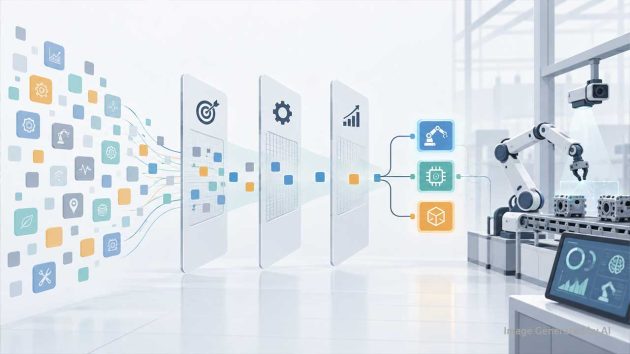
Autonomy runs along a progression from chatbots that take text in and return text, through tool-using agents that act on explicit commands, to multi-step agents orchestrating work across connected systems, and finally agentic fleets that coordinate specialized agents handling defined tasks. Industrial AI autonomy is still narrow compared to coding workflows where AI labs have invested the most optimization effort.
How Does an Agentic Quality Inspection Workflow Operate?
Traditional quality inspection on a manufacturing line depends on a person detecting a defect visually, another person deciding what happened, and a third taking action. Different shifts interpret the same defect differently, and none of it is systematically documented.
An agentic approach to the same process assigns each step to a purpose-built agent. The detection agent, paired with a camera system and machine vision, inspects for defects. It passes findings to an analysis agent that does nothing but evaluate those images. The analysis agent communicates with a compliance agent that is trained specifically on the facility’s SOPs and quality specifications. That agent determines whether the product is in or out of spec, with data to back the determination. Based on the result, an action agent triggers the appropriate response: pushing defective product off the line, stopping the line, or initiating a rework workflow. A supervisory agent orchestrates the entire chain, ensuring each agent completes its task before the next one begins.
This architecture produces more consistent results than generalized large language models because each agent is hyperfocused and trained on a bounded task. The same pattern applies to process optimization, scheduling, and other plant-floor workflows where precision matters more than breadth.
Which Capabilities Should Manufacturers Test Before Deploying AI?
Not every capability is visible during a pilot. Separating what you can evaluate before signing a contract from what only emerges in production prevents costly surprises.
Capabilities visible during a pilot:
- Retrieval grounding: Is the AI reading your actual documents line by line and embedding them for search, or relying on generic metadata from a basic API? The depth of document retrieval determines answer accuracy on domain-specific questions.
- Deterministic checks: A production-ready AI platform still uses classical software engineering alongside models. The vendor should know when a regression model or if-statement is more accurate than an LLM call, and use the right tool for each step.
- Verifier pass: Multiple models read, reread, and cross-check outputs before delivering a result. This is testable in a pilot and indicates the vendor’s quality assurance architecture.
Capabilities visible only in production:
- Domain fine-tuning: During a pilot, your team manually collects and uploads documents. In production, integrations feed data continuously, and the model gets trained on your specific workflows, rubrics, and edge cases at a level a pilot cannot replicate.
- Continuous evaluation: The vendor downloads real production cases on a regular schedule, tests the AI against them, and tracks accuracy over time. This creates an ongoing feedback loop that does not exist in pilot conditions.
Asking a vendor to demonstrate capabilities from the first group during evaluation, while confirming they have the infrastructure for the second group, separates AI systems that produce real results from those that only look good in a demo.
Frequently Asked Questions
1. How should manufacturers interpret AI vendor accuracy claims?
Compare any vendor’s accuracy claim against published benchmarks from major AI labs. OpenAI’s GPT-6 Astra scored 41% on general workplace task automation. If a vendor claims higher accuracy across broad industrial tasks without specifying the exact task, data set, and benchmark methodology, request that evidence before proceeding.
2. What is the difference between abstraction, calibration, and autonomy in industrial AI?
Abstraction measures whether AI learns concepts rather than matching text strings. Calibration measures whether AI flags what it does not know instead of guessing confidently. Autonomy measures whether AI executes multi-step workflows across connected systems. Each improves at a different rate, and each matters differently depending on the use case.
3. What makes agentic AI different from a standard AI model for quality inspection?
Agentic architectures assign each inspection step to a specialized agent: detection, analysis, compliance verification, and corrective action. A supervisory agent coordinates the chain. This produces more consistent results than a single generalized model because each agent is trained on a bounded, specific task.
4. Which AI capabilities are impossible to evaluate during a pilot?
Domain fine-tuning and continuous evaluation require production data volumes, live integrations, and sustained operation over time. A pilot uses manually uploaded documents and operates on a limited scope. Manufacturers should confirm the vendor has infrastructure for both capabilities before committing to a production deployment.
This article is based on a panel discussion with Maddie Zeng of NeoAI, Jonathan Weiss of Cumulocity, Flemming Kongsberg of Siemens, and Benson Chan of Strategy of Things, moderated by Yash Titus of Strategy of Things, recorded at the Industrial AI Summit 2026 hosted by IIoT World. AI tools were used to help summarize and organize the content. Reviewed and edited by the IIoT World editorial team.