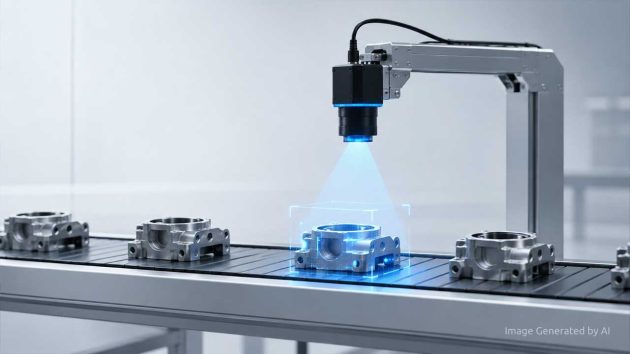
Cognex reported that Schneider Electric doubled its production yield and eliminated most false rejects after deploying the OneVision AI vision platform across its manufacturing lines. At a 1,200-parts-per-day facility, AI-based inspection saves $342,000 per year compared to manual quality checks, with an 8-month payback period and 374% three-year ROI. AI vision systems detect defects at 99.2% accuracy, compared to 87% for trained human inspectors, and do it 15 times faster.
The AI vision inspection market reached $32.66 billion in 2025 and is on track to exceed $40 billion in 2026, growing at a 22.88% CAGR through 2035 (Astute Analytica). Defect detection and quality control account for 41% of all deployments, ahead of assembly verification (26%) and packaging inspection (19%).
The Human Inspection Ceiling
Sandia National Laboratories research shows that human inspectors miss 20-30% of defects under production conditions. At peak concentration, trained inspectors reach approximately 87% detection accuracy. After four hours on a line, fatigue pushes that figure to 70%.
Individual inspector variation reaches 34%, meaning the same part can pass or fail depending on who inspects it and when. The cost of poor quality absorbs an estimated 20% of total manufacturing revenue across the sector.
AI vision systems hold detection accuracy at 99.2% regardless of shift length. Inspector variation drops to zero. Per-part inspection time falls from 38 seconds to 2.4 seconds, a 15x throughput gain.
AI vs. Manual Inspection: Head-to-Head
| Metric | Manual Inspection | AI Vision |
| Detection accuracy | 87% (drops to 70% after 4 hrs) | 99.2% (constant) |
| Speed per part | 38 seconds | 2.4 seconds |
| Throughput multiplier | 1x | 15x |
| Shift-to-shift consistency | 66% stable | 100% stable |
| Inspector variation | 34% between individuals | 0% |
| Annual cost (1,200 parts/day) | $420,000 (12 inspectors) | $78,000 (platform fee) |
| Escaped defect cost | $168,000/year | $24,000/year |
Edge-First Architecture Dominates
Fifty-eight percent of AI vision installations run entirely at the edge, with another 27% using hybrid edge-cloud configurations. Only 15% rely on cloud-based processing, according to Astute Analytica.
Inspection decisions must happen in milliseconds at the production line. Cognex’s OneVision platform follows this model. Training and model updates happen in the cloud; runtime inference stays fully edge-based, inside the camera or an adjacent controller. The In-Sight 3900 runs inspections 4x faster than the previous generation, and OneVision has cut multi-site scaling costs by 50%.
Who Leads: Cognex, Keyence, NVIDIA, LandingAI
Cognex ($994 million revenue in 2025, +9%) added 9,000 new customer accounts in a single year, triple the rate from 2024. Over 100 customers adopted OneVision since its June 2025 beta launch, including Schneider Electric, Essity, and 3M. Essity’s OT Manager Amin Tajeddine noted that “building a viable solution took less than a day.”
Keyence ($7.16 billion revenue, $93.6 billion market cap) holds 28-32% of semiconductor backend inspection in Taiwan and South Korea. Its IV3 AI vision sensors, priced at $1,500-$3,500 per unit, deliver real-time 3D reconstruction at 60 fps with sub-micron accuracy.
NVIDIA Metropolis operates at the platform layer. TSMC uses Metropolis with the TAO Toolkit to detect nanometer-scale defects in semiconductor fabrication. Foxconn Industrial Internet, Pegatron, Quanta, and Wistron have adopted Metropolis for factory-floor vision, with Foxconn automating PCB quality-assurance inspection. TSMC CEO C.C. Wei stated that NVIDIA’s accelerated computing and AI now operate “across fab operations optimization, lithography, process control and inspection.”
LandingAI targets mid-market manufacturers without ML teams. Its LandingLens platform offers a no-code, four-step workflow where domain experts, not data scientists, label defects and train models. A partnership with Snowflake Cortex AI adds automotive-specific visual inspection.
Synthetic Data Solves the Cold-Start Problem
New product lines start with no defect images to train on. Research published in April 2026 (arXiv 2604.22850) demonstrates a few-shot diffusion-based framework that generates photorealistic defect images across varied lighting, orientations, and surface conditions. Detection accuracy improved from 78.8% to 83.3% with synthetic augmentation. In zero-shot domain adaptation, where the model has never seen the target product, accuracy jumped from 65.0% to 85.1%.
Without synthetic data, manufacturers spend months collecting and labeling real defect samples before a model becomes production-ready. Combined with Vision-Language Models like YOLO-World for semantic defect classification, manufacturers can deploy inspection on a new product line without waiting for real defect data.
Deployment Economics: The 8-Month Payback
For a facility processing 1,200 parts per day, manual inspection with 12 human inspectors costs $420,000 annually. An AI vision platform runs at $78,000 per year. Year-one savings reach $342,000 in labor alone, with an additional $144,000 in reduced escaped-defect costs. Against a $240,000 initial deployment investment, the payback period is 8 months. The three-year ROI, factoring in high-speed applications where defect costs drop 80-95%, reaches 374%.
Cognex’s OneVision also cuts scaling time. Multi-site rollouts that once took months now complete in days. 3M Senior Manufacturing Technology Engineer Scott Daniels noted that “engineers can quickly label real production images, build models, and deploy them with far less effort.”
Industry Adoption by Vertical
| Industry | Market Share | Key Driver |
| Electronics & Semiconductor | 27% | Nanometer-scale defect detection (TSMC + NVIDIA) |
| Automotive | 22% | 15x inspection speed, $342K/year savings |
| Food & Beverage | 14% | Packaging and label verification compliance |
| Pharmaceutical & Healthcare | 11% | Fastest-growing segment, regulatory documentation |
| Logistics & Warehousing | 9% | Automated sortation and barcode verification |
Deep learning models account for 34% of the technology mix, followed by machine learning (27%) and edge AI processing (22%). Traditional computer vision retains a 17% share, primarily in high-speed, low-complexity applications like barcode reading and simple dimensional checks.
Frequently Asked Questions
1. What accuracy does AI vision achieve compared to manual inspection?
AI vision systems reach 99.2% detection accuracy and maintain that level continuously. Human inspectors average 87% at peak concentration and decline to approximately 70% after four hours of continuous inspection. Individual inspector variation adds another 34% inconsistency between shifts.
2. What is the ROI timeline for AI vision quality inspection?
At a 1,200-parts-per-day facility, AI vision delivers $342,000 in annual labor savings against a $78,000 platform fee and $240,000 initial investment. Payback occurs within 8 months. Three-year ROI reaches 374%, including defect cost reductions of 80-95% in high-speed applications.
3. Why are most AI vision deployments edge-based?
Fifty-eight percent of deployments run at the edge because inspection decisions must happen in milliseconds at the production line. Hybrid edge-cloud architectures (27% of deployments) use cloud resources for model training while keeping runtime inference local. Cognex’s OneVision follows this pattern, training in the cloud but running all production inspection on edge hardware.
4. How does synthetic data solve the cold-start problem in AI inspection?
New product lines lack defect images for model training. Diffusion-based synthesis frameworks generate photorealistic defect images under varied conditions. Research published in April 2026 showed detection accuracy improving from 78.8% to 83.3% with synthetic augmentation, and zero-shot domain adaptation jumping from 65.0% to 85.1%, allowing manufacturers to deploy AI inspection on new products from day one.
5. Which companies lead the AI vision inspection market in 2026?
Cognex ($994 million revenue, 9,000 new accounts in 2025) leads in general manufacturing with its OneVision platform. Keyence ($7.16 billion revenue) dominates semiconductor backend inspection with 28-32% market share in Taiwan and South Korea. NVIDIA Metropolis provides the platform layer for advanced fabrication, with TSMC as its anchor deployment. LandingAI targets mid-market manufacturers with a no-code visual inspection platform.
AI tools were used to assist with research and data compilation for this article. Edited and verified by the IIoT World editorial team.
Related from IIoT World
- Five Frontier Technologies Reshaping Manufacturing in 2026
- Computer Vision Platforms for Flexible Visual Inspection
- What Edge AI Needs from Industrial Data
- IIoT ROI: Proving Value with Real-Time Data in Manufacturing
Sources
- iFactory / Astute Analytica: AI Vision Inspection Market 2026
- iFactory: AI vs Manual Inspection in Automotive Plants
- Cognex OneVision Adoption Press Release, May 2026
- NVIDIA-TSMC AI Manufacturing Partnership, June 2026
- LandingAI + Snowflake Cortex AI Partnership
- Keyence Machine Vision Patents and Market Position
- arXiv 2604.22850: Synthetic Data for Manufacturing Inspection
- iFactory: AI Vision Camera Use Cases Highest ROI
- OxMaint: Computer Vision vs Manual Inspection
- BuildMVPFast: AI Quality Control 2026