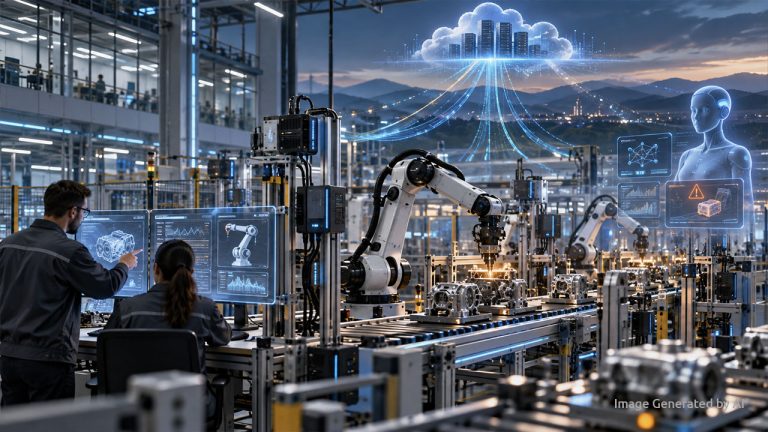
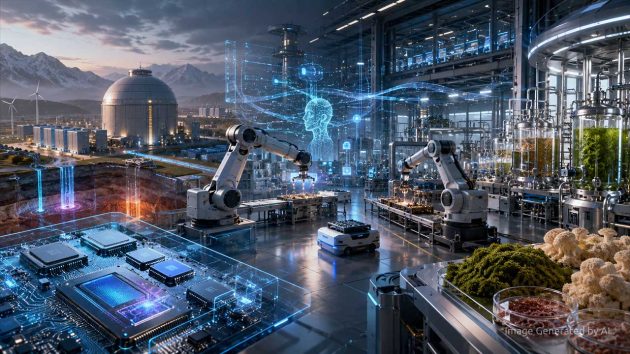
The Stanford Emerging Technology Review (SETR) 2026, published by the Hoover Institution and Stanford School of Engineering, maps ten frontier technologies moving from research into real-world deployment. Five of them are hitting manufacturing operations directly: autonomous AI agents that promise to run multi-step production workflows but keep failing in practice, robotics platforms that still lack the data to work reliably outside structured factory lines, an energy supply crisis driven by industrial reshoring and AI infrastructure buildout, a semiconductor architecture shift that changes how edge hardware gets designed, and distributed biomanufacturing models that could relocate production closer to demand.
Here is where each stands and what manufacturers need to watch.
1. AI Agents in Manufacturing: Promising but Unreliable
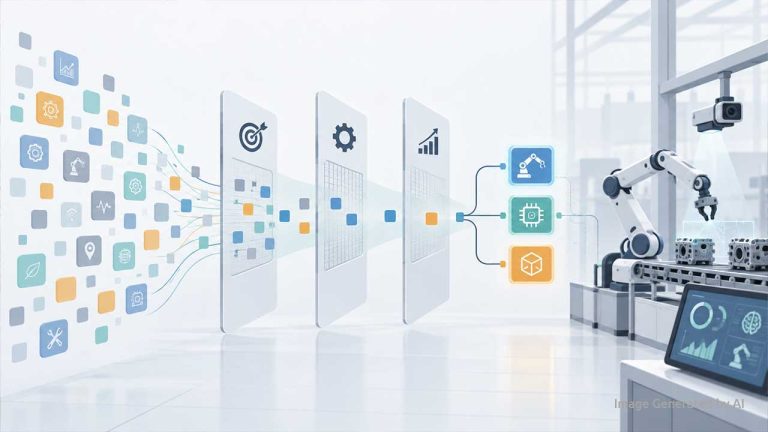
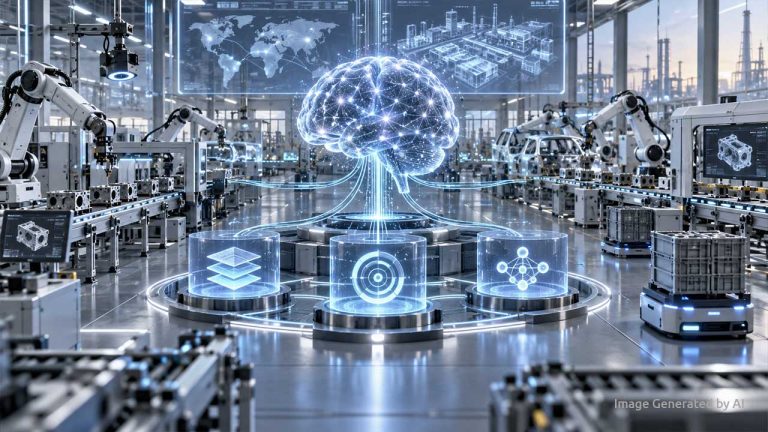
The frontier of artificial intelligence has shifted from large language models toward autonomous AI agents, systems designed to execute complex, multi-step tasks independently. In manufacturing, the applications are immediate: agents that coordinate production scheduling across MES and ERP systems, trigger quality deviations automatically, or manage predictive maintenance workflows without human intervention at every step.
The problem is reliability. Agents frequently suffer from goal drift (losing focus on their original objective), infinite loops, and severe limitations in context length, which restricts their ability to retain details across sessions. These are not edge cases. They are the primary reason most enterprise agent deployments stall before reaching production.
To address this, the industry is adopting the Model Context Protocol (MCP), an open standard introduced by Anthropic and adopted by OpenAI and Google DeepMind. MCP provides a universal interface for agents to securely connect with external tools, read files, and access real-time data beyond their initial training. For manufacturers, this means agents that can pull live data from historians, SCADA systems, and quality databases rather than operating on stale training data. At the same time, smaller, compute-efficient models purpose-built for specific industrial tasks are replacing the assumption that bigger models are always better.
2. Factory Robotics Still Lacks the Data to Scale
Robot density in US manufacturing stood at 285 robots per 10,000 employees in 2022, ranking the country tenth globally behind South Korea, Germany, and China. Humanoid robots are generating attention for logistics, manufacturing, and material handling roles, but high costs, inefficient energy use, and safety concerns limit adoption.
The deeper bottleneck is data. Training AI language models required massive text datasets that were available on the internet. Training robots requires detailed visual and sensor data on touch, motion, and physical interactions, and those datasets are orders of magnitude smaller. Simulations help but lack real-world complexity, requiring costly calibration to close the gap between simulated and actual factory conditions.
The Stanford report notes that success in robotics requires blending advanced AI methods with proven engineering approaches. For manufacturers evaluating humanoid or mobile robot deployments, the implication is clear: the hardware is advancing faster than the software and data infrastructure needed to make it reliable. Companies investing in operational data collection, sensor instrumentation, and simulation environments are building the foundation that will determine how quickly robotics scales on their lines.
3. Energy Supply: The Constraint Behind Industrial Reshoring
The growth of AI infrastructure, data centers, and manufacturing reshoring has created an energy supply problem that existing grids cannot absorb. In the United States, total electricity demand is projected to grow by 15 to 20 percent over the coming decade, with data centers accounting for nearly half of that increase. Factories competing for grid capacity in regions with new data center construction are already facing higher costs and longer interconnection timelines.
To secure reliable, carbon-free baseload power, companies are investing in Small Modular Reactors (SMRs). Kairos Power, which uses a molten fluoride salt coolant (FLiBe), has signed a deal with Google to deploy reactors producing roughly 500 megawatts of carbon-free electricity by the mid-2030s. Oklo, using liquid sodium metal coolant, is pursuing similar agreements. While these deals target data centers first, the technology has direct implications for energy-intensive manufacturing: chemicals, steel, cement, and semiconductor fabrication all need reliable, decarbonized baseload power that wind and solar alone cannot consistently provide.
Geothermal energy is advancing in parallel. Quaise Energy is developing drills that use millimeter-wave beams generated by a gyrotron to vaporize rock at depths conventional drill bits cannot reach. The target: over 12 miles (20 km) below the surface, where temperatures approach 500 degrees Celsius. If the technology scales, it would make dispatchable geothermal heat accessible virtually anywhere, removing the geographic constraints that have historically limited geothermal power to volcanic regions.
4. Chiplets and the New Edge Hardware for Industrial AI
The economic and physical limits of shrinking transistors are forcing a hardware architecture shift. Instead of manufacturing one massive, monolithic chip, the semiconductor industry is moving to 2.5-D integration using chiplets: smaller, highly optimized functional blocks of silicon combined on a single interposer substrate. This approach delivers high bandwidth and power efficiency while bypassing the yield problems that plague monolithic chips at advanced process nodes.
For manufacturers running AI inference at the edge, chiplets matter directly. Custom combinations of processing, memory, and I/O blocks can be assembled for specific industrial workloads, whether that is real-time vision inspection on a production line, vibration analysis on rotating equipment, or running small language models on edge hardware without cloud dependency. The chiplet model also shortens design cycles and reduces the cost of application-specific hardware.
The supply chain behind this shift carries its own risk. Lithium, cobalt, and rare-earth elements remain concentrated in China and the Democratic Republic of the Congo. The Stanford report highlights that strengthening semiconductor supply chains requires diversifying mineral sources, investing in recycling, and building domestic processing capacity, all of which affect lead times and costs for the industrial hardware that factories depend on.
5. Distributed Biomanufacturing: Producing Closer to Demand
Biology is becoming an engineering discipline, and the manufacturing implications are starting to materialize. The Stanford report highlights a shift from centralized, capital-intensive biotech production toward distributed models. Fermentation-based production sites can be established anywhere with access to sugar and electricity, enabling faster response to regional demand and reducing dependence on long supply chains.
The longer-term concept to watch is electrobiosynthesis (eBio). Today, biomanufacturing relies on agricultural feedstocks like sugar or corn for carbon inputs. eBio bypasses agriculture entirely by using electricity to fix carbon dioxide from the air into organic molecules through microbial catalysis. If it scales, eBio could enable production of fuels, materials, and food ingredients in regions with poor soil or severe water scarcity, fundamentally changing where and how certain goods are manufactured.
These are early-stage developments, but for manufacturers tracking supply chain resilience and localization trends, distributed biomanufacturing represents a structural shift in how production footprints are designed.
What Connects These Five Shifts
Each of these technologies addresses a physical constraint that software alone cannot solve: agent reliability, robot training data, energy supply, hardware architecture limits, and geographic dependence on centralized production. The manufacturers positioned to benefit are those already investing in operational data infrastructure, energy resilience, and edge computing, the foundations that determine how quickly any of these technologies can move from pilot to production.
Source: The Stanford Emerging Technology Review 2026, published by the Hoover Institution, Stanford School of Engineering, and Stanford Institute for Human-Centered AI.