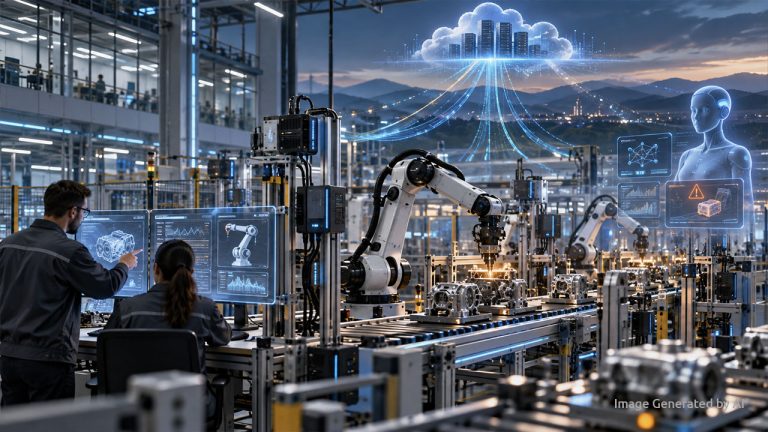
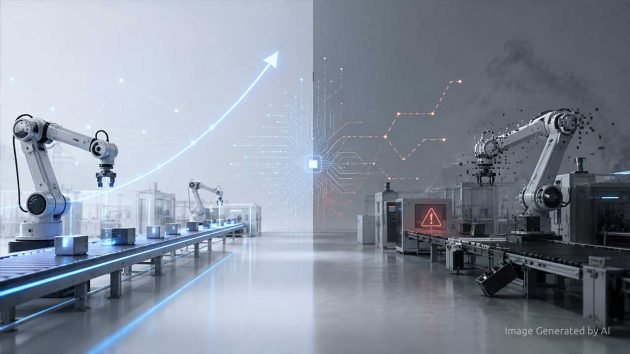
Manufacturers that ship AI agents into production report an average return of 171% on investment and a 34% gain in production efficiency, according to 2025-2026 enterprise deployment data. These results span multiple industrial AI use cases, from predictive maintenance and quality inspection to autonomous order processing and supply chain optimization. At the same time, Gartner predicts that more than 40% of agentic AI projects will be canceled by the end of 2027, and 80% of AI projects across industries fail outright.
What Counts as Agentic AI
Agentic AI refers to software that perceives conditions, makes decisions, and executes multi-step workflows with limited human intervention. In a factory context, an agent might detect a quality anomaly on a vision system, cross-reference it against process parameters, adjust machine settings, and log the corrective action, all without an operator clicking through screens.
Unlike chatbots that answer questions or RPA bots that follow rigid scripts, agentic systems adapt to changing conditions. Gartner flags a pattern it calls “agent washing,” where vendors rebrand existing products as agentic without adding real autonomy. Of thousands of agentic AI vendors on the market, Gartner identifies only about 130 as legitimate. Fifty percent of generative AI projects were abandoned after proof of concept in 2025, exceeding analyst predictions of 30%.
Deployments Delivering Results Right Now
Siemens reports a 20% throughput increase at Erlangen, Honeywell is building what it calls the first AI-driven control room at Borouge, and Rockwell Automation targets 42% of manufacturing processes for AI support through its Plex platform.
Siemens launched its Eigen Engineering Agent at Hannover Messe 2026, marking a shift from conversational copilots to autonomous execution. At its Erlangen Electronics Factory, Siemens reports a 20% increase in throughput, 10-15% reductions in capital expenditure, and nearly 100% design validation on an AI-driven adaptive manufacturing blueprint. The Maintenance Copilot Senseye pilot cut reactive maintenance time by 25%. ThyssenKrupp has deployed the Engineering Copilot globally, reporting improvements in code quality and development speed.
Honeywell integrated AI agents into its Experion Cognition platform for anomaly detection, alarm prediction, and operator workflow guidance. At the Borouge facility in Ruwais, Abu Dhabi, Honeywell and Borouge are building what they describe as the industry’s first AI-driven control room for full-scale, real-time operations, announced in January 2026.
Rockwell Automation embedded AI agents across its Plex platform in August 2026. Plex QMS now integrates with FactoryTalk Analytics VisionAI for AI-driven quality management. The Plex Connected Worker agent converts CAD files into step-by-step work instructions automatically. Rockwell reports that 42% of manufacturing processes are expected to become AI-supported within the next year.
Agentic AI Deployment Results (2025-2026)
| Company | Application | Key Result | Status |
| Siemens (Erlangen) | Adaptive manufacturing | 20% throughput increase, 10-15% capex reduction | Live blueprint, 2026 |
| Siemens (Senseye) | Predictive maintenance copilot | 25% reduction in reactive maintenance time | Pilot |
| Honeywell (Borouge) | AI-driven control room | Full-scale real-time operations | Announced Jan 2026 |
| Rockwell (Plex) | Quality + work instructions | 42% of processes targeted for AI support | Live, Aug 2026 |
| Danfoss | Order processing | 80% automation of transactional decisions | Production |
| Suzano | Materials data queries | 95% reduction in query time | Production |
Why 76% of Manufacturing AI Projects Fail
The failure rate for AI projects in manufacturing sits at 76.4%, according to Folio3 AI, and 84% of those failures trace back to leadership decisions rather than technical limitations, according to Labor411. Those leadership failures cluster around three areas.
- No success metrics defined upfront. Projects with quantified success metrics achieve a 54% success rate. Projects without them: 12%. Yet 73% of companies launching AI initiatives lack clear metrics from the start.
- Integration underestimated. In manufacturing, integration consumes 58% of total project resources. Legacy OT systems, proprietary protocols, and fragmented data architectures turn what looks like a software deployment into a multi-year infrastructure project.
- Underfunding the foundation. Sixty-eight percent of organizations underinvest in data preparation, change management, and workforce training. In 2025, enterprises spent $684 billion on AI globally. Of that, $547 billion produced no measurable results.
Failed AI projects cost between $4.2 million and $8.4 million on average. The median time to positive ROI for projects that do succeed is 4-8 months from production go-live, trending toward 8 months in manufacturing due to longer data preparation cycles.
AI Regulation: EU AI Act, Product Liability, and U.S. State Laws
The EU AI Act’s transparency and general provisions became applicable in August 2026, with high-risk obligations phased in through December 2027 for standalone AI systems and August 2028 for AI embedded in regulated products such as machinery. Manufacturers selling into or operating within Europe face a rolling compliance timeline. The EU Product Liability Directive, effective December 2026, classifies AI as a product under strict liability with extra-territorial reach.
For machinery manufacturers, the EU Machinery Regulation layers AI requirements into existing safety rules rather than applying the AI Act directly. ISO 42001 certification is becoming a procurement requirement for AI vendors across regulated supply chains.
In the United States, there is no unified federal AI law. Instead, 48 states have passed their own legislation, creating a patchwork of obligations. Texas TRAIGA took effect January 1, 2026; California FEHA automated decision rules became active in October 2025.
Manufacturers lead in operational AI controls such as human oversight and real-time monitoring, but remain underprepared for adversarial AI attacks and third-party AI failures, according to Supply Chain Management Review.
Frequently Asked Questions
1. How are manufacturers using AI agents in production today?
Twenty-eight percent of manufacturers shipped AI agents into production as of 2025. Primary use cases include predictive maintenance (Siemens Maintenance Copilot cut reactive maintenance time by 25%), autonomous quality inspection (Rockwell Plex QMS with VisionAI), process optimization (Siemens Erlangen achieved a 20% throughput increase), and order processing automation (Danfoss automated 80% of transactional order decisions).
2. What is agentic AI in manufacturing, and how does it differ from chatbots or RPA?
Agentic AI systems perceive factory conditions, make decisions, and execute multi-step workflows with limited human oversight. Unlike chatbots, which respond to questions, or RPA bots, which follow scripted sequences, agentic systems adapt to changing conditions. Gartner notes that only about 130 of thousands of vendors claiming agentic AI capability are legitimate, a pattern Gartner calls “agent washing.”
3. Why do most manufacturing AI projects fail?
Manufacturing AI projects fail at a rate of 76.4%, with 84% of failures driven by leadership rather than technology. Specifically, 73% of companies lack defined success metrics (projects with metrics succeed 54% of the time versus 12% without), integration consumes 58% of project resources in manufacturing environments, and 68% of organizations underinvest in data foundations and change management.
4. What ROI do industrial AI use cases deliver in manufacturing?
Industrial AI deployments in manufacturing report an average ROI of 171% (192% for U.S. enterprises), with a 34% increase in production and supply chain efficiency. Specific results: Siemens achieved a 20% throughput increase and 10-15% capex reduction at Erlangen, Danfoss automated 80% of transactional order decisions, and Suzano cut materials data query time by 95%. The median time to positive ROI is 4-8 months from production go-live.
5. What AI governance requirements apply to manufacturers in 2026?
The EU AI Act’s transparency and general provisions became applicable in August 2026, with high-risk obligations phased in through December 2027 for standalone systems and August 2028 for AI in regulated products. The EU Product Liability Directive (December 2026) classifies AI as a product under strict liability with extra-territorial reach. ISO 42001 certification is becoming a procurement requirement in regulated supply chains. In the U.S., 48 states have passed AI legislation in the absence of a unified federal law, creating compliance complexity for multi-state operations.
AI tools were used to assist with research and data compilation for this article. Edited and verified by the IIoT World editorial team.
Related from IIoT World
Sources
- Gartner: Over 40% of Agentic AI Projects Will Be Canceled by End of 2027
- Siemens: AI Agents for Industrial Automation
- Honeywell Agentic Workflows for Autonomous Operations (ARC Advisory)
- Rockwell Automation: Plex QMS + FactoryTalk Analytics VisionAI
- AI Project Failure Rate Statistics (Folio3)
- AI Agents in Manufacturing ROI Data (Customertimes)
- EU AI Act Compliance and Enforcement (Foley)
- AI Governance for Manufacturers in 2026 (Entechus)
- Engineering.com: Siemens AI Agents for Industrial Automation
- Smart Industry: Honeywell Agentic Workflows for Autonomous Operations
- HPCwire: Gartner on Agent Washing and Legitimate Vendors
- Syntes AI: AI Project Failure Statistics 2026
- Labor411: 84% of AI Failures Caused by Leadership
- AI Monk: Agentic AI Enterprise ROI Case Studies
- SCMR: Manufacturers AI Adoption Outpacing Cyber Compliance