Factories collect enormous volumes of machine data, yet most of it lacks the structure AI needs. Brian Shepherd, CEO of Velotic, compares the state of industrial data to an old poem: water, water everywhere, and not a drop to drink. In his white paper, The Journey to Value in Industrial AI, Shepherd maps out five foundational conditions that manufacturers must satisfy before scaling AI, introduces the Value Cube, a three-dimensional framework for assessing readiness, and backs the argument with case studies from Church & Dwight and Papa John’s. The reason those conditions look different from any front-office AI checklist comes down to one thing: factories run on physical AI.
What Is Physical AI in Manufacturing?
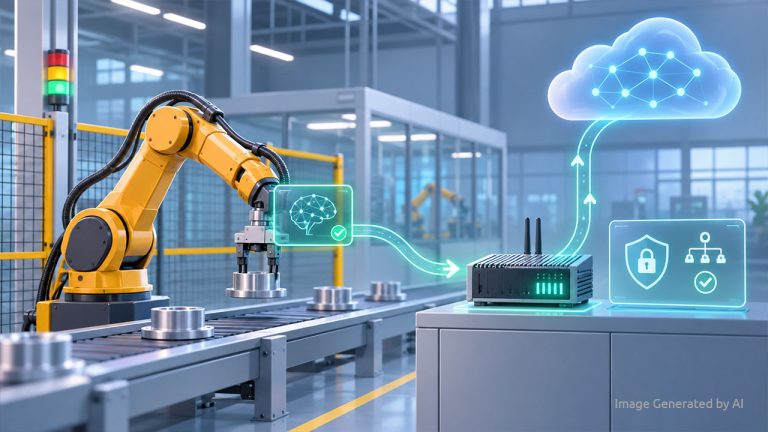
Physical AI is artificial intelligence applied inside production environments where machines, robots, sensors, and human operators interact in a tightly choreographed sequence to build physical products. Applying AI on the plant floor differs fundamentally from deploying it in sales, marketing, or corporate finance because production decisions operate under real-time physical constraints.
The concept divides into three sequential stages:
- Sensing: Gathering raw operational data from sensors, equipment, and control systems across the production line.
- Thinking: Integrating and contextualizing that data into a unified source so AI tools can reason over what is happening.
- Acting: Closing the operational loop by executing precise, deterministic changes that improve the production process.
Because each stage depends on the one before it, a failure anywhere in the sensing-thinking-acting sequence stalls the entire AI deployment. The white paper insists on five specific conditions before manufacturers start.
What Must Be True Before Industrial AI Works?
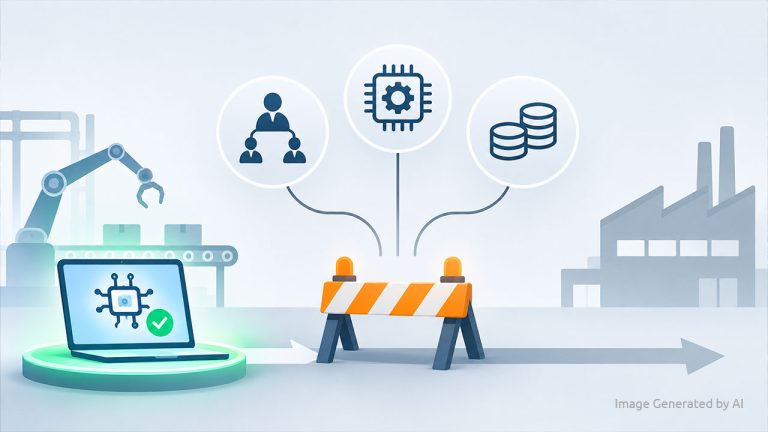
The white paper identifies five foundational conditions that must be in place before manufacturers pursue AI at scale, and the weakest one sets the pace for the entire organization. The Value Cube framework asks plant leaders to self-assess readiness across all five:
- Selecting the right tool for the job: Choosing software built for the specific operational problem.
- Building a solid data foundation: Structuring and contextualizing raw plant data so algorithms can extract insights.
- Deploying AI in the right place at the right cost: Focusing investment on bottlenecks with clear financial returns.
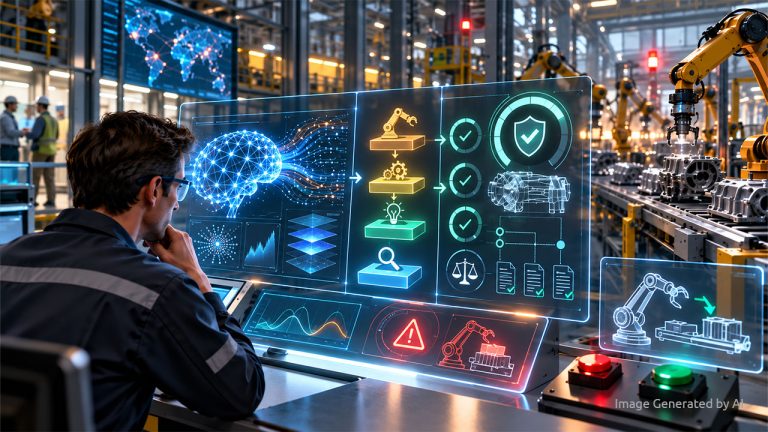
- Embedding trustworthiness from the start: Designing transparent, predictable systems that engineers and operators can verify and rely on.
- Choosing between autonomous and augmented operations: Defining where automation stops and human judgment takes over.
Across customer conversations, building a solid data foundation stands out as the biggest bottleneck. Plants already collect large volumes of machine data, but without proper contextualization, AI tools cannot turn those numbers into useful decisions. Once the data foundation is in place, the most consequential choice left is the fifth condition: how much autonomy to give the AI.
Why Start with Augmented Operations?
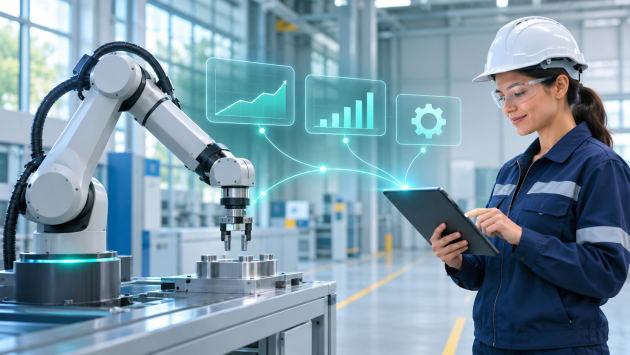
Fully autonomous operations remain a long-term goal for many manufacturers, but augmented operations deliver the fastest value in the short and medium term. Giving frontline workers AI copilots, assistants, and real-time recommendations helps them work faster and manage broader areas of responsibility without removing experienced operators from the loop.
The decision of when an algorithm should adjust a production schedule on its own versus when a human approves the change comes down to balancing cost, benefit, and risk. Over the next few years, most industrial operators will focus on deploying AI tools into the hands of their most trusted frontline workers. Two case studies in the white paper show what that approach produces when the five conditions are met.
How Did Church & Dwight and Papa John’s Prove AI Value?
Consumer goods producer Church & Dwight gained 6% on overall equipment effectiveness (OEE). Papa John’s cut quality audits across 11 centers from a full week down to roughly three clicks. Both deployments succeeded because they combined contextualized machine data with disciplined organizational change management.
Each company connected machines, sensors, and controls in its operating environment and combined that data with input from workers on the floor, creating complete operational context for both asset performance and quality control. “Most of the time, this is not about a technology challenge. The technology is there. It’s about an organizational change management problem,” said Brian Shepherd, CEO of Velotic. Both companies started with a clear vision, launched small, learned fast, and scaled from there. The product stack powering that cycle of sensing, contextualizing, and acting is what Velotic calls the Industrial Intelligence Loop.
What Powers the Industrial Intelligence Loop?
Velotic launched in March 2026 by combining the Proficy business from GE Vernova with the ThingWorx and Kepware businesses from PTC into a single company focused entirely on industrial operations. The Industrial Intelligence Loop, the company’s core strategy, runs on these three product lines: Kepware gathers data from industrial equipment, Proficy provides HMI/SCADA, MES, and data historian capabilities to contextualize and store it, and ThingWorx builds the applications, analytics, and AI-enabled workflows that close the loop.
A recent ThingWorx release brought agentic AI into the platform, with similar AI capabilities coming to Proficy MES and SCADA products later in 2026.
| Condition | Assessment Question |
| Right tool for the job | Is the software built for this specific operational problem? |
| Solid data foundation | Is plant data structured and contextualized for AI consumption? |
| AI in the right place at the right cost | Does the investment target a bottleneck with clear financial return? |
| Trustworthiness from the start | Can engineers trace and verify every AI decision? |
| Autonomous vs. augmented | Is the organization deploying AI as operator assistants or as autonomous agents? |
For the full conversation on the five conditions and the Value Cube framework, watch the CXO Series episode with Brian Shepherd.
Sources
Related from IIoT World
This article is based on a video interview with Brian Shepherd, CEO of Velotic, and Lucian Fogoros of IIoT World. AI tools were used to help summarize and organize the content. Reviewed and edited by the IIoT World editorial team.