Small and medium manufacturers deploy AI at a fraction of the rate of large enterprises, 4% versus 77% according to a 2024 MIT and Microsoft study, yet their data is more usable for AI than data held by $10 billion-plus corporations. During a panel at IIoT World’s Manufacturing & Supply Chain Day 2025, Karthikeyan Natarajan of Infinite Uptime, Jeff Winter, then of Critical Manufacturing (now Vice President of Commercial Strategy at Belden), Carl March of EY, and Michael O’Donnell of Magnet discussed why this inversion exists and what subscription-based, cloud-hosted prescriptive AI models mean for manufacturers without dedicated data science teams.
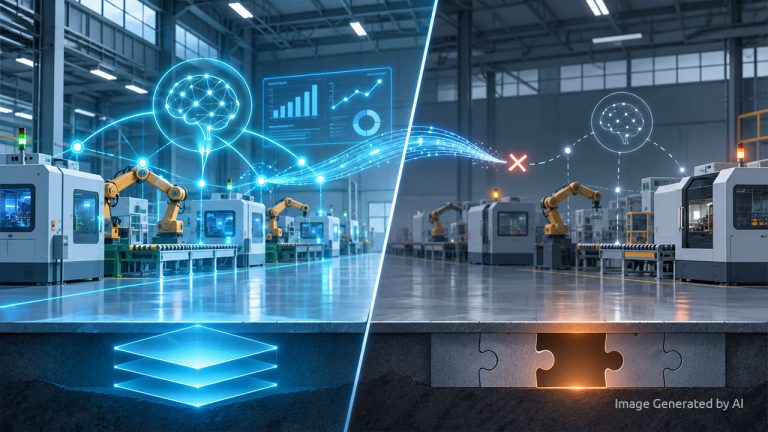
Why Do SMEs Have Better AI Data Readiness?
A 2024 MIT and Microsoft study organized companies into four revenue tiers, from above $10 billion down to $100 million to $499 million. On AI deployment, 77% of the largest companies had begun deploying use cases, compared to only 4% of the smallest group, a 73-point difference.
On data usability for AI, the results inverted: smaller companies reported significantly higher percentages of AI-suitable data, with more than half claiming over 50% of their data was ready.
Larger companies carry more facilities, more software systems, more history, and more complexity. Connecting, normalizing, and contextualizing all of that data creates a bigger problem than many recognize. Smaller manufacturers tend to have fewer systems, less legacy complexity, and data that is simpler to prepare for AI consumption, which positions them to adopt AI faster and more efficiently. The question is what type of AI that data should feed.
How Does Prescriptive AI Go Beyond Predictive Maintenance?
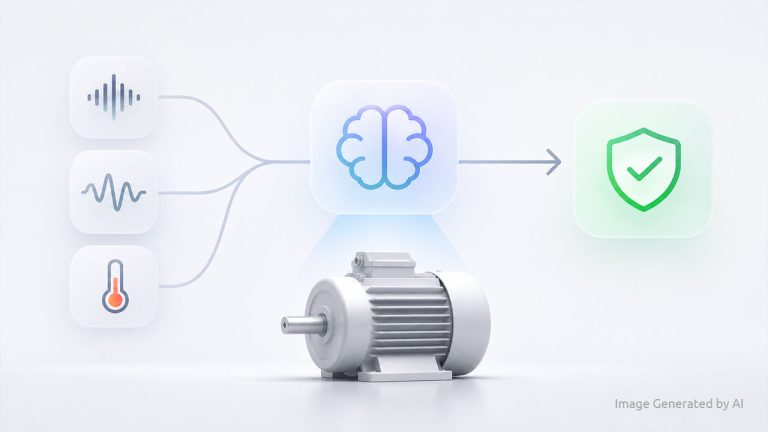
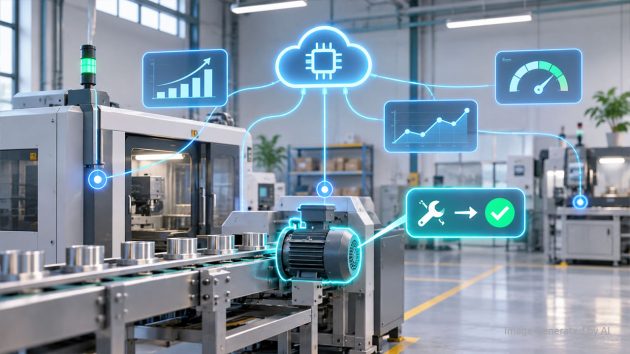
Prescriptive AI sits one level above predictive analytics. Where predictive maintenance flags that a failure may be approaching, prescriptive systems recommend the specific action to take, when to take it, and what outcome to expect. The system predicts, prescribes, and then verifies whether the prescribed action produced the intended result.
Delivering those prescriptions at industrial scale requires more than a standard machine learning model. Industrial AI combines physics-based models with real-time operational data to optimize, predict, and control physical systems across safety, reliability, productivity, quality, and energy. A layered intelligent stack integrates physics-based anomaly detection, predictive and prescriptive analytics, and LLM-powered AI that prioritizes actions through explainable reasoning validated by domain experts in a center of excellence.
In practice, the filtering between raw data and useful action is massive. A prescriptive platform monitoring 25,000 assets generates over 100,000 alerts daily and filters those down to 800 to 1,000 critical points through machine learning. From there, 35 to 40 specific recommendations reach customers each day, and 96% are acknowledged as useful. The system reports 99.9% accuracy with fewer than 5% false positives and fewer than 0.3% false negatives, the level of precision conservative manufacturing process teams require before acting on AI recommendations. Achieving that precision in a factory setting requires a fundamentally different approach than consumer or enterprise AI.
How Does Industrial AI Differ from Consumer AI?
Industrial AI is fundamentally more difficult than consumer AI across four dimensions: environment complexity, accuracy demands, security and privacy stakes, and scalability constraints. These differences explain why off-the-shelf commercial AI tools trained on photos, text, and clicks rarely translate to a shop floor where mistakes mean scrap, downtime, or safety incidents.
| Dimension | Consumer/Commercial AI | Industrial AI |
| Environment | Homogeneous (photos, texts, clicks) | Heterogeneous, constantly changing (temperature, tolerances, machine states vary between shifts and plants) |
| Accuracy threshold | 95-98% acceptable | 99.5%+ (mistakes mean scrap, downtime, safety risks, regulatory issues) |
| Security and privacy | Personal data | Recipes, yields, process data, critical infrastructure under ISO 27001, NIS standards, GDPR |
| Scalability | Instant scaling to millions of users | Asset-specific and plant-specific tuning, smaller failure data sets, on-premise systems with limited interoperability |
A model that works in Plant A often fails in Plant B without major retuning. The environment varies between factories and even between shifts within the same facility. These four differences make industrial AI a completely different discipline, more demanding, less forgiving, and far more context-dependent than the AI most people interact with daily. For SMEs with limited budgets and no AI teams, these technical demands compound the adoption challenge.
What Holds SMEs Back from Adopting Prescriptive AI?
Four barriers slow SME adoption despite their data advantage: data silos across fragmented systems, cultural resistance from operators and managers who fear job displacement and do not trust AI automatically, high upfront costs with unclear ROI timelines, and a lack of in-house data scientists or AI engineers.
Without internal AI expertise, SMEs over-rely on vendors, which increases costs further. Harvard Business Review research found up to 80% failure rates for AI projects. Wharton research found 75% success rates when ROI metrics targeted productivity and throughput gains. Weak ownership, dashboard syndrome where visualizations replace actionable prescriptions, and wrong commercial models add to these barriers. AI implementations that stop at dashboards and fail to deliver closed-loop prescriptions do not generate operator trust or measurable ROI.
How Can SMEs Navigate AI Vendor Selection?
Hundreds of AI solutions crowd the market, and evaluating them consumes more time and budget than a small manufacturer can afford. The panel described four practical steps for SMEs navigating vendor selection while avoiding disconnected solutions that accumulate technical debt over time.
Focus on value first, specifically throughput and productivity gains with proven track records. Evaluate what other manufacturers have already deployed. Assess the current state honestly and build a roadmap covering immediate needs, medium-term goals, and longer-range capability building. Seek outside help from partners with cross-sector experience.
That outside help often comes from peer networks. Manufacturing communities worldwide should share AI experiences openly, because AI adoption is not competitive intelligence. A spaghetti sauce manufacturer and a metal parts shop both benefit from comparing approaches. Regional manufacturing networks and not-for-profit consultancies, such as the one serving 150 small and medium manufacturers annually in Ohio, provide a structured path for that knowledge exchange.
What ROI Can SMEs Expect from Prescriptive AI?
SaaS and OPEX-based prescriptive AI platforms deliver measurable returns within 3 to 6 months across process industries including steel, cement, paper and pulp, mining, and tires. Downtime costs $30,000 to $50,000 on average, and 125,000 hours of avoided downtime translates to $4 to $5 billion in cumulative savings.
Reported results across process industries:
- 2.5% throughput improvement for a 20-million-ton steel manufacturer
- 15% capacity utilization improvement for a large tire manufacturer
- 75% improvement in mean time between failures
- 30% reduction in maintenance cost
These results are consistent with broader industry benchmarks. The World Economic Forum Lighthouse Program, starting with 16 factories in 2018 and now at 201, includes manufacturers of all sizes; one of the original 16 was a small Italian manufacturer with roughly 200 employees. AI now accounts for more than half of all submitted use cases, and the 2025 cohort reported 40% labor productivity improvement and 28% energy consumption reduction. A McKinsey evaluation found manufacturing reported the highest cost reduction and highest revenue increase from AI.
SaaS pricing makes this accessible for SMEs: monthly fees per asset per plant, no large upfront license, cloud-hosted and managed by the provider.
How Will Prescriptive AI Reshape Factory Work?
Roughly 30% of the US manufacturing workforce will retire within the next decade, and many plants already operate with 30% to 40% fewer experienced technicians than they need. Prescriptive AI converts tribal knowledge into algorithms that guide less experienced workers, functioning as a maintenance or process assistant.
Deploying those assistants no longer requires a data science team. Low-code, no-code platforms reduce the dependency on specialized AI talent. As manufacturers upgrade ERP, MES, and IoT platforms, built-in prescriptive AI will ship with those systems, lowering the barrier further.
The scale of the opportunity matches the urgency. Global manufacturing spend runs $16 to $17 trillion annually, with more than a trillion dollars lost to poor quality, equipment unavailability, and supply chain disruptions. Plant-level ownership, closed-loop execution, and OPEX-based models form the conditions for SMEs to act.
This article is based on a panel discussion at IIoT World’s Manufacturing & Supply Chain Day 2025, featuring Karthikeyan Natarajan of Infinite Uptime, Jeff Winter, then of Critical Manufacturing (now at Belden), Carl March of EY, and Michael O’Donnell of Magnet, moderated by Lucian Fogoros of IIoT World. The session was sponsored by Infinite Uptime. AI tools were used to help summarize and organize the content. Reviewed and edited by the IIoT World editorial team.
Additional Sources
- Taking AI to the Next Level in Manufacturing — MIT Technology Review and Microsoft, 2024
- Keep Your AI Projects on Track — Harvard Business Review, November 2023
- Gen AI Fast-Tracks Into the Enterprise: Year Three Full Report — Wharton School, 2025
- Global Lighthouse Network — World Economic Forum
- The State of AI in 2024 — McKinsey & Company
Sponsored by Infinite Uptime