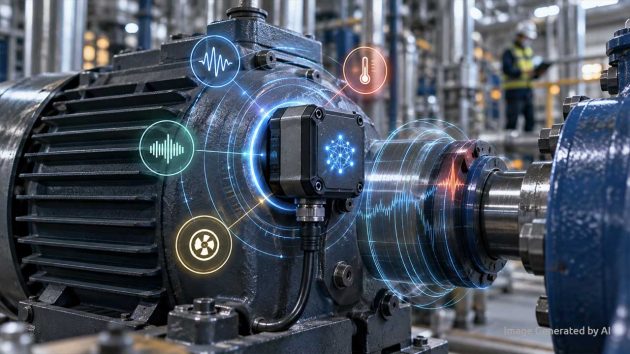

Somewhere right now, a bearing is failing. The vibration pattern shifted twelve days ago, and nobody noticed. By Thursday, that $800 bearing will trigger a shutdown costing $260,000 per hour (Aberdeen Research, cited in MachineMetrics). In 2026, there is no excuse for that.
AI predictive maintenance uses machine learning and sensor data to predict equipment failures 30 to 90 days before they occur, shifting maintenance from scheduled guesswork to data-driven precision. The global predictive maintenance market reached $14.29 billion in 2025 (Grand View Research), growing at a 28.6% CAGR. Yet only 27% of manufacturers actively use it today, down from 30% in 2024 (MaintainX, 2025).
Scheduled Maintenance and the 30-40% Waste Problem
Calendar-based schedules either replace parts too early or too late, after failure has already begun. IBM research estimates 30% of preventive maintenance tasks are unnecessary. AI predictive maintenance changes that.
| Dimension | Reactive | Preventive | Predictive (AI) | Prescriptive |
| Strategy | Fix after failure | Fixed schedule | ML forecasting | AI prescribes + executes |
| Lead Time | Zero | None | 30-90 days | 30-90 days |
| Accuracy | N/A | Low | 80-95% | 80-95% |
| Requirements | Parts stockpile | PM calendar | Sensors + platform | Sensors + agentic AI |
Predictive and prescriptive AI identifies when equipment will fail, why, and what to do. Calendar-based schedules give none of that.
The 2026 Adoption Paradox: 65% Plan It, 32% Do It
Two-thirds of maintenance teams plan to adopt AI by year’s end, but only 32% have partially or fully implemented it, according to the MaintainX 2026 Maintenance Trends Report. While 88% of organizations use AI in at least one business function, only 7% have fully scaled it across the enterprise (McKinsey State of AI, 2025).
Three barriers dominate, according to the OxMaint 2025 Global Industry Report:
- Budget (25% cite as top barrier): unclear ROI justification, especially for mid-size manufacturers
- Skills (24%): 69% of maintenance professionals are over 50, and up to 1.9 million manufacturing jobs are projected to remain unfilled by 2033 (Deloitte / Manufacturing Institute, 2024)
- Cybersecurity (22%): connecting operational technology to IT networks introduces attack surfaces many plants are not prepared to defend
A predictive maintenance system that generates alerts nobody reads is a $200,000 dashboard.
From Proof of Concept to Production: Implementing AI Predictive Maintenance
Implementing AI predictive maintenance does not require replacing legacy equipment or hiring a data science team. But it requires realistic expectations, not a plug-and-play promise.
Step 1: Identify critical assets. Select 5-10 machines with the highest downtime cost. Install vibration, temperature, and pressure sensors ($200-500 per machine). Expect this phase to expose data gaps you did not know existed.
Step 2: Build your data baseline. Integrate sensor feeds with your CMMS or analytics platform. Seventy percent of the real work happens here: cleaning data, mapping outputs to failure modes, filling gaps. Budget 6-12 months of baseline data before predictions become reliable.
Step 3: Deploy and validate. Activate ML models on the selected assets. Validate predictions against known maintenance events. First proof of value matters more than perfection at this stage.
Step 4: Scale with discipline. Expand from initial deployment to full facility over 12-24 months (AlphaBOLD, 2025). Train staff on alert interpretation. 82% of companies have experienced unplanned downtime recently, yet most lack documented response procedures (Maintainly, 2026).
ROI That Speaks for Itself: Real Numbers from the Shop Floor
Facilities fully using AI-driven maintenance report 30-50% reduction in unplanned downtime and 20-40% extension of equipment useful life (McKinsey, 2025). Returns of 300-500% with payback in 6-18 months are documented across multiple deployments (Tech-Stack, 2025).
Unilever (Indaiatuba, Brazil): Deployed AI maintenance across 50,000+ IoT sensors. Result: $2.3 million in annual savings, 45% reduction in maintenance costs, and the $1.2 million investment recovered in under 7 months.
GE Aerospace: Uses AI-driven digital twin technology across its jet engine fleet, achieving 60% earlier lead time on preventive maintenance and cutting false alerts in half over the past decade (Aviation Week).
Automotive stamping plant (200 employees): Invested $145,000 in sensors across 12 hydraulic presses. Within 8 months, the system detected seal degradation on 3 presses before failure, each avoided shutdown saving an estimated $180,000.
“Optimal predictive maintenance not only saves us money, it also means we can deliver the planned quantity of vehicles on time,” said Deniz Ince, Data Scientist at BMW’s Innovation Team (BizTech Magazine, March 2025).
What’s Next: From Predictive to Prescriptive and Beyond
Prescriptive systems go beyond forecasting: instead of telling you a motor will fail in 23 days, they recommend reducing the load by 15% or replacing a specific seal. In 2026, agentic AI systems are beginning to execute these interventions autonomously, scheduling work orders, ordering parts, and adjusting parameters without human initiation.
Digital twins are becoming standard architecture for predictive programs at scale. The generative AI in IoT market reached $2.61 billion in 2026 (GlobeNewsWire), giving teams the ability to query equipment history in natural language.
Gartner projects that over 40% of agentic AI projects could be abandoned by 2027 due to complexity and cost. The winners will build on clean data, trusted models, and skilled teams. Frontier features come second.
AI Predictive Maintenance: Your Questions Answered
What is the difference between predictive and preventive maintenance? Preventive maintenance follows fixed schedules regardless of equipment condition. Predictive maintenance uses AI and sensor data to forecast failures before they happen, intervening only when needed.
How long does it take to implement AI predictive maintenance? Expect 90 days for an initial deployment on 3-5 assets, plus 6-12 months of baseline data collection. Full facility rollout typically takes 12-24 months.
What ROI can I expect from AI predictive maintenance? Returns of 300-500% with payback in 6-18 months are documented across multiple deployments (Tech-Stack, 2025). Unilever recovered its $1.2M investment in under 7 months.
Do I need to replace existing equipment to start? No. Retrofit IoT sensors can be added to legacy machines without replacement. The average age of US industrial equipment is 24 years (Maintainly, 2026).
What data do I need to get started? Start with vibration, temperature, and pressure sensor data from your most critical assets. Historical maintenance logs and failure records accelerate model training significantly.
This article was created with the assistance of AI and reviewed and edited by the IIoT World editorial team to ensure accuracy, clarity, and editorial quality.
Sources
- MachineMetrics / Aberdeen Research
- Grand View Research, 2025
- MaintainX, 2026 Maintenance Trends Report
- McKinsey State of AI, 2025
- OxMaint Global Industry Report, 2025
- Deloitte / Manufacturing Institute, 2024
- Stacker / Maintainly, 2026
- AlphaBOLD, 2025
- Aviation Week — GE Aerospace Digital Twins
- Tech-Stack, 2025
- GlobeNewsWire / ResearchAndMarkets, July 2026
- Gartner, June 2025
- BizTech Magazine, March 2025