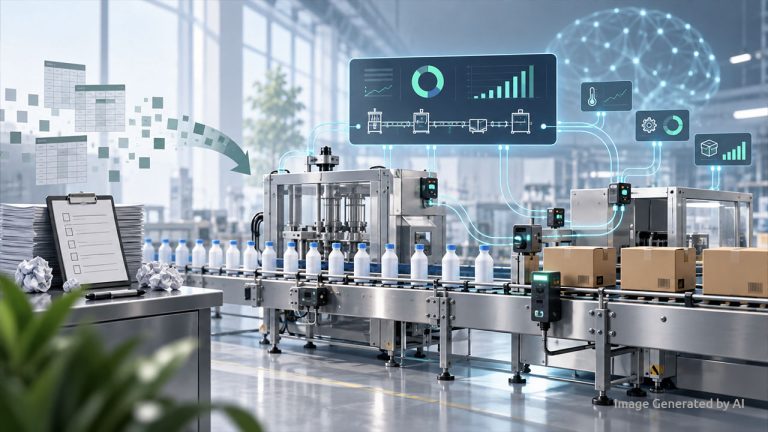
The “Predict, Prevent, Optimize” panel at AI Frontiers 2025 identified the primary barrier to scaling predictive analytics in manufacturing: not machine learning models, but the data pipelines that must move sensor readings quickly, cleanly, and in sync across legacy OT systems, historians, and cloud platforms.
Why Do Out-of-Sync Sensor Readings Break Predictive Models?
Predicting a pump failure requires aligning pressure fluctuations, vibration trends, and lubrication changes down to milliseconds. Delayed or unsynchronized data distorts the analysis and makes predictions meaningless.
This problem is especially acute in manufacturing, where systems span decades of legacy OT, modern IoT devices, cloud platforms, and everything in between. Each layer introduces its own data format, latency, and reliability challenges.
Strategic Perspective: Quantifying the Hidden Cost of Bad Data in Industrial Operations
Why Do Predictive Analytics Pilots Fail at Scale?
A pilot succeeds on a single line, but expanding to multiple assets or plants multiplies complexity. Data must travel from edge devices through historians into cloud platforms while staying synchronized across decades of legacy OT.
At the heart of industrial data plumbing sits the time series database. Purpose-built for timestamped sensor streams, these databases handle write-heavy workloads and preserve the temporal relationships that predictive models require. For manufacturers scaling beyond pilots, choosing the right time series database makes the difference between analytics infrastructure that enables growth or creates bottlenecks.
Technical Deep Dive: The Role of Time-Series Data in Modern Manufacturing Infrastructure
What Do Industrial Data Pipelines Require?
Industrial data pipelines need four capabilities: ingesting millions of sensor readings per second, sub-second timestamp precision, open APIs without vendor lock-in, and resilience against outages or network instability.
How Does Data Infrastructure Create Agility?
Building data pipelines once creates reusable infrastructure for predictive maintenance, quality control, and energy optimization instead of starting from scratch for every analytics initiative.
Why Do Predictive Analytics Stall at Proof of Concept?
Models trained in controlled environments fail when faced with noisy, unsynchronized, or delayed production data. Industrial-strength data pipelines bridge this gap between pilot success and production-grade deployment.
Recommended Roadmap: Intelligent Systems Maturity: Transitioning from Monitoring to Automated Prevention
The takeaway: Predictive analytics isn’t just about clever algorithms. It’s about moving data fast, clean, and at scale. Without the right plumbing, foresight stays stuck in the lab.
Source: Predict, Prevent, Optimize: Real Results from Augmented Industrial Data session at AI Frontiers 2025.
Related Reading
How Do You Standardize a Unified Namespace Without a Universal Standard?