In 2026, the industrial sector has reached a critical turning point where “High Tech” meets “High Touch.” According to the latest member survey from the Association for Advancing Automation (A3), 41% of manufacturers are prioritizing AI Vision systems in their 2026 automation strategies. This makes vision technology the top emerging priority, outpacing both Large Language Models and humanoid robotics in immediate factory-floor adoption.
With economic forecasts predicting a period of “profitless prosperity”, where inflation and rising labor costs squeeze margins despite high demand, machine vision has emerged as the most pragmatic tool for survival.Here are the five primary drivers behind this 2026 trend.
1. The “High Tech, High Touch” Quality Standard
While manufacturers automate to survive, the end goal remains human-centric: satisfying the customer. In a market where products are easily commoditized, Customer Experience (CX) is the ultimate differentiator.
- The Reality: Data shows that 63% of customers will abandon a brand after just one or two bad experiences.
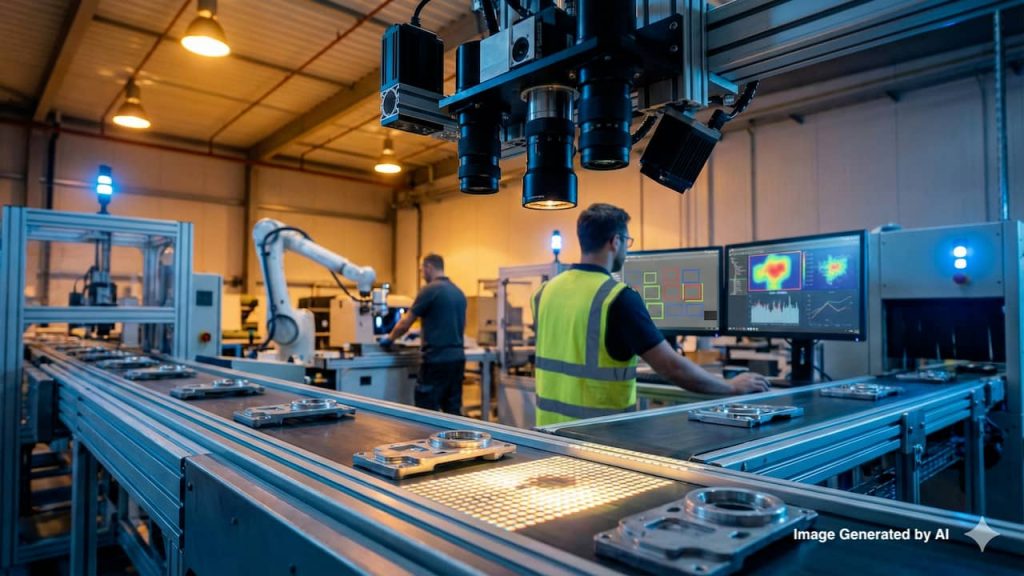
- The AI Solution: AI Vision systems serve as the “eyes” of the smart factory. Unlike traditional rules-based cameras, AI vision can detect subtle, non-linear anomalies, micro-scratches, slight misalignments, or color variations.
This ensures the “High Tech” speed of 2026 automation does not compromise the “High Touch” quality consumers demand, meeting what industry experts call the “SUPER” standard of exceeding expectations.
2. The Midwest and Southwest: New Automation Hubs
The deployment of AI Vision is geographically concentrated in regions modernizing their industrial base to compete with global pressures and nearshoring trends.
The Midwest Powerhouse remains the heart of American manufacturing, aggressively adopting vision systems to update aging infrastructure. Meanwhile, the Southwest Expansion is fueled by the rapid growth of high-tech manufacturing corridors.
| Region | Opportunity Share | Strategic 2026 Focus |
|---|---|---|
| U.S. Midwest | 37.4% | Retrofitting legacy automotive and heavy machinery plants with Physical AI. |
| U.S. Southwest | 18.7% | Growth in semiconductor and electronics manufacturing (TX, AZ, NM). |
3. Combatting the “Labor-Price Cycle”
The 2026 outlook is heavily influenced by a persistent shortage of specialized talent. 19% of manufacturers cite a “Lack of Skilled Workforce” as their single greatest challenge.
Furthermore, inflation driven by the “Labor-Price Cycle” means human labor is becoming more expensive relative to total productivity. AI Vision allows companies to automate complex inspection and sorting tasks that previously required human eyesight and subjective judgment. This transition to Physical AI is essential for maintaining output as the labor pool continues to tighten into the late 2020s.
Why this matters for Industrial Survival:
In an era of “profitless prosperity” where activity is high but margins are squeezed by the labor-price cycle, efficiency is the only shield against inflation. AI Vision breaks this cycle by automating complex visual inspections that previously required expensive, scarce skilled labor.
4. Synergy with Software-Defined Automation
In 2026, AI Vision is rarely a standalone tool. It is part of a “triple threat” of technologies that manufacturers are synchronizing to create software-defined automation:
- AI Vision (41% adoption)
- Large Language Models (35% adoption)
- AI Programming (35% adoption)
These technologies create a feedback loop: AI programming tools help engineers deploy vision systems faster, while LLMs interpret visual data into actionable business insights. This allows factories to rapidly retool their visual inspection criteria as product lines change, maintaining agility in a volatile economy.
5. Managing “Profitless Prosperity” Through Efficiency
ITR Economics defines the current era as one of “profitless prosperity”, a phase where rising industrial activity (currently growing at 1.3%–1.5%) does not translate to rising profits due to cost pressures.
“Efficiency is the only shield against inflation.” — ITR Economic Outlook
With General Factory Automation leading the industry growth charts, AI Vision provides the immediate ROI needed to protect the bottom line. By reducing scrap waste and preventing costly returns, these systems directly attack the cost inputs that threaten profitability.
Sources:
- Alex Shikany’s presentation, January 16, 2026, A3 Member Survey Results (A3 Business Forum).
- Brian Beaulieu: ITR Economics outlook (Inflation analysis, labor-price cycle, and profitless prosperity forecasts). Presentation during the A3 Business Forum
- Brittany-Hodak: Customer experience statistics and the High Tech/High Touch concept. Presentation during the A3 Business Forum
Editorial Note: To provide a concise breakdown of this extensive data, we utilized AI tools to assist in summarizing portions of these survey results. All AI-generated summaries have been reviewed, verified, and contextualized by the IIoT World editorial team.
2026 Smart Factory: AI Vision and Automation FAQ
1. Why is AI Vision prioritized over Humanoid Robots in 2026?
While humanoid robots show promise, AI Vision offers immediate ROI by retrofitting existing production lines. According to A3, 41% of manufacturers prefer Vision because it directly addresses quality control and “profitless prosperity” by reducing waste without requiring a total factory floor redesign.
2. What is “Software-Defined Automation” in the context of Smart Factories?
This refers to the synchronization of AI Vision, LLMs, and AI Programming. Instead of hardware-heavy changes, factories can reconfigure inspection parameters and assembly logic through code, allowing for rapid pivots in production as market demands shift.
3. How does AI Vision solve the “Labor-Price Cycle”?
The Labor-Price Cycle occurs when rising wages drive up product prices, which in turn fuels inflation. AI Vision breaks this cycle by automating “Physical AI” tasks like complex visual inspections and judgment calls, reducing the dependency on an increasingly expensive and scarce skilled labor pool.
4. Which US regions are leading the 2026 automation trend?
The U.S. Midwest leads with a 37.4% opportunity share, focused on automotive retrofitting. The U.S. Southwest follows at 18.7%, driven by the semiconductor boom and nearshoring in states like Texas and Arizona.
5. What is the “SUPER” standard in manufacturing?
The SUPER standard is a quality benchmark where “High Tech” automation is used to ensure “High Touch” customer satisfaction. It focuses on exceeding customer expectations by detecting microscopic defects that traditional rules-based systems miss.
About the author