
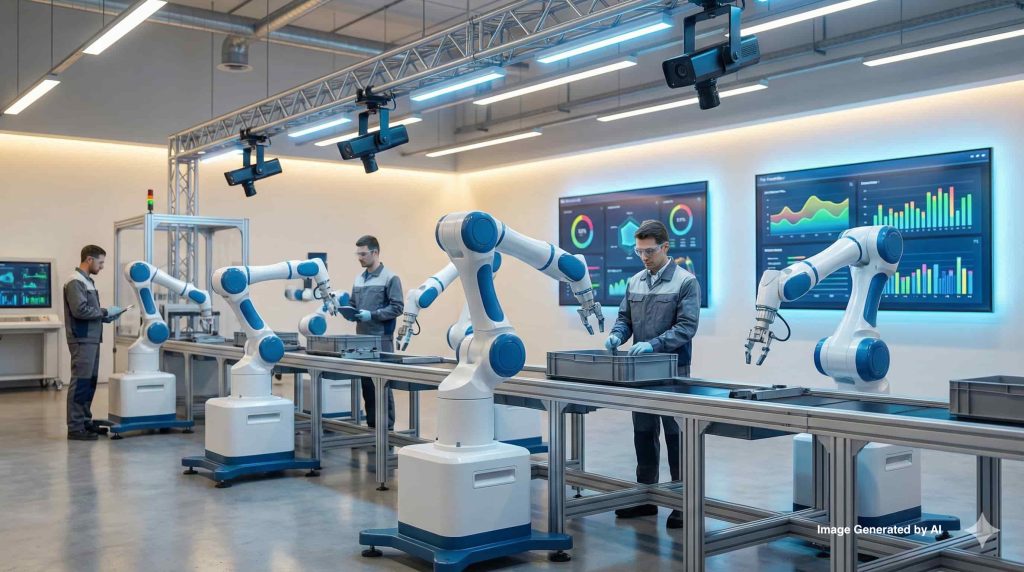
The industrial landscape of 2026 has evolved beyond “growth at all costs” to a focus on technological survival. As we navigate a sluggish business cycle, rising power costs, and a staggering labor gap of 425,000 workers, automation is a macroeconomic necessity. According to the Association for Advancing Automation (A3), 86% of employers now view AI, machine vision, and collaborative robotics as the primary levers for business transformation, shifting the factory floor from manual labor to intelligent orchestration.
-
The Economic Imperative: Automating Through a Sluggish Cycle
According to ITR Economics, 2026 presents a “milder-than-normal” rise in activity. With industrial production lacking robust momentum and electricity costs climbing, the Smart Factory has transitioned from a luxury to a macroeconomic necessity.
- The Labor Gap: The U.S. construction industry requires 425,000 new workers in 2026 alone to balance supply and demand.
- The Solution: Automation stands as the primary hedge against an aging demographic and a shrinking labor pool.
-
AI & Machine Vision: The Intelligence Revolution
AI has graduated from a theoretical concept to a reality on the factory floor. Data from the Association for Advancing Automation (A3) indicates that 86% of employers view AI as the dominant driver of business transformation through 2030.
Key Adoption Rates for 2026
| Emerging Technology | Implementation (%) | Primary 2026 Use Case |
|---|---|---|
| AI – Vision | 41% | Quality Control: Deep learning for high-speed defect detection. |
| AI – LLMs | 35% | Knowledge Management: Conversational AI manuals for technicians. |
| AI – Programming | 35% | Software-Defined Automation: AI-assisted code generation. |
| Additive Manufacturing | 22% | Custom Tooling: In-house 3D printing of jigs and fixtures. |
| Edge Computing | 21% | Real-Time Control: Local data processing to reduce latency. |
| Cloud Computing | 19% | Digital Twins: Scalable infrastructure for global site visibility. |
| AI – LAMs | 15% | Autonomous Workflows: Multi-step task execution. |
| Humanoid Robots | 13% | Flexible Logistics: Handling tasks in human-centric spaces. |
| Augmented Reality | 12% | Guided Assembly: Digital overlays for worker training. |
| AI – World Models | 7% | Scenario Modeling: Predictive simulations for supply chains. |
-
The Velocity of Change: 2025 vs. 2026 Adoption Trends
The shift toward a technology-first model is accelerating as industrial leaders move from “testing” to “scaling”. Recent year-over-year (YoY) data reveal manufacturers are doubling down on intelligence-based solutions.
Generative AI: The Explosive Growth Sector
While AI-Vision remains the top priority at 41%, its growth has stabilized from its 42% peak in 2025. The most significant momentum is found in Large Language Models (LLMs), which saw a massive jump from 16% interest in 2025 to 35% in 2026. This 19-point surge suggests manufacturers are rapidly moving toward complex, language-based diagnostic and training tools.
Key Tech Momentum Shifts
- Confidence in Innovation: Manufacturers “not planning” to implement emerging tech dropped from 21% to 17% YoY, indicating that staying stationary is no longer a viable strategy.
- The Rise of Physical AI: Interest in Humanoid Robots grew from 8% to 13% YoY.
- Software-Defined Operations: Interest in AI-Programming rose from 31% to 35%, reflecting a push to remove IT/OT silos.
To see exactly how this 19-point surge in LLM interest translates to the factory floor, explore these 15 real-world AI in manufacturing use cases, which detail the shift from predictive models to language-based worker copilots.
-
The Robotics Shift: General Industry Takes the Lead
The “Big Three” automotive dominance has shifted. In a historic change, general industry now acts as the primary driver of robotics growth.
- Food & Consumer Goods: Witnessed a 51% year-over-year surge in robotics orders.
- The Rise of Cobots: In 2025/2026, 70% of collaborative robot orders came from non-automotive sectors.
While automotive remains the largest market for machine vision, Logistics is the sector to watch, with a projected 14.2% CAGR through 2029.
FAQ: The Future of Smart Manufacturing in 2026
1. What is the fastest-growing technology in smart factories for 2026?
Large Language Models (LLMs) are the fastest-growing segment, with interest nearly doubling from 16% to 35% in one year. They are primarily used for knowledge management and creating worker “copilots”.
2. Are humanoid robots being considered for factories?
Yes. Interest in humanoid robots climbed to 13% for 2026. These are viewed as solutions for complex assembly and logistics in environments originally built for humans.
3. Why is the “skepticism gap” closing in manufacturing?
The percentage of companies with no plans to adopt emerging tech fell from 21% to 17% YoY. Manufacturers recognize these technologies are essential for resilience against rising operational risks and inflation.
4. What is the biggest challenge for smart factories in 2026?
The primary challenge is economic resilience. High electricity costs and a sluggish cycle mean manufacturers must use AI and robotics to lower operational expenditures (OPEX) rather than just increasing output.
5, Which industries are adopting robotics the fastest?
While automotive is rebounding, the Food & Consumer Goods and Logistics sectors are seeing the fastest growth rates.
6. Why is there a surge in collaborative robots (cobots)?
Cobots offer more flexibility and are easier to program than traditional robots. They are now widely used in general industries like packaging to fill critical labor gaps.
Source: January 16, 2026, A3 Member Survey Results (A3 Business Forum).
Editorial Note: To provide a concise breakdown of this extensive data, we utilized AI tools to assist in summarizing portions of these survey results. To ensure the highest level of technical accuracy, all AI-generated summaries have been reviewed, verified, and contextualized by the IIoT World editorial team.