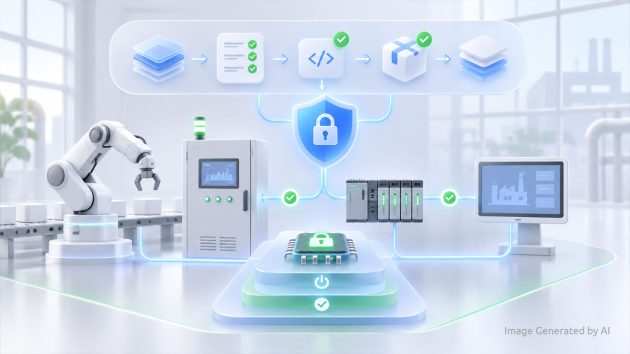
Upwards of 70% of observable attacks on OT environments involve no active vulnerability exploitation at all, according to Megan Samford, then VP and Chief Product Security Officer for Energy Management at Schneider Electric (now Chief Security Officer). Products inadvertently connected to the internet provide the entry point. During a panel at IIoT World’s Manufacturing Days 2024, cybersecurity leaders from Schneider Electric, Keyfactor, and aDolus Technology explained why ICS security for manufacturers now centers on software supply chain verification, product certification under IEC 62443, and regulatory pressure from the EU Cyber Resilience Act.
Why Are Supply Chain Attacks the Top OT Threat?
Supply chain attacks give adversaries return on investment that perimeter defenses cannot counter, because the malware arrives through a trusted vendor channel. The 2014 Dragonfly attacks followed this pattern: attackers replaced legitimate vendor software with trojanized versions, and users downloaded it voluntarily. Within a week or two, the attackers had penetration into 300 to 400 OT systems.
Subsequent attacks followed the same playbook. The XZ library attack, described during the panel as “very, very sophisticated,” targeted a key open-source repository used in SSH, the secure shell protocol widely used in industrial devices. SolarWinds followed identical logic: compromise the software supply chain, and every customer who updates becomes a victim.
Nation-state actors and criminal ransomware groups both invest in supply chain tactics. State actors pursue geopolitical and military objectives through embedded vulnerabilities. Criminal groups use supply chain compromise as a mass distribution channel for ransomware. Any large enterprise that is a good target for ransomware is equally a good target for a supply chain attack, an efficient method for mass-distributing malware across hundreds of victims at once. Detecting these attacks requires visibility into the software components vendors deliver, and that visibility starts with a software bill of materials.
What Do SBOMs Reveal About Industrial Controllers?
An SBOM is an ingredients list for software. The analogy used during the panel: buy a can of tomato soup and you can read what is inside on the label. A software bill of materials provides the same transparency for the code running on PLCs, HMIs, RTUs, and other industrial devices.
Regulations from the EU Cyber Resilience Act to NIS2 now require software producers to supply SBOMs. NERC CIP 13 already mandates supply chain transparency for power companies. Singapore, Japan, and multiple US agencies are moving in the same direction. The regulatory picture is fragmented by region and vertical, but the trajectory is consistent: manufacturers must know what software they are buying and what risks it carries.
What SBOMs reveal once generated exposes deeper problems. One analysis uncovered 17 different copies of OpenSSL inside a single software package, evidence of no dependency management. Another case found a Linux kernel version 2.26 with an extensive vulnerability list inside a major supplier’s product. A third discovered Huawei cellular firmware inside RTUs deployed on Midwestern pipelines, a finding with immediate geopolitical implications.
| ICS Security Layer | What It Covers | Key Standard / Regulation | Who Is Responsible |
| Software supply chain | Code provenance, third-party components, SBOM generation | EU CRA, NIS2, NERC CIP 13 | Product manufacturers |
| Secure development lifecycle | Code review, static analysis, vulnerability testing | IEC 62443 4-1 (maturity levels 1-4) | Product manufacturers |
| Product security features | Signed firmware, secure boot, event logging, encryption | IEC 62443 4-2 | Product manufacturers |
| System-level security | Multi-vendor environments, secure deployment, network architecture | IEC 62443 3-3 | System integrators, asset owners |
| Asset inventory and exposure | Devices on the network, internet-facing assets, firmware versions | Operational best practice | Asset owners |
| Build environment security | Source code repositories, factory floor compilation, anti-counterfeit shipping | Manufacturer internal controls | Product manufacturers |
How Does IEC 62443 Certification Protect Asset Owners?
IEC 62443 provides a framework that covers products, systems, and organizations across their entire lifecycle. All major industrial automation vendors, referred to during the panel as the “Seven Sisters” (Schneider Electric, Rockwell Automation, Siemens, GE, Emerson, Johnson Controls, and Honeywell), follow IEC 62443 as their foundational product security standard.
Asset owners evaluating products should look for two certifications. IEC 62443 4-1 certifies the vendor’s secure development lifecycle, with maturity levels from one to four. IEC 62443 4-2 certifies the product itself, covering security features (signed firmware, secure boot, event logging) and processes including SBOM generation, vulnerability testing, and secure code practices. IEC 62443 3-3 addresses system-level security for mixed-vendor environments. Schneider, Siemens, GE, and Rockwell products coexist in the same facility, and 3-3 prescribes how they should be connected, deployed, and operated securely through to disposal.
The panel drew a distinction between vendors who claim compliance and those who submit to independent third-party audits. Self-attestation provides a baseline. Third-party certification from organizations such as ISASecure provides verified assurance that the vendor’s claims hold up under external scrutiny.
Why Does the EU Cyber Resilience Act Matter Globally?
The EU Cyber Resilience Act requires any manufacturer selling connected products in Europe to meet security requirements by January 2027. The regulation covers both security features (event logging, signed firmware, secure boot) and ongoing lifecycle management (vulnerability disclosure, end-of-life policies, patch management, customer notification).
A multinational manufacturer producing a product for France or Sweden ships the same product to the United States. Meeting CRA requirements for Europe raises the security baseline for every market, and US critical infrastructure owners benefit from the security investments European regulation forced.
The panelists treated CRA as a turning point for product security. One panelist described hearing two IoT manufacturers at a recent event say they were not worried about CRA or NIS2, and characterized the response: “You are a dinosaur. You will not be on the floor in the next couple of years.” Competitors who comply will meet procurement requirements that non-compliant vendors cannot, creating a competitive disadvantage even for manufacturers that sell exclusively in North America. The Department of Energy’s Cyber-Informed Engineering initiative addresses similar principles in the US. Regulations address what vendors must build into products, but they cannot fix what asset owners have already deployed and inadvertently left exposed.
What Is the Most Overlooked OT Vulnerability?
Devices connected to the internet without the asset owner’s knowledge remain the single largest source of OT compromise. The panel was unequivocal: the majority of attacks enter through products inadvertently exposed to the internet, including HMIs, engineering workstations, and any product capable of routing to the public internet.
The attackers exploiting these exposures are often unsophisticated. Script kiddies and ransomware operators scan for internet-facing industrial devices and find them. Advanced persistent threats deserve attention, but a dedicated APT targeting a specific facility is extremely difficult for any asset owner to withstand. The accessible defense is eliminating the internet-exposed attack surface that allows less sophisticated attackers to walk in.
Asset owners should maintain an asset inventory (knowing it will never be 100% accurate, but striving for it), ensure proper network segmentation, and confirm that no devices have direct internet exposure. One panelist proposed a national-scale “100-day push” to find and disconnect all industrial devices with direct internet connections across US critical infrastructure, arguing this single action would reduce a measurable amount of attack surface across all sectors. Removing internet exposure stops the simplest attacks, but the software already running on those devices carries its own risks.
How Should Manufacturers Verify Software Before Install?
Code signing attaches a cryptographic signature to software, confirming the author’s identity and proving the code has not been modified since signing. Verification at boot time or during over-the-air updates confirms only authenticated code runs on the device.
Many existing ICS devices, particularly older controllers, lack code signing. Out-of-band verification fills the gap: before loading firmware onto a controller, asset owners can analyze the software to confirm provenance and flag known vulnerabilities. “Harvest now, decrypt later” attacks add urgency, as adversaries collecting encrypted data today anticipate post-quantum computing will break current encryption.
The SolarWinds breach exposed build environment risk: attackers compromised the compilation pipeline rather than the source code itself. The panel’s recommended defense is manual code reviews where no single developer can commit to a main branch without a trusted reviewer, combined with verified factory-floor compilation that confirms the shipped code matches what was reviewed.
This article is based on a panel discussion at IIoT World’s Manufacturing Days 2024, featuring Megan Samford of Schneider Electric, Ellen Boehm of Keyfactor, Eric Byres of aDolus Technology, moderated by Patrick C Miller. The session was sponsored by Schneider Electric, Keyfactor, and aDolus Technology. AI tools were used to help summarize and organize the content. Reviewed and edited by the IIoT World editorial team.
Related from IIoT World
- How Procurement Budgets Fix OT Supply Chain Security
- OT Cybersecurity for Manufacturing 2026
- Industrial Cybersecurity Threats 2026
- Vendor Laptops and USB Drives: Plant Floor Security
- AI Ransomware: Manufacturing Data as a Target
Additional Sources
- IEC 62443 Series — ISA/IEC, industrial automation and control system cybersecurity standard
- EU Cyber Resilience Act — European Commission, 2024
- NERC CIP Standards — NERC, critical infrastructure protection for power systems
About the author