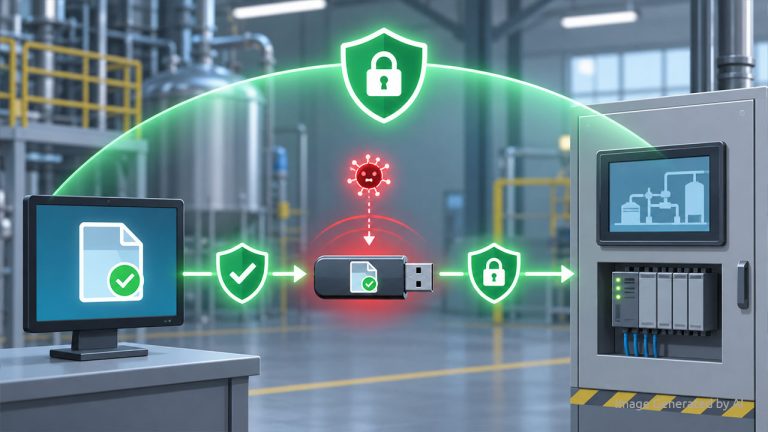
Traditional VPN connections into operational technology networks stay open long after the maintenance session ends, creating persistent backdoors that security teams rarely audit and seldom close. During a session at IIoT World’s ICS Cybersecurity Day, Ruben Lobo, who leads product management for industrial switching and cybersecurity at Cisco, joined Pete Kavanagh of Cisco, Tim Householder of Worldwide Technology, and moderator Kevin Wood of Cisco to explain how zero trust network access (ZTNA) eliminates these risks when the gateway runs on the industrial network switch itself, closer to the OT assets instead of centralized in the DMZ.
Why Do VPN Connections Stay Open in OT Environments?
Every OT remote access session starts with a legitimate purpose: a vendor updates firmware, a remote engineer troubleshoots a drive fault, a system integrator validates a configuration. The VPN tunnel opens, the work gets done, and the tunnel stays open. Firewall rules accumulate. Nobody deletes them because nobody remembers what they were for.
The session described this as the “infinite firewall rule” problem. Once VPN connections and firewall rules are created, they persist indefinitely because removing a rule that might still serve a purpose feels riskier than leaving it in place. Over time, the number of open connections into the control network grows, and auditing those connections takes weeks or months across multiple sites where each facility handles remote access differently.
Security exposure is only part of the cost. Engineers at manufacturing plants sit next to contractors’ laptops for the entire duration of a remote access session, watching the screen to make sure nothing unauthorized happens. That engineer’s time has a measurable cost, and every hour spent monitoring a laptop is an hour taken from maintaining production equipment.
What Risks Does Port Forwarding Create in OT?
In transportation and critical infrastructure, the problem extends beyond VPN. Service providers install generic cellular modems with public IP addresses and configure port forwarding from the open internet through to the industrial asset. Anyone with the IP address and credentials can connect, and the organization has no control over what machine or network the third party is connecting from.
The assets behind these connections were never designed to be internet-facing. They often expose standard HTTP admin interfaces without firewall capabilities. Once a user connects to a single device through port forwarding, lateral movement across the network becomes possible. The remote session was opened for one specific asset, but the user can reach other devices on the same segment without visibility into that movement.
| Risk Factor | Traditional VPN / Port Forward | ZTNA with Embedded Gateway |
| Connection duration | Always-on, rarely decommissioned | Time-bound, session-based |
| Access scope | Full network segment once connected | Specific assets only (resource-based isolation) |
| User verification | Credentials at connection time | Multi-factor authentication, posture check, IDP integration |
| Lateral movement | Possible across entire segment | Blocked by zero trust segmentation on the switch |
| Firewall complexity | Rules accumulate indefinitely | Single outbound rule on port 443 |
| Gateway hardware | Dedicated appliance, separate supply chain | Embedded in existing industrial switch or router |
| Audit capability | Manual, facility-by-facility | Centralized session recording and scheduling |
| Third-party device trust | Uncontrolled (contractor’s own laptop) | Host posture check enforced before access |
How Does Shadow IT Enter OT Networks?
Machine builders and system integrators install cellular gateways inside the equipment they sell. These gateways provide value-added services like predictive maintenance data collection. They also act as remote access backdoors that the asset owner never authorized and often does not know about.
The session described a case where a client discovered during a data acquisition walk-through that a machine builder had established a cloud-based historian connection without disclosure. Data was leaving the facility over a connection the plant team did not know existed. Discovery typically happens by accident, either during a modernization project or when a new visibility tool identifies unknown devices communicating on the network.
Software bills of materials (SBOMs) help for newly purchased equipment, but they do not retroactively solve the installed base. Plants that deploy deep packet inspection tools routinely find cellular gateways, unauthorized cloud connections, and other communications that were embedded by equipment suppliers.
Where Should the ZTNA Gateway Sit in Relation to OT Assets?
ZTNA shifts the access control model from a perimeter VPN to a cloud-based or on-premises trust broker that verifies identity, device posture, and authorization before granting access to specific resources. The trust broker works, but the placement of the gateway component that connects it to OT assets determines whether the deployment improves or undermines network segmentation.
Most deployments place the ZTNA gateway in a centralized location, typically in the DMZ or at a higher level of the Purdue model. Centralization avoids the cost of distributing gateways to every cell, cabinet, or remote site. It also creates a burden: the end customer must expose OT asset IP addresses upward through NAT boundaries and zone-based firewalls to reach the centralized gateway.
In manufacturing environments, PLCs and HMIs might be NATed to higher network layers, but drives, I/O modules, sensors, and field devices typically are not. Exposing those IP addresses to reach a centralized gateway flattens the network segmentation that the organization spent years building. The access method designed to improve security ends up weakening the zone isolation it was meant to protect.
What Changes When the Gateway Runs on the Industrial Switch?
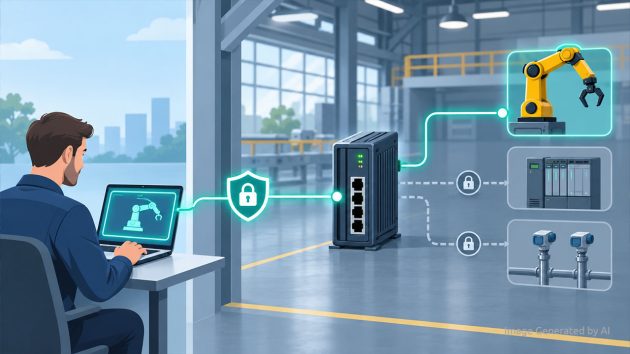
Cisco embeds the ZTNA gateway as a software feature on its industrial switches and routers rather than deploying it as a separate appliance. The trust broker remains in the cloud (part of Cisco’s IoT Operations Dashboard), and centralized policy stays intact. The gateway component sits at the same network layer as the OT assets.
Because the gateway runs on the switch that connects the assets, it sits below the NAT boundary and below any zone-based firewalls, providing 100% reachability to any asset using private IP addresses without exposing those addresses to higher network layers. The firewall configuration simplifies to a single outbound rule on port 443 from the switch to the cloud trust broker.
The same networking device that provides connectivity also enforces zero trust segmentation. By integrating with network access control (NAC) systems, the switch can prevent lateral movement between assets on the same segment. A remote user authenticated for one specific drive cannot reach other devices on the same switch, and a session established for firmware maintenance cannot be used for data extraction from a neighboring PLC.
How Does ZTNA Reduce Remote Access Costs in OT?
The cost of traditional remote access extends beyond the VPN license. Dedicated gateway hardware must be purchased, installed, managed, patched, and secured across every site. Some organizations issue corporate-managed laptops to contractors, adding lease costs, licensing, and support overhead for every third-party relationship.
Expanding VDI environments into OT creates its own cost. Virtual desktop infrastructure requires additional compute, virtualization licenses, and application licensing. Extending VDI into control network zones often requires bypassing security boundaries that align with the Purdue model or IEC 62443 conduit structures, undoing years of segmentation work.
Embedding the ZTNA gateway on existing network switches eliminates the dedicated hardware cost entirely. The supply chain integrity concern disappears because the gateway is a software feature on a network device that the organization already vets and manages. The centralized trust broker reduces administrative overhead by providing a single location for policy, audit, and compliance reporting instead of site-by-site firewall rule management.
How Should Organizations Start Zero Trust in OT?
Zero trust in industrial environments is a strategy, not a single product purchase. Organizations should identify where the greatest value and risk concentration lie, then apply zero trust principles to that specific area first rather than attempting a complete transformation at once.
Secure remote access is one execution point within that broader framework. The platforms used for ZTNA (identity providers, trust brokers, posture assessment tools) can be reused for other zero trust initiatives: network segmentation, asset visibility, compliance monitoring. Proving value to the business through one initiative creates justification for expanding into additional areas.
Visibility remains the prerequisite. Without knowing what assets exist on the network, zero trust policies cannot be written or enforced. Active discovery and deep packet inspection (Cisco Cyber Vision was cited as one example) provide the asset inventory and traffic context needed to define access policies. Embedding those capabilities into network infrastructure reduces hardware sprawl and eliminates the cost of spanning traffic to centralized sensors.
This article is based on a session with Ruben Lobo (then Product Management Lead, now Director of Product Management for Industrial Switching and Security), Pete Kavanagh (then Internal Solution Architect, now Principal IoT Solutions Architect), and Kevin Wood (then Chief IoT Architect, now Principal Solutions Engineer) of Cisco, and Tim Householder, Sr. Industry Advisor for Manufacturing and Distribution at Worldwide Technology, recorded during IIoT World’s ICS Cybersecurity Day. The session was sponsored by Cisco. AI tools were used to help summarize and organize the content. Reviewed and edited by the IIoT World editorial team.