
Ransomware attacks targeting operational technology environments have increased by approximately 70% year over year for the past four consecutive years, and more than half of attacks that reach OT originate from the IT network. At IIoT World’s Manufacturing & Supply Chain Day 2025, cybersecurity leaders from Schneider Electric, ABB, Keyfactor, TÜV, and the Manufacturing ISAC discussed what makes securing IT/OT convergence different from enterprise security, where third-party vendors create the largest exposure, and how compliance frameworks like IEC 62443 and the EU Cyber Resilience Act are changing procurement decisions.
Why Do IT and OT Operate on Different Security Clocks?
IT and OT environments run on fundamentally different timelines, priorities, and risk tolerances. IT prioritizes speed and agility. OT prioritizes uptime and safety with equipment life cycles of 10 to 15 years or longer. Security controls designed for one environment do not translate to the other.
Identity and access management, network segmentation, and patch management all require OT-specific approaches. Manufacturing environments rarely run a single vendor’s platform. A typical site operates separate systems for emergency shutdown, distributed control, PLCs, and vibration monitoring, often from multiple vendors. Many of these systems carry completely unmanaged credentials and run legacy operating systems that cannot accept modern security patches.
Equipment life cycles make the problem worse. IT has much shorter refresh cycles, while OT control systems may run seven to eight years before an upgrade, and the underlying plant infrastructure can operate for 20 to 30 years. Replacing technology that still functions is a difficult argument to make at the board level, even when the security risk is obvious.
Where Do Most OT Security Breaches Actually Originate?
More than half of attacks that reach OT environments enter through the IT network. The IT/OT boundary itself is where the majority of exposure concentrates. Dependent IT systems like ERP, historians, and CRM tools that pull data from OT environments create pathways that attackers exploit.
Third-party vendors represent a separate risk. In the Canadian mining sector, 76% of disclosed breaches were related to third-party vendor access. Credentials get shared, sessions go unmonitored, and the attack surface expands with every vendor that touches the OT network.
The Colonial Pipeline and Jaguar Land Rover incidents showed how unclear IT/OT boundaries can cause major operational disruptions even when the OT network itself is not breached. The Manufacturing ISAC, in partnership with Accenture, produced a white paper on futureproofing security for manufacturing environments.
Nation-state actors have added urgency. Targeted attacks against critical infrastructure during the Russia-Ukraine conflict showed that industrial automation systems and power facilities are viable military targets, expanding attacker motivation from financial gain to geopolitical disruption.
What Security Framework Works for OT Environments?
OT security frameworks must account for process safety, operational context, and regulatory alignment before reaching technical controls. Starting with technology alone, without understanding the consequences of a security event on physical processes, leads to controls that either over-restrict operations or miss the highest-consequence exposures.
Schneider Electric uses what it calls an OT-first four-pillar security framework:
- Embedding security into product development through secure development life cycles and vulnerability analysis
- Prioritizing controls at each site based on operational consequence
- Testing those controls across Schneider’s own 180-plus digital factories with continuous monitoring
- Delivering managed security services with threat-informed monitoring tied to operational impact
ABB follows a parallel approach through what it calls a secure reference architecture, incorporating regulatory mandates specific to each region and focusing on availability, safety, and resilience. ABB manages cybersecurity across approximately 400 manufacturing and product development facilities.
Both companies emphasize that network segmentation is the typical starting point. Segmentation must be vendor-specific, process-specific, and in some cases geographically specific. Protection controls and recovery strategies follow, tailored for OT maintenance constraints.
How Does PKI Establish Trust in Connected Factories?
Public key infrastructure provides the foundation for digital trust in connected manufacturing environments. PKI assigns a unique digital identity to each device, from control systems and smart meters to HMIs and networking equipment, allowing the device to authenticate itself to other systems and establish encrypted communication channels through TLS connections.
Enterprise IT has used PKI for decades to issue digital certificates for laptops, firewalls, and user devices. The same technology now extends into OT environments, where connected products need a unique birth identity that travels with them through their operational life. OEMs building connected vehicles, smart meters, and smart home devices embed these identities during manufacturing so that each device can authenticate, communicate securely, and have its access revoked when decommissioned or transferred.
PKI serves as the enforcement mechanism for access control across heterogeneous factory networks. When a device presents a valid certificate, it can access the systems it needs. When a certificate expires or is revoked, access stops, providing traceability for every connection without requiring manual credential management across hundreds or thousands of devices.
How Should Manufacturers Manage Third-Party OT Access?
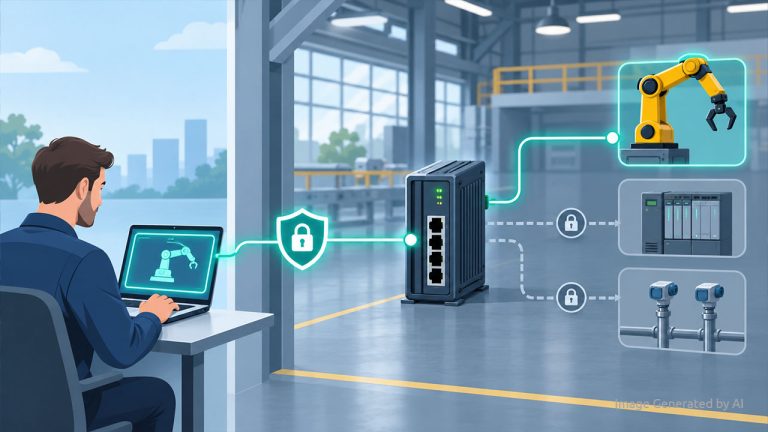
Third-party remote access requires OT-specific session controls that go beyond standard IT remote access tools. The infrastructure must control session duration, record every action taken during the session, and monitor activity in real time. Scheduling sessions for specific individuals at specific times with specific scope reduces the attack surface that open-ended access creates.
Schneider Electric’s approach illustrates the model: remote sessions are centrally managed, session-monitored, and controlled through an OT-specific solution. ABB aligns with the same principles, emphasizing granular control over what happens during each remote session, traceability, and auditability.
The COVID-19 pandemic accelerated adoption of remote connectivity in OT environments. What had been resisted for years became an operational necessity when physical access to plants was restricted. Remote access proved achievable and valuable, but only when the infrastructure is designed for OT constraints from the start.
How Are Compliance Frameworks Changing OT Procurement?
IEC 62443, the EU Cyber Resilience Act, NIS2, CMMC, and NIST 800-53 are shaping how manufacturers procure, deploy, and maintain industrial equipment. Some manufacturers already use these frameworks as competitive differentiators, certifying their products against IEC 62443 requirements and marketing that compliance to customers who demand security assurance.
The Cyber Resilience Act requires device manufacturers selling into Europe to embed security from the design phase, including strong identity verification, encrypted channels, secure firmware signing, and over-the-air update verification. IEC 62443 defines security levels for industrial devices and systems, providing a benchmark for procurement RFQ processes.
Operators should make security a condition of doing business with vendors. Demand full visibility into software bills of materials and understand each vendor’s vulnerability disclosure policy. If an HMI ships with Windows, clarify who is responsible for patching that operating system.
Compliance frameworks are converging across regions. The United States has NERC CIP for power and CMMC for defense. The European Union has NIS2 and the Cyber Resilience Act. South Asian regions are incorporating certified device requirements into critical infrastructure procurement.
| Security Domain | IT Approach | OT-Specific Approach | Why It Differs |
| Upgrade cycle | Shorter hardware refresh cycles | 7-8 year control system, 20-30 year plant infrastructure | Equipment runs decades; replacement requires production downtime |
| Network segmentation | Flat or zone-based | Vendor-specific, process-specific, geography-specific | Each plant has unique architecture with multi-vendor systems |
| Remote access | Standard VPN or identity provider | Session-monitored, time-limited, OT-specific tools | 76% of mining breaches related to third-party vendor access |
| Identity management | Active Directory, SSO | PKI with device birth certificates, per-device digital identity | Legacy devices have unmanaged credentials; cannot run modern IAM |
| Patch management | Monthly patch cycles | Coordinated with maintenance windows; some systems unpatchable | Production uptime takes priority; patches require validation |
| Compliance | SOC 2, ISO 27001 | IEC 62443, Cyber Resilience Act, NIS2 | OT frameworks require process safety context beyond data protection |
This article is based on a panel discussion at IIoT World’s Manufacturing & Supply Chain Day 2025, featuring Ellen Boehm of Keyfactor, Jay Abdallah of Schneider Electric, Rob Putman of ABB, and Vaibhav Sharma of TÜV, moderated by Tim Chase of Manufacturing ISAC. The session was sponsored by Keyfactor. AI tools were used to help summarize and organize the content. Reviewed and edited by the IIoT World editorial team.
Sponsored by Keyfactor