
OT cybersecurity threats in 2026 are crossing boundaries that previous threat models did not account for. At S4x26, presentations from Secvulre, Accenture, Copia Automation, ABS, and Emerson identified four threats reshaping how asset owners assess risk: the weaponization of distributed energy resources through harmonic swarm attacks, hardware trojans designed for physical destruction, Industrial Control Lifecycle Management (ICLM) as a replacement for IT-derived DevOps in OT, and compliance penalties that now exceed the estimated cost of many cyber incidents.
Weaponized Distributed Energy Resources
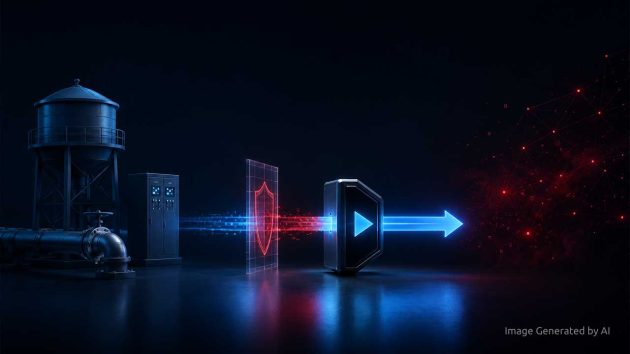
The shift from mechanical generators to software-controlled inverters has made the power grid programmable. An adversary with centralized control over smart inverters does not need to damage a device physically. By retuning control parameters, attackers can initiate harmonic swarm attacks: coordinated grid-wide oscillations that inject high-frequency signals at 20 kHz and above.
Standard protection relays typically monitor frequencies up to approximately 3 kHz. Signals above that threshold pass through undetected. The resulting electrical stress causes rapid dielectric puncture in substation transformers before traditional safety mechanisms activate. The attack exploits the gap between what inverters can produce and what protection relays can see.
Hardware Trojans Cross the Digital-Physical Line
The September 2024 pager and radio explosions across Lebanon and Syria demonstrated that a supply chain compromise can produce physical casualties. Raphael Arakelian of Accenture presented this incident at S4x26 as “Operation Grim Beeper,” classifying it as a hardware trojan with malicious firmware co-development.
The attack used embedded firmware to trigger a concealed detonator via a heating circuit, regardless of user interaction. For OT security, this exposes a gap in current threat models. Frameworks like MITRE EMB3D account for data interception and untrusted firmware but do not model embedded cyber-kinetic payloads designed for physical destruction.
Industrial Control Lifecycle Management Replaces OT DevOps
IT DevOps prioritizes speed and continuous deployment. In OT environments, 10% of personnel write code while 90% sustain it, according to Adam Gluck of Copia Automation at S4x26. Applying IT DevOps practices to industrial control systems creates misaligned priorities.
Industrial Control Lifecycle Management (ICLM) redesigns the DevOps value stream for OT by prioritizing resilience and governance over speed. The focus shifts to automated backups for critical devices, firmware image capture, and code drift monitoring. These practices lower Mean Time to Recovery (MTTR) when IT/OT convergence incidents occur, because the organization can restore a known-good state rather than rebuilding from documentation.
Compliance Risk Overrides Probabilistic Cyber Risk
In multiple critical infrastructure sectors, the financial consequence of a compliance failure now exceeds the estimated cost of a probable cyber incident. Security spending is following the regulatory pressure.
In maritime operations, IACS UR E26 and E27 standards require vessels to demonstrate cyber resilience. Michael DeVolld of ABS Cyber Center of Excellence described the enforcement mechanism at S4x26: a failure to comply results in loss of class certificates and vessel detention at port, costing operators upward of $100,000 per day in lost revenue.
The EU Cyber Resilience Act (CRA) applies similar pressure to manufacturers of products with digital elements. Ben Morgan of Emerson presented the penalty structure at S4x26: non-compliance carries fines of up to 15,000,000 euros or 2.5% of global annual turnover. Because compliance failures produce immediate, certain financial consequences while cyber incidents remain probabilistic, organizations are treating regulatory risk as the primary driver for OT security investment.
FAQ
1. What is a harmonic swarm attack on the power grid?
A harmonic swarm attack exploits software-controlled smart inverters in distributed energy resources (DERs). Attackers with centralized control over these inverters retune their parameters to inject high-frequency signals at 20 kHz and above, creating coordinated grid-wide oscillations. Standard protection relays monitor only up to approximately 3 kHz, so the attack passes through undetected. The resulting electrical stress causes dielectric puncture in substation transformers before safety mechanisms can respond.
2. What is Industrial Control Lifecycle Management (ICLM)?
ICLM is a framework for managing industrial control systems that replaces IT-derived DevOps practices with OT-specific priorities. While IT DevOps emphasizes speed and continuous deployment, ICLM prioritizes resilience and governance. Key practices include automated backups for critical devices, firmware image capture, and code drift monitoring. Adam Gluck of Copia Automation presented ICLM at S4x26, noting that 10% of OT personnel write code while 90% sustain it, making speed-focused IT practices a poor fit.
3. How does the EU Cyber Resilience Act affect OT manufacturers?
The EU Cyber Resilience Act (CRA) applies to manufacturers of “products with digital elements,” which includes many OT devices and systems. Non-compliance penalties reach up to 15,000,000 euros or 2.5% of global annual turnover. Ben Morgan of Emerson presented the implications at S4x26. Because compliance failures produce immediate and certain financial consequences while cyber incidents remain probabilistic, many OT organizations now treat regulatory compliance as a higher priority than traditional risk-based cybersecurity spending.
Related from IIoT World
- Top 7 ICS/OT Cybersecurity Trends and Frameworks for 2026
- How Do You Secure OT When AI Writes the Malware?
- Securing Automation: Why the Specification Stage Is the Right Time to Embed OT Cybersecurity
This article is based on presentations at S4x26 in Miami, attended by Lucian Fogoros of IIoT World. Sources: Presentations by Secvulre, Raphael Arakelian of Accenture, Adam Gluck of Copia Automation, Michael DeVolld of ABS Cyber Center of Excellence, and Ben Morgan of Emerson.
AI tools were used to help summarize and organize the content. Reviewed and edited by the IIoT World editorial team.