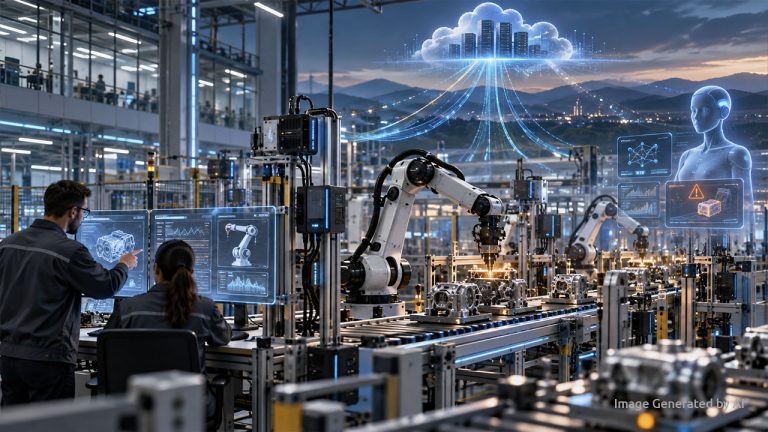
Manufacturing faces a widening AI readiness gap: AI capability is doubling every 3.5 months, a 100x improvement in a single year, according to data cited during an IIoT World panel session. Yet industrial adoption remains slow and fragmented. Legacy systems, fragmented data, and a shortage of data-literate leaders keep most manufacturers from scaling AI beyond isolated pilots.
Why Is Manufacturing Struggling to Adopt AI?
Manufacturing is aware of AI’s potential but lacks the operational foundation to act on it. Legacy systems, fragmented data pipelines, under-resourced teams, and a shortage of data-literate leaders create an “AI readiness gap” that prevents most industrial organizations from moving past early pilots.
Why Does AI Adoption Stay Linear in Industry?
Industrial AI adoption is slow and fragmented even as AI capabilities grow exponentially. Companies experiment in isolated pockets: optimizing equipment downtime, forecasting energy demand, automating quality inspections. These efforts rarely connect or scale. Organizations that do not start building AI foundations now will not be positioned to benefit when AI reaches full potential in three to five years.
What Are the Business Risks of the AI Gap?
The AI readiness gap carries direct business risk for manufacturers. Companies face mounting pressure to reduce emissions, meet ESG targets, and stay cost-efficient. According to data cited in the IIoT World session, 78% of companies have set emissions reduction targets, yet nearly half are behind schedule. AI can help close that gap, but only if organizations act quickly.
How Do Manufacturers Close the AI Readiness Gap?
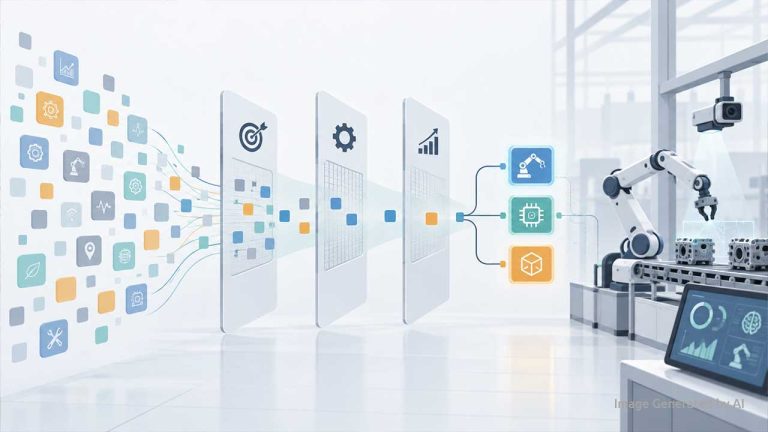
Closing the AI readiness gap requires action across four areas. Industrial enterprises must treat AI adoption as a structured operational priority, not an optional experiment. The steps below, drawn from IIoT World panel insights, address executive commitment, data infrastructure, workforce capability, and use-case selection in sequence.
What Is the Future of AI in Manufacturing?
AI is evolving from a productivity tool into a core operating system for manufacturing and energy companies. Organizations that close the readiness gap now will set the competitive baseline others must match. Those that wait risk missing a window where advantage is measured in months.
This article was written based on the insights shared during a live IIoT World panel discussion on AI, industrial transformation, and sustainability.
Related articles:
- Why Historians Cannot Feed Physical AI
- How PPG Built MES Blueprints for 140 Plants
- How Do You Standardize a Unified Namespace Without a Universal Standard?