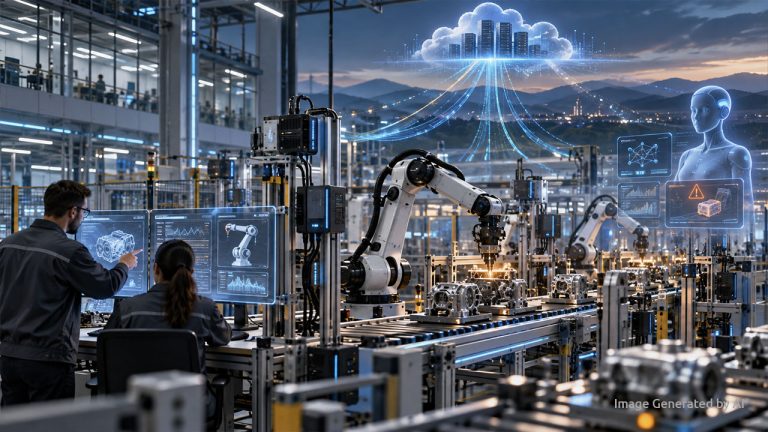

AI agents embedded directly inside industrial data pipelines, rather than layered on top as analytics, are now operationally viable for manufacturers. At Cognite’s 2025 event, SVP Laxmi Akkaraju outlined how this approach delivers autonomous root cause analysis, transparent reasoning, and drift-aware model governance across OT and IT systems.
Here are the key takeaways and what they imply for manufacturing leaders.
- What Is an “Agent-Inside” Industrial AI Workflow?
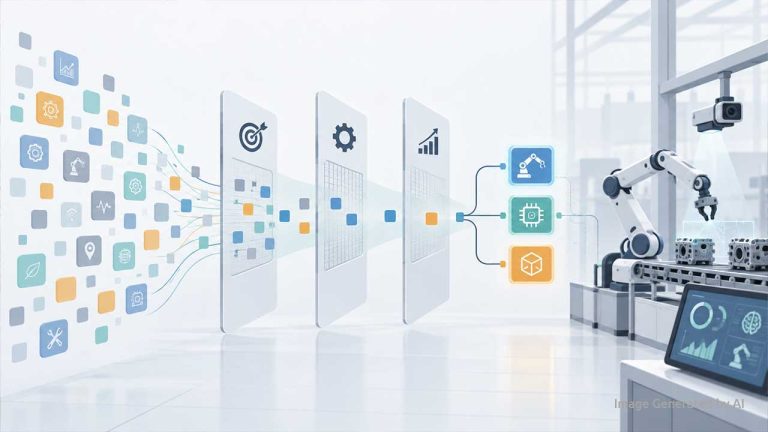
An “agent-inside” workflow places AI agents directly inside the data pipeline, where they query contextualized, validated, governed data, rather than sitting outside operations as a separate analytics layer. According to Cognite’s Laxmi Akkaraju, this architectural shift is what makes use cases like autonomous root cause analysis and cross-silo data discovery operationally reliable at scale.
In practice, this enables:
- Autonomous root cause analysis (RCA): When a machine fails, the embedded agent can traverse the industrial knowledge graph, generate a cost/impact diagram, and surface the most probable causal factors.
- Unstructured document mining: Agents can comb through files, logs, manuals, and reports in bulk to retrieve supporting evidence or insights.
- Data discovery and exploration: Without knowing where your needed sensor or operational data lives, you can ask the agent to find it across silos and integrate it into a “cloud native fusion” layer.
These use cases have existed conceptually, but embedding the agent into the pipeline — with full context, lineage, and determinism — is what makes them operationally reliable at scale.
- How Do Industrial AI Agents Build Operator Trust?
Industrial AI agents build operator trust by revealing their reasoning path: which data sources were referenced, how conclusions were reached, and what assumptions underlie each output. Cognite’s agents query only internal contextualized data, not the open web, which removes the risk of hallucinations and gives engineering, maintenance, and operations teams an auditable basis for every recommendation.
For manufacturers, that means:
- Operators can see why a recommendation is made, not just what.
- You can audit and validate the agent’s logic against domain knowledge and empirical records.
- You reduce the “black box” fear and foster acceptance across engineering, maintenance, and operations teams.
- How Is Model Drift Managed in Industrial AI?
Model drift in industrial AI occurs when sensor recalibration, equipment changes, or process shifts alter the data patterns a model was trained on. Cognite addresses this by benchmarking all models within its platform ecosystem to detect divergence over time, flagging drift proactively, and adjusting configuration automatically, with autonomous remediation planned for future releases.
- Benchmarking all models/ML services within their platform ecosystem to detect divergence over time
- Flagging drift proactively, so the model currency is monitored
- Adjusting code/config automatically, as needed, to realign behavior
- Planning an “auto alarm/autonomous remediation” feature in future releases
For manufacturers, this means the AI agents evolve — but under guardrails. Drift won’t silently degrade your insights; it will be surfaced.
- Who Controls Data Governance in Industrial AI Platforms?
Data governance ownership is a critical design question in multi-platform industrial AI architectures. In Cognite’s approach, the agent platform retains ownership over data governance, quality, and validation regardless of whether the deployment is cloud-agnostic or hybrid, giving manufacturers a unified governance backbone across OT, IT, and external systems.
Implications:
- You get a unified governance backbone across OT, IT, and external systems
- You avoid fragmentation or conflicting versions of truth
- You reduce integration risk and finger-pointing between AI tool vendors or cloud providers
- What Is a Fleet of Industrial AI Agents?
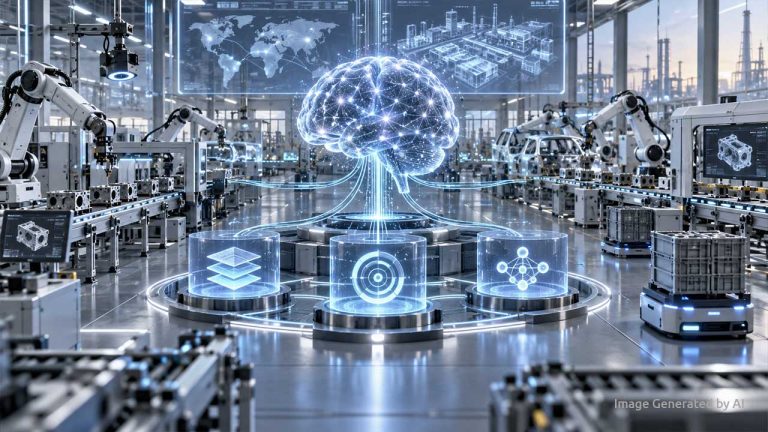
A fleet of industrial AI agents is an ecosystem of coordinated agents, including those from the platform vendor, the manufacturer’s own models, and third-party tools, that interoperate and complement each other. Cognite’s Laxmi Akkaraju describes the medium-term direction as agents that learn from each human interaction and improve over time, within a human-plus-AI hybrid operating model.
- Agents that learn from each human interaction, improving over time
- Fleets of agents (Cognite’s, clients’, third-party) that interoperate and complement each other
- An ecosystem where your own models or analytic stacks plug into the agent fabric, not replace it
In manufacturing, this hints at a future where agent orchestration becomes akin to managing a digital workforce: allocating specialized agents, monitoring their performance, and coordinating their cooperation.
- Why Does Industrial AI Interoperability Matter?
Industrial AI interoperability matters because vendor lock-in limits architecture flexibility and future investment options. Cognite’s platform is cloud-agnostic, supports major cloud providers, and is open to client and third-party agents. Cognite is already applying standards including MCP and emerging agent interoperability protocols internally to support this cross-vendor ecosystem.
For manufacturers, that means:
- You can bring your existing AI/analytics stack into the loop
- You can adopt best-of-breed agents from vendors or internal R&D
- You protect your architecture flexibility and future margins
What Should Manufacturers Do About Industrial AI Now?
Manufacturers moving toward embedded AI agents should act on six concrete priorities: piloting agent workflows in domains where data lineage is manageable, building a governed industrial knowledge graph, defining transparency and trust requirements, monitoring for model drift in live deployments, planning for multi-agent orchestration, and enforcing platform openness to protect future architecture options.
Why this matters
Embedded AI agents in data pipelines represent a significant architectural leap for industrial AI. For manufacturers, that means no more AI bolted on as an afterthought — but intelligent workflows that evolve, reason, and learn in context. The difference: faster insights, stronger trust, and scalable deployment.
Sponsored by Cognite
Related articles:
FAQ
1. What is the difference between embedded AI agents and traditional industrial analytics?
Traditional industrial analytics layers models on top of operations as separate dashboards or reporting tools, often disconnected from live workflows. Embedded AI agents, as described by Cognite’s Laxmi Akkaraju, are placed directly inside the data pipeline, where they query contextualized and validated data with full lineage and determinism. This architectural difference is what makes autonomous root cause analysis and cross-silo data discovery operationally reliable at scale.
2. How does an industrial AI agent perform root cause analysis?
When a machine failure occurs, an industrial AI agent embedded in the data pipeline can traverse the industrial knowledge graph, generate a cost and impact diagram, and surface the most probable causal factors. Cognite’s approach ensures the agent queries only internal, contextualized data rather than the open web, which eliminates hallucinations and gives operators an auditable reasoning path showing which sources were referenced and how conclusions were reached.
3. Embedded AI agents vs. standalone AI models: which is better for manufacturing?
Standalone AI models in manufacturing often suffer from brittleness: they are built in silos, rely on manual data wrangling, and are disconnected from actual operations. Embedded AI agents, by contrast, operate within a governed data pipeline with full context and lineage. Cognite’s platform adds model drift detection, automatic configuration adjustment, and transparent reasoning, making embedded agents more operationally reliable for continuous manufacturing environments.
4. Why is model drift detection important for industrial AI deployments?
Industrial environments change constantly: sensor recalibration, new equipment, process shifts, and maintenance strategy changes all alter data patterns over time. Without drift detection, AI models silently degrade and produce unreliable outputs. Cognite benchmarks all models within its platform ecosystem to detect divergence, flags drift proactively, and adjusts configuration automatically, with autonomous remediation planned in future releases to keep models aligned with current operational reality.
Related Reading
2026 Smart Manufacturing Ecosystem: 27 Platforms for Industrial AI
What to watch in 2026: From generic AI tools to industrially trained intelligence
Agentic AI Isn’t a Product , It’s an Integrated Business Strategy