Tesla’s Optimus program holds an estimated 1,000 to 1,200 humanoid robot units deployed across Fremont and Giga Texas as of mid-2026, yet the company reports zero external sales, publishes no uptime figures, and Musk himself described those units on the Q4 2025 earnings call as “primarily for learning and data collection rather than performing productive tasks.”
Where Does Tesla Optimus Stand in Mid-2026?
Tesla converted its Fremont Model S/X line to Optimus assembly in mid-2026, with initial units going to internal training rather than commercial customers.
Tesla ended Model S/X production at Fremont in early May 2026 and spent four months converting that line for Optimus assembly. As of the Q2 2026 earnings call on August 5, 2026, Musk stated production was starting “soon,” targeted for late July or August 2026. No unit count was disclosed for Q2. Early Fremont builds go to the “Optimus Academy,” an internal program where robots learn simple factory skills before advancing to productive tasks.
The production ramp also faces a material supply constraint. China imposed April 2025 export controls on seven medium and heavy rare earth elements, including terbium and dysprosium used in NdFeB servo magnets. The IEA reports China controls 94% of global sintered permanent magnet production; after those April 2025 controls, European rare earth magnet prices reached up to six times Chinese levels. Each humanoid robot requires approximately 3.5 kg of NdFeB magnets across 40-plus servo actuators. China suspended a broader second set of controls through November 2026, but the underlying supply concentration is unresolved.
What Tasks Has Tesla Confirmed for Optimus?
Confirmed tasks include battery cell sorting, parts handling, kitting, quality inspection, and pick-and-place, but Tesla has published no throughput or error rate data.
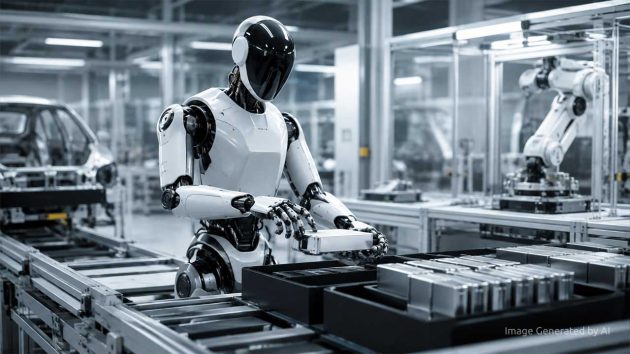
The verified internal task list for Optimus covers sorting 4680 battery cells, moving parts between stations, kitting, quality inspection, and pick-and-place. Tesla has not published cycle times, error rates, or throughput for any of these tasks. On the Q2 2026 call, Musk stated: “This is going to be the hardest product to scale manufacturing that we’ve ever made at Tesla because everything on the robot is new.” With over 10,000 unique components, he noted the ramp “will move as fast as the least lucky, slowest, dumbest part in the entire 10,000.”
How Does Optimus Compare to Figure AI and Agility Robotics?
Figure AI and Agility Robotics have paying external customers with documented operating hours; Optimus has zero external deployments and no verified performance data.
As of mid-2026, no humanoid robot from any manufacturer has been deployed above the low hundreds of units in a sustained commercial environment, per a July 2026 Technology.org analysis. Within that constrained field, Figure AI and Agility Robotics hold a clear advantage: data from paying external customers.
| Platform | External Customers | Documented Operating Hours | Verified Output | Commercial Sales |
| Tesla Optimus | None | Not disclosed | Not independently verified | 0 (none announced) |
| Figure AI (Figure 02) | BMW Spartanburg | 1,250+ hours | 90,000+ sheet-metal parts; >99% placement accuracy | Confirmed commercial deployment |
| Agility Robotics (Digit) | GXO, Schaeffler, Toyota Canada, Mercado Libre | 65,000+ across 9 facilities | Multi-site operational data | Confirmed commercial deployment |
| Unitree (all humanoid models) | Varied | Not disclosed | 5,500+ humanoid units shipped in 2025 (all models combined) | 5,500+ units (2025); 20,000 targeted (2026) |
Figure AI’s BMW Spartanburg deployment runs ten-hour shifts loading sheet-metal parts into welding fixtures, with 90,000-plus parts and above 99% placement accuracy. Agility’s RoboFab facility has stated production capacity for 10,000 Digit units annually.
What Does Optimus Cost and What Constrains Production?
Current manufacturing cost runs $50,000 to $100,000 per unit, with AI5 chip integration delayed until mid-2027 and rare earth supply risks unresolved.
Current manufacturing cost is estimated at $50,000 to $100,000 per unit. Musk stated at Davos in January 2026 that the consumer target price is “under $20,000,” with a long-term mass-production price target of $20,000 to $30,000. Industry estimates based on Bureau of Labor Statistics data put fully loaded US manufacturing labor at $95,000 to $120,000 per year. Optimus will not receive Tesla’s AI5 chip until volume production is reached, projected around mid-2027. Wolfe Research considers meaningful external revenue unlikely before late 2027. Goldman Sachs projects a $38 billion humanoid robot market by 2035; Bank of America projects 90,000 units shipped industry-wide in 2026, scaling to 1.2 million by 2030.
AI tools were used to assist with research and data compilation for this article. Edited and verified by the IIoT World editorial team.
Related from IIoT World
Frequently Asked Questions
1. How many Tesla Optimus robots are deployed in 2026?
Axis Intelligence Research estimates 1,000 to 1,200 Optimus units at Fremont and Giga Texas as of mid-2026. Tesla has not confirmed this. On the Q4 2025 earnings call, Musk stated the units are “primarily for learning and data collection rather than performing productive tasks.”
2. What tasks is Tesla Optimus performing in its factories?
Confirmed tasks include sorting 4680 battery cells, moving parts between production stations, kitting, quality inspection, and pick-and-place. Tesla has not published cycle times, error rates, or throughput figures for any of these tasks.
3. How does Tesla Optimus compare to Figure AI and Agility Robotics?
Figure AI logged 1,250-plus hours at BMW Spartanburg, with 90,000-plus parts at above 99% placement accuracy. Agility Robotics accumulated 65,000-plus hours across nine commercial facilities. Optimus has zero external customers and no independently verified performance data as of August 2026.
4. How much does a Tesla Optimus robot cost?
Current manufacturing cost is estimated at $50,000 to $100,000 per unit. Musk stated at Davos in January 2026 that the consumer target price is “under $20,000,” with a long-term mass-production price target of $20,000 to $30,000. Industry estimates based on Bureau of Labor Statistics data put fully loaded US manufacturing labor at $95,000 to $120,000 per year.
5. When will Tesla Optimus be available for external customers?
Early builds go to the Optimus Academy for internal training, not external customers. Wolfe Research considers meaningful revenue unlikely before late 2027. AI5 chip integration for Optimus is projected around mid-2027.
Sources
- Axis Intelligence Research: Tesla Optimus Statistics and Deployment Data
- Optimusk.blog: Tesla Optimus Factory Deployment, Q4 2025 Earnings
- Electrek: Tesla Optimus Production at Fremont, Model S/X Line Conversion
- Tesla Q2 2026 Earnings Call Transcript (Motley Fool)
- Not a Tesla App: Tesla Q2 2026 Earnings Summary, Optimus Academy
- Holland & Knight: China Export Controls on Rare Earth Materials, April 2025
- IEA: Export Controls on Critical Minerals, Supply Concentration Risks
- Rare Earth Exchanges: Humanoid Robots and Rare Earth Magnet Requirements
- Adamas Intelligence: Humanoid Robots and NdFeB Markets
- Pillsbury Law: China Suspends Export Controls on Certain Critical Minerals
- Technology.org: Humanoid Robots in 2026, Deployment Tracker
- Unitree Robotics: Global Humanoid Robot Shipments Exceeding 5,500 Units
- Interesting Engineering: Unitree Targets 20,000 Humanoid Robots in 2026
- Agility Robotics: RoboFab Manufacturing Facility
- Built In: Tesla Optimus Robot Price Target
- Optimusk.blog: Tesla Optimus vs Human Cost, BLS Data
- Goldman Sachs: Global Humanoid Robot Market $38 Billion by 2035
- Humanoids Daily: Bank of America Long-Term Humanoid Robot Forecast