David Reger, founder and CEO of Neura Robotics, stood next to a 4NE1 Mini humanoid robot at the AWS booth during Hannover Messe 2026 and laid out the math: China, Japan, and Europe together face a deficit of 101 million workers by 2030. His company’s answer is a line of cognitive humanoid robots built to work in the same spaces and on the same tasks that human workers handle today. Physical AI is the field of artificial intelligence that gives robots the ability to perceive, reason about, and physically interact with real-world environments, moving intelligence from screens and servers into machines that touch, lift, and assemble. The same week, Neura and AWS announced a strategic partnership to scale physical AI from controlled lab environments to global manufacturing deployment.
What Can Humanoid Robots Do on a Factory Floor Today?
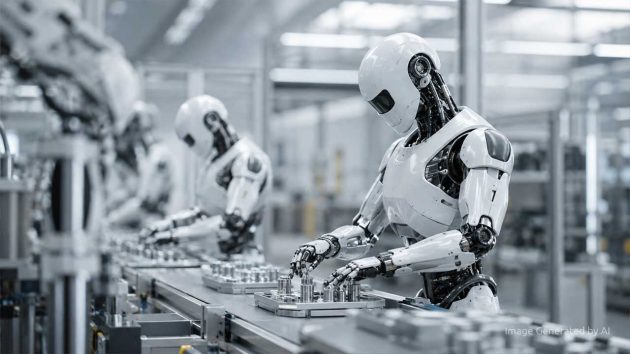
Physical AI humanoids perform the same manual tasks as human workers, including pressing buttons, turning switches, loading parts into machines, and sorting components into bins, all within existing factory layouts that were designed for people. The humanoid form factor is the key differentiator. Because the 4NE1 matches a human worker’s height and reach at 180 cm, it fits into production lines without requiring facility modifications. Current deployments start with straightforward, repetitive operations: placing parts inside machines, sorting components into baskets, and responding to changing conditions on the line. The distinction from traditional industrial robots is that these systems are fully autonomous and reactive. When something changes in the environment, the robot adapts without reprogramming.
The manufacturing-grade 4NE1 Gen 3.5 lifts up to 100 kg, operates for six to eight hours on hot-swappable batteries that enable 24/7 operation, and processes its environment through seven cameras providing 360-degree perception along with a patented artificial skin that detects proximity. Neura targets precision assembly, quality inspection, palletizing, and machine tending across automotive and electronics manufacturing. Other humanoid deployments are already showing measurable production results at scale.
How Does Physical AI Learn with Limited Training Data?
Physical AI robots learn tasks through a combination of real-world sensor data and high-fidelity simulation, then share what they learn across an entire fleet through cloud infrastructure. The challenge is that while large language models train on trillions of internet data points, robots operate with far less available training material. The smaller 4NE1 Mini, standing at 132 cm with 25 degrees of freedom, serves as the training platform. Anything a research team builds or trains on the Mini transfers directly to the full-size manufacturing models.
The AWS partnership announced at Hannover Messe addresses the infrastructure side of this problem. AWS becomes Neura’s primary cloud provider, hosting the Neuraverse platform for physical AI training, real-time data processing, and fleet intelligence sharing. Neura Gym, the company’s controlled training environment, integrates with Amazon SageMaker to accelerate training pipelines. Amazon is also exploring deployment of Neura robots across select fulfillment centers, creating one of the most advanced real-world environments for robotics at global scale.
“Physical AI will only reach its full potential if intelligence can be trained, validated, and continuously improved in the real world,” according to the AWS partnership announcement.
Why Is the Manufacturing Labor Shortage Accelerating Robot Adoption?
Major manufacturing economies face a combined 101 million worker deficit by 2030, according to David Reger. China accounts for 87 million of that deficit, while the EU and Japan are each projected to be short 7 million workers. The aging population across all three regions is driving the deficit, and industry surveys show 86% of manufacturers now treat AI and robotics as essential to sustaining output.
Neura’s longer-term target goes beyond the tasks robots handle today. The capability still exclusive to humans is assembly of objects the robot has not encountered before, and that is what Neura is building toward. The company has set a target of delivering five million cognitive robots by 2030 and has raised 185 million euros to date, with a partner network that includes Kawasaki, Schaeffler, Bosch, Qualcomm Technologies, and now AWS.
What Does the 4NE1 Cost and When Is It Available?
| 4NE1 Mini | 4NE1 Gen 3.5 | |
| Height | 132 cm | 180 cm |
| Max payload | 3 kg | 100 kg |
| Runtime | 2.5 hours | 6-8 hours (hot-swap) |
| Degrees of freedom | 25 | 25+ |
| Target use | Research, education | Manufacturing, logistics |
| Price | 19,999-29,999 euros | 60,000-98,000 euros |
| Availability | April 2026 | Late 2026 |
The 4NE1 Gen 3.5, designed in collaboration with Studio F.A. Porsche, is priced at 98,000 euros for individual orders and drops to 60,000 euros per unit for fleet purchases of 20 or more. Both models run on the NVIDIA Thor T5000 processor and the NVIDIA Isaac GR00T XX foundation model, with the Neuraverse operating system managing fleet-level coordination.
IIoT World covered the first measurable production results from humanoid robots at BMW earlier in 2026, where a similar deployment model achieved factory-scale output.
Based on a video interview with David Reger, founder and CEO of Neura Robotics, recorded by Lucian Fogoros of IIoT World at the AWS booth during Hannover Messe 2026. Additional specifications from Neura Robotics public product documentation and the AWS-Neura partnership announcement of April 20, 2026.
Frequently Asked Questions
1. What is Neura Robotics?
Neura Robotics is a German cognitive robotics company founded in 2019 and headquartered in Metzingen. The company develops humanoid robots for manufacturing, logistics, and personal use. CEO and founder David Reger coined the term “cognitive robotics.” Neura has raised 185 million euros and partners with AWS, Kawasaki, Schaeffler, Bosch, and Qualcomm Technologies.
2. What tasks can the 4NE1 humanoid robot perform in factories?
The 4NE1 Gen 3.5 handles precision assembly, quality inspection, palletizing, machine tending, pressing buttons, turning switches, and loading parts into machines. It lifts up to 100 kg, has 25+ degrees of freedom, and runs six to eight hours with hot-swappable batteries for continuous 24/7 operation.
3. How does physical AI differ from traditional industrial robotics?
Physical AI robots are fully autonomous and reactive, adapting to changing conditions without reprogramming. Models trained on the smaller 4NE1 Mini transfer directly to the manufacturing-grade 4NE1 Gen 3.5. Fleet intelligence is shared across all robots through the cloud-based Neuraverse platform hosted on AWS.
4. How many manufacturing workers will the world be short by 2030?
According to Neura Robotics CEO David Reger, major economies face a combined 101 million worker deficit by 2030: China 87 million, the EU 7 million, and Japan 7 million, driven by rapid population aging across all three regions.
5. What is physical AI and how does it work in factories?
Physical AI is artificial intelligence that enables robots to perceive, reason about, and physically interact with real-world manufacturing environments. In factories, physical AI systems like Neura Robotics’ 4NE1 use cameras, proximity sensors, and foundation models to adapt to changing conditions without reprogramming. Training happens through a combination of real-world sensor data and simulation, then transfers across an entire robot fleet through cloud platforms such as AWS-hosted Neuraverse.
6. What is the ROI of deploying humanoid robots in manufacturing?
Neura Robotics prices the manufacturing-grade 4NE1 Gen 3.5 at 60,000 to 98,000 euros per unit, with fleet orders of 20 or more qualifying for the lower price point. With a 101 million worker deficit projected by 2030, the ROI calculation compares robot unit cost against the rising cost of unfilled manufacturing positions across China (87 million deficit), the EU (7 million), and Japan (7 million).
7. How is AI being used in manufacturing operations today?
Cognitive humanoid robots like Neura Robotics’ 4NE1 Gen 3.5 use physical AI to perform precision assembly, quality inspection, palletizing, and machine tending in existing factory layouts. These systems process their environment through seven cameras and artificial skin sensors, adapting autonomously to changing conditions. Fleet intelligence sharing through cloud platforms means one robot’s learned task transfers to every unit in the network.
About the author