Physical AI integrates artificial intelligence software with physical factory hardware, from robotic arms and mobile manipulators to quadruped sensor platforms, so machines can see, reason, and adapt to real-world conditions without human guidance at every step. Companies including Cambrian Vision (Germany), Inbold (France), and Path Robotics (US) are deploying these systems for tasks from flexible cable handling to autonomous welding, with documented results including scrap rate reductions of up to 60% on components worth $1,200 each. Dominic Meyer, CEO of Looq AI, says that placing intelligence into specialized industrial hardware delivers results that humanoid robots will not match for decades.
How Physical AI Differs from Software-Only AI
Physical AI integrates machine intelligence into factory hardware at the point of physical action, while software-only AI processes data in the digital realm without direct contact with the shop floor.
The distinction maps to a useful analogy. If Agentic AI (software agents) acts as a “robotic arm for the mind” by taking over cognitive tasks like root cause analysis, physical AI acts as the intelligent body. It fuses real-time sensor data, computer vision, and machine learning algorithms directly into robotic platforms, giving machines the ability to perceive and respond to their surroundings rather than following pre-programmed paths.
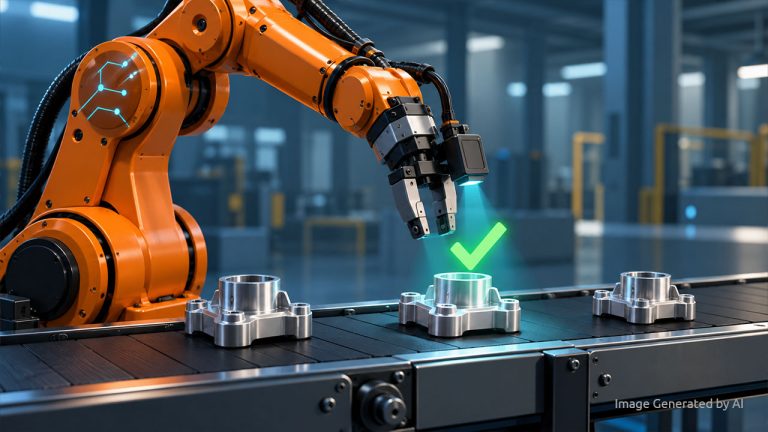
A welding robot that adjusts to part variations in real time is physical AI. A dashboard that shows weld quality metrics is not. The distinction matters because the ROI case, the safety requirements, and the deployment model are fundamentally different for each.
Where Physical AI Is Already Deployed
Physical AI deploys across three operational categories: hazardous-area inspection with quadruped robots, adaptive manufacturing with AI-vision robotics, and real-time operator guidance through computer vision.
Hazardous environment inspection. Oil and gas companies deploy AI-powered quadruped robots (“robot dogs”) as mobile sensor platforms, sending them into dark, enclosed areas where humans face serious safety risks. These robots capture high-definition images to detect oil leaks or corrosion. At the enterprise level, autonomous robotic fleets perform offshore inspections with minimal human intervention, reducing risk while continuously updating digital twins with real-time condition data. The operating concept is “zero-touch”: constant monitoring without constant human presence.
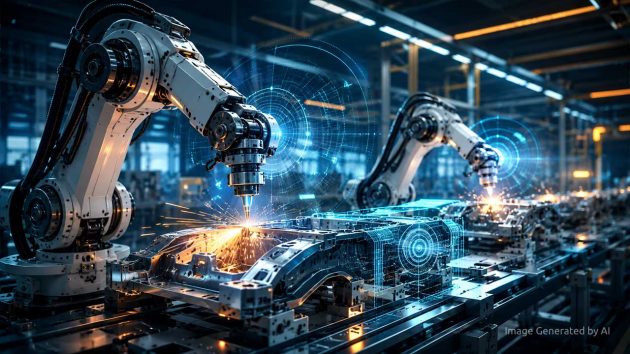
Adaptive manufacturing. Cambrian Vision, a German startup, uses AI vision to allow robotic arms to handle highly flexible materials like cables, a task that has historically defeated conventional automation. In France, Inbold deploys automated guided vision so mobile manipulators can adjust dynamically during product assembly. Path Robotics, based in Columbus, Ohio, uses AI for autonomous welding that self-adjusts to part variations in real time.
Operator guidance. Physical AI does not always mean replacing the human hand. It can also guide it. By using computer vision to verify each step of a complex assembly in real time, manufacturers have reduced scrap rates significantly while keeping the operator at the center of the work.
Why Specialized Robots Are Outperforming Humanoids
Specialized industrial robots outperform humanoids on the shop floor because they meet existing safety standards, solve targeted problems, and deliver measurable production returns today.
The humanoid robotics space generates enormous media attention but lacks the safety regulations needed for dynamic industrial environments. Viral demonstrations showing humanoid robots being pushed or stepping on objects highlight a liability concern for plant operators responsible for worker safety. The physical constraints of bipedal designs compound the problem.
Dominic Meyer, CEO of Looq AI, puts it directly: “How many robots do you see climbing up 37-foot ladders to reach a bolt on the backside of a boiler to see what the condition of that is? Zero. And will that change in the next 30 years? I put my bets on no.”
Instead of waiting for humanoid technology to mature, manufacturers are placing targeted AI sensor streams and specialized robots at the source of each problem. The result is faster deployment timelines and returns on problems that exist today.
| Humanoid Robots | Specialized Industrial Robots | |
| Safety standards | No established industrial frameworks | Proven protocols with built-in guardrails |
| Current ROI | R&D and pilot stage; no proven production returns | Documented productivity gains and cost savings |
| Environment fit | Limited by bipedal balancing constraints | Built for harsh, confined, or hazardous spaces |
| Task scope | General-purpose but unreliable at scale | Narrow focus, high reliability per task |
Where the Real ROI Comes From
The highest physical AI returns come from combining computer vision with robotics to automate manual tasks that machines perform faster and more accurately than human operators.
Three deployment patterns consistently produce measurable returns.
Capacity increases. AI vision systems and robotics automate tedious manual inspection and assembly tasks, directly increasing line throughput and overall production capacity. When machines handle visual quality checks at production speed, the inspection bottleneck disappears.
Deskilling complex procedures. By using computer vision to verify each step of a complex assembly in real time, one manufacturer reduced scrap rates by 60% on components worth $1,200 each, saving millions of dollars annually. The operator still performs the work, but AI catches errors before they become waste. The technology does not replace the person. It compresses the learning curve.
Autonomation. The Toyota Production System concept applied to physical AI: automate 80% to 90% of mundane physical work and let skilled human operators manage the remaining exceptions. This is not “lights out” manufacturing. It is a deliberate split between machine efficiency and human judgment, targeting the 10% of tasks where human decision-making still outperforms any algorithm.
The pattern across all three: manufacturers who deploy physical AI to solve specific, well-defined problems see returns that justify the investment. Those attempting full-line automation face significantly higher cost and complexity.
Frequently Asked Questions
1. What is physical AI in manufacturing?
Physical AI is the integration of AI software with physical factory hardware, including robotic arms, quadruped sensor platforms, and mobile manipulators, so machines can perceive and adapt to real-world conditions autonomously. It differs from software-only AI because physical AI operates at the point of physical action on the shop floor, not just in the digital realm.
2. What is the difference between humanoid robots and specialized industrial robots?
Humanoid robots are designed for general-purpose tasks using a human-like form factor. Specialized industrial robots are purpose-built for specific tasks such as hazardous-area inspection, flexible material handling, or autonomous welding. In current factory environments, specialized robots deliver higher ROI, operate under proven safety standards, and perform reliably in conditions where humanoids face practical limitations.
3. How does physical AI improve manufacturing quality?
Physical AI improves quality by using computer vision to monitor and guide production in real time. In one documented case, AI vision verifying each step of a complex assembly reduced scrap rates by 60% on components worth $1,200 each. The operator performs the work; the AI catches errors before they become waste.
4. What is autonomation in manufacturing?
Autonomation is a Toyota Production System concept where machines handle 80-90% of repetitive physical work and skilled human operators manage the remaining exceptions. Applied to physical AI, this means deploying specialized robots and computer vision for predictable tasks while humans focus on complex problem-solving and the judgment calls that machines cannot reliably make.
This article draws on sessions from IIoT World Days 2025 virtual events, including discussions on manufacturing skills gaps, smart operations in oil and gas, startup innovations in robotics, generative AI in manufacturing, supply chain resilience, and manufacturing agility.
Check the upcoming 2026 events.
Related from IIoT World
- Eliminating the “Hidden Factory”: The Economics of Agentic Quality Control. How agentic AI and explainable AI reshape quality control economics in manufacturing.
- Industrial AI 2026 Summit. Free virtual conference, September 9-10, 2026. Expert sessions on automation, predictive analytics, and operational intelligence.
- Why Most Manufacturers Never Feel “Ready” for a Digital Twin. How to start with digital twins using existing IIoT infrastructure.