Sensors, cloud infrastructure, and algorithms keep improving, but the hardest input to capture for any manufacturing AI system is the knowledge held by a maintenance engineer who has been watching, listening to, and repairing the same equipment for 15 years. That engineer knows which vibration pattern means a bearing is failing versus which one is normal for a specific product run. They know which fixes worked in situations the maintenance logs never recorded. When they retire, that knowledge leaves with them. During a panel at IIoT World’s AI Manufacturing Day 2026, experts from TDK SensEI, AWS, Omron Automation, and Acerta identified tribal knowledge and workforce trust, not technology, as the factors that determine whether AI adoption in manufacturing succeeds or stalls.
What AI Models Miss Without Operational Context
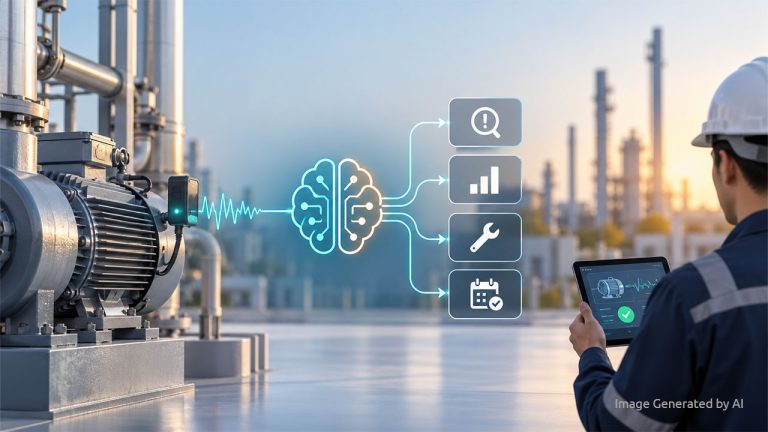
A maintenance engineer who has spent years on a particular line knows that a specific motor runs hotter during summer months and that the reading is normal, not a fault indicator. They know that a particular pump’s seal tends to degrade faster when running a high-viscosity product. They know that a vibration spike during the first 10 minutes after a product changeover is mechanical settling, not bearing wear. None of that knowledge appears in a maintenance log or a sensor stream.
Without it, an AI model trained on raw data will generate false positives on normal operating variations, which erodes the trust that predictive maintenance programs depend on.
“As people are retiring, that resident knowledge is also leaving the company. So you want to make sure that your systems can come in and help new people that are coming in with the knowledge gap,” said Sundeep Ahluwalia, Chief Product Officer at TDK SensEI. TDK operates one of the world’s largest manufacturing footprints, and the company has used its own internal operations to develop approaches for capturing and embedding that kind of operational context into AI systems.
Why Manufacturing Workers Resist AI Adoption
Capturing that operational knowledge requires the willing participation of the people who hold it. Technology headlines about AI-driven layoffs have made that participation harder to secure. When organizations announce that AI is coming to the plant, some maintenance teams interpret that as a signal that their expertise, and potentially their jobs, are being replaced. In that environment, asking workers to volunteer the knowledge that makes them valuable is asking them to participate in their own displacement, at least from their perspective.
The organizations that have overcome this resistance share a common approach: they frame AI as a tool that helps experienced workers do more with current resources rather than a way to produce the same output with fewer people. When a maintenance engineer sees that their knowledge, once captured, helps them avoid the 6 p.m. phone call about a machine going down during their family time, the incentive to participate shifts.
Inviting operators, IT teams, and maintenance staff to the table before selecting technology, rather than after deploying it, changes the dynamic entirely. People who are consulted in the design of a system are more likely to contribute the knowledge that makes it work.
How LLMs Capture Tribal Knowledge from Maintenance Engineers
For organizations that have addressed the trust barrier, large language models now offer a practical path for capturing tribal knowledge at scale. Recording conversations with experienced maintenance engineers and processing those transcripts through AI tools can extract specific failure patterns, diagnostic shortcuts, and operating nuances that would otherwise require months of structured interviews to document.
Maintenance engineers are often willing to talk about their machines in conversation even when they would not fill out a structured knowledge capture form. The information comes out naturally, in descriptions of which readings to watch after specific events, how long to wait before rechecking, and which thresholds apply to which operating conditions. A single conversational exchange can encode a diagnostic rule that a model would otherwise need hundreds of labeled data points to learn.
Organizations building predictive maintenance programs should treat knowledge capture as a parallel workstream, not a follow-on phase. The engineers who hold the most valuable operational knowledge are often the ones closest to retirement. Waiting until the models are built to start capturing their input risks losing the context that would have made those models accurate.
How Floor Champions Drive AI Adoption in Manufacturing
Accurate models built on captured operational knowledge create their own advocates. Adoption spreads faster through a small number of people on the production floor who have seen predictions confirmed on their own equipment than through any company-wide training program.
These champions are typically maintenance leads or process engineers who participated in the initial deployment, saw a prediction confirmed, and experienced the difference between reacting to a breakdown and addressing a known issue during a planned window. Their advocacy carries more weight than any slide deck because it comes from firsthand experience on the same equipment their colleagues operate every day.
Related from IIoT World
- Beyond the Alert: The Best Industrial AI Use Cases for Predictive Maintenance
- Predictive Maintenance: The Hidden ROI Driver Manufacturers Can’t Ignore
- 15 Real-World AI in Manufacturing Use Cases: From Predictive Maintenance to Agentic AI
This article is based on a panel discussion at IIoT World’s AI Manufacturing Day 2026, sponsored by TDK SensEI. Panelists: Sundeep Ahluwalia, Chief Product Officer, TDK SensEI; Steve Blackwell, Head of Product Engineering & Services Center of Excellence, AWS; Thomas Kuckhoff, Sr. Product Manager, Omron Automation Americas; and Greta Cutulenco, Founder and CEO, Acerta. Moderated by John DiPaola. AI tools were used to help summarize and organize the content. Reviewed and edited by the IIoT World editorial team.
Sponsored by TDK SensEI. Editorially Independent.
FAQ
1. What happens when manufacturing AI lacks operational context?
AI models trained on raw sensor data without operational context generate false positives on normal operating variations, such as temperature spikes during product changeovers or vibration patterns specific to certain product runs. These false alarms erode the operator trust that predictive maintenance programs depend on. Organizations that capture operational context from experienced maintenance engineers and integrate it into their models see fewer false alarms and higher adoption rates on the production floor.
2. How can manufacturers capture tribal knowledge for AI?
Recording conversations with experienced maintenance engineers and processing the transcripts through large language models is an emerging approach. Engineers often share diagnostic patterns, failure signatures, and operating nuances in natural conversation more readily than in structured forms. Organizations should treat knowledge capture as a parallel workstream alongside model development, especially for engineers approaching retirement, rather than deferring it until after AI systems are deployed.
3. What is the biggest barrier to AI adoption in manufacturing?
The biggest barrier is often workforce resistance rooted in concerns about job displacement. Organizations that frame AI as a tool that helps experienced workers handle more responsibility, rather than a way to reduce headcount, see higher participation in knowledge sharing and faster adoption. Involving maintenance staff in technology selection and deployment planning, rather than announcing changes after decisions are made, builds the trust needed for successful implementation.