
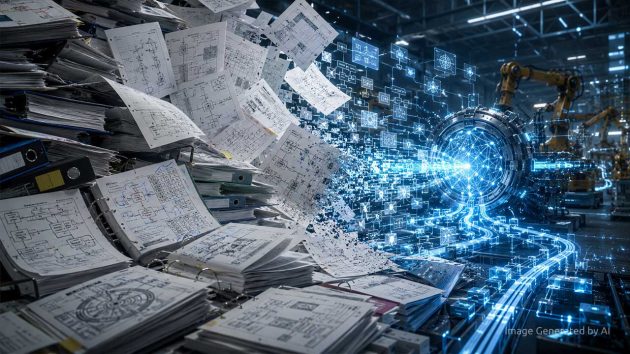
Most plants were built to make products, not to feed AI agents. The operational knowledge that AI needs is locked in formats that were never designed to be searched, structured, or consumed by machines.
During a session at IIoT World’s AI Manufacturing Day 2026, Chris Huff and Anthony Vigliotti of Adlib Software, alongside Mathias Oppelt of Siemens, described why document preparation is the infrastructure problem most manufacturers underestimate when deploying AI agents. Plants running today “were never designed for AI.” They were designed for production.
Where the Knowledge Actually Sits
A greenfield AI strategy sounds clean: connected assets, structured data, modern platforms, well-tagged information, and clear system integration.
Most manufacturers do not operate in that world.
They run plants with a mix of old and new equipment. Some systems are modern. Others are decades old. Some processes are documented in controlled systems. Others depend on PDFs, tribal knowledge, old drawings, maintenance notes, or supplier files that were never meant to support machine reasoning.
That does not make the plant broken. It means the plant reflects years of practical decisions made to keep production running.
The problem starts when manufacturers expect AI agents to work across that environment without first preparing the source information. AI agents need clean context, and brownfield plants typically provide scattered context.
A procedure lives in one system, a drawing in another, a quality record in a PDF, a supplier update in an email attachment, a specification in several versions. The operator, engineer, or quality manager may know which source is right. The AI system usually does not.
That gap becomes serious when AI is expected to do more than summarize.
Tables, Diagrams, Handwriting, Scanned Pages
One reason factory documents block AI agents is that they are rarely simple text files.
A standard operating procedure may include tables, revision histories, signatures, embedded images, handwritten notes, checkmarks, diagrams, and scanned pages. An engineering document may include tolerances, symbols, drawings, embedded CAD references, or process flows. A quality record may combine structured fields with free-text notes and attachments.
When a document enters a preparation pipeline, the question is what it actually contains: handwriting, check marks, diagrams, embedded Visio flows, CAD drawings, 2D or 3D elements, and other components that need to be decomposed before AI can use them properly.
AI agents need more than a file name or a paragraph of extracted text. They need the information in the document to be represented in a way the system can use.
If the document includes a diagram and the AI only reads the surrounding text, the answer may be incomplete. If a table is extracted incorrectly, the recommendation may be wrong. If a handwritten note changes the meaning of a record, but the system misses it, the workflow may move forward with bad information. Document preparation is part of the AI foundation.
Where Documents Stall: Integration
Many AI projects focus first on the model or the user interface. In manufacturing, the harder question comes earlier: can the information move cleanly into PLM, MES, ERP, QMS, maintenance systems, supplier systems, and AI workflows?
Integration is one of the places where systems of action stall. Structured data has to flow into the systems manufacturers already use, and it has to arrive in a format those systems can accept.
A plant may have the right information, but not in the right structure. A document may contain the approved specification, but the data may not be connected to the workflow that needs it. A quality system may require certain fields, while the source document contains those values in an image, table, or scanned attachment.
When AI agents cannot connect source information to operational systems, they remain limited. They may answer questions, but they cannot reliably support workflow execution.
That is the difference between a useful assistant and an agent that can move work forward.
Legacy Systems Are Not Going Away
Manufacturers cannot solve this by replacing every legacy system. Existing systems are tied to production, compliance, training, maintenance, validation, supplier relationships, and years of operating history. Replacing them all would be expensive, disruptive, and unrealistic.
Many brownfield environments have legacy systems that will still be around years from now. The practical issue is how to work with them. The goal is to create a layer that can extract, structure, and preserve context from the systems and documents already in place. This allows AI to work with the plant’s reality instead of pretending that reality does not exist.
Making Plant Knowledge Machine-Readable
Factory documents are sources of operational knowledge that must be converted into machine-readable data. But converting does not mean flattening everything into plain text. The structure, context, metadata, and source relationships all need to survive the conversion.
An AI-ready document process should be able to identify the type of document, extract key entities, preserve the source location, capture relevant metadata, and maintain the relationship between the extracted data and the original file. It should also account for complex elements such as tables, drawings, embedded images, and scanned content.
The session described this as creating a machine-readable digital twin of information from legacy technology: context maintained, metadata preserved, and format ready for AI consumption.
AI does not need every legacy system to disappear. It needs plant knowledge to become usable by modern workflows.
Document Quality Decides Agent Performance
AI agents are different from simple search tools because they are expected to carry out steps in a process. That makes document quality more important.
If an agent is only answering a question, an incomplete response may lead to a follow-up search. If an agent is helping route a supplier approval, prepare a quality review, compare a requirement, or recommend the next workflow step, incomplete source information can create a process failure.
Can the agent find the right thing, understand how it fits the process, and pass the information forward in a usable form?
In manufacturing, that usually requires three things:
- accurate extraction from complex documents
- context from the source system or process
- clean integration into the workflow that uses the data
Without those pieces, AI agents stay at the edge of operations. They can assist, but they cannot support reliable action.
Pick One Workflow
Manufacturers should start with the document sets that already slow down work. That may include supplier documentation, quality records, equipment manuals, change orders, batch records, compliance packages, or engineering specifications. The right starting point is usually a document-heavy workflow where teams already spend time searching, checking, extracting, comparing, or rekeying information.
The goal is not to digitize everything at once. It is to select one workflow, identify the documents behind it, and determine what AI would need in order to support the process correctly.
A practical first pass should answer:
- Which documents contain the operational knowledge?
- Which versions are approved?
- What data needs to be extracted?
- Which diagrams, tables, notes, or attachments matter?
- Which system needs the structured output?
- Who needs to verify the result before the workflow moves forward?
This keeps the project grounded in manufacturing work, not AI experimentation.
The Actual Blocker
Brownfield plants are often treated as a barrier to industrial AI. That is only partly true. The age of the equipment matters less than whether the plant’s knowledge can be made usable for AI without disrupting operations.
Manufacturers already have a large amount of valuable information. The problem is that much of it is locked inside documents and systems that were never designed for autonomous workflows. AI agents will not fix that by themselves. They need prepared inputs, preserved context, and a clean path into operational systems.
For manufacturers, the next step is to make the knowledge inside that plant readable, structured, and useful enough for AI to support the work. AI agents become practical when factory documents become usable.
Related from IIoT World
- Why Your Factory’s AI Keeps Failing: The One Document You Forgot
- Document as Evidence vs. Data Source: Industrial AI Governance
- Why Manufacturers Get Stuck Before They Start Digitalizing
This article is based on a panel discussion at IIoT World’s AI Manufacturing Day 2026, sponsored by Adlib Software. Panelists: Chris Huff, CEO, Adlib Software; Anthony Vigliotti, CPO, Adlib Software; and Mathias Oppelt, Vice President Head of Customer Driven Innovation, Siemens. Moderated by Hamish Mackenzie, Advisory Board Member, IIoT World. AI tools were used to help summarize and organize the content. Reviewed and edited by the IIoT World editorial team.
Sponsored by Adlib Software. Editorially Independent.
FAQ
1. Why do factory documents block AI agents?
Most manufacturing knowledge lives in documents that were created for people, not machines. SOPs, engineering drawings, batch records, quality files, and supplier specifications often contain tables, diagrams, handwriting, embedded images, scanned pages, and multi-layered content. AI agents need this information decomposed, structured, and integrated into operational systems before they can use it. When documents remain in their original format, AI cannot extract the context it needs to support workflows reliably.
2. How should manufacturers prepare factory documents for AI?
Start with document-heavy workflows where teams already spend time searching, checking, or rekeying information. Identify the documents behind the workflow, determine what AI would need to support it, and build a process that can classify documents, extract key entities, preserve source metadata, and deliver structured output into PLM, ERP, QMS, or other operational systems. Complex elements like CAD drawings, Visio flows, and handwritten notes need specialized decomposition.
3. What does machine-readable plant knowledge mean?
Machine-readable plant knowledge means converting factory documents into structured, AI-consumable formats while preserving the context, metadata, and source relationships that make the information useful. This is more than flattening documents into plain text. It requires maintaining the connection between extracted data and the original file, version, and approval trail so that AI agents can use the information in workflows where accuracy and traceability matter.