
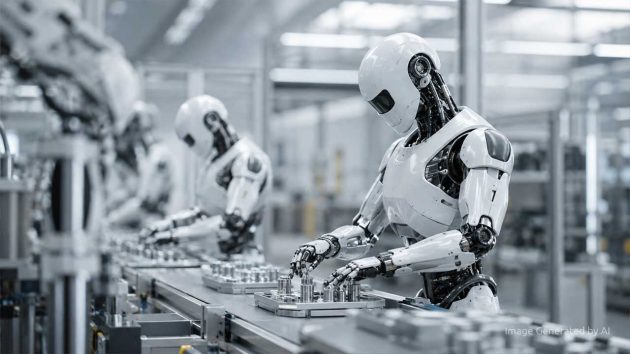
AGIBOT’s G2 completed 140 continuous hours on a Longcheer Technology consumer electronics production line with a 99.9% success rate. Agility Robotics’ Digit handles bearing components at Schaeffler’s South Carolina factory and has accumulated over 65,000 operating hours across customer facilities, with more than $300 million in multi-year Digit v5 orders. UBTECH’s Walker S2 has orders exceeding 800 million yuan from BYD, Foxconn, and six other manufacturers. Across electronics, automotive parts, industrial components, and pharmaceutical manufacturing, humanoid platforms are producing verified operational data in 2026.
Which Manufacturers Use Humanoid Robots on Production Lines?
AGIBOT’s G2 operates on a Longcheer Technology consumer electronics line at 99.9% success rate, Agility Robotics’ Digit handles bearing components at Schaeffler’s South Carolina facility, and Toyota Motor Manufacturing Canada deployed seven Digit units for automotive parts handling in April 2026.
AGIBOT G2 at Longcheer Technology (Nanchang, China) represents what AGIBOT calls the world’s first embodied AI deployment on a consumer electronics mass production line, announced April 15, 2026. The G2 handles precision loading and unloading at multimedia integrated test stations, picking up tablets, placing them into test jigs with millimeter-level precision, and sorting finished versus defective units. Throughput reaches 310 units per hour, with a 19-20 second cycle time per operation. The success rate in continuous operation exceeds 99.9%. Line integration took 36 hours. The robot produces approximately 3,000 units per shift and operates 24/7 with downtime below 4%. AGIBOT demonstrated continuous operation exceeding 140 hours. Expansion to 100 robots is planned for Q3 2026.
Agility Robotics’ Digit at Schaeffler (Cheraw, South Carolina, 750 employees) handles baskets of bearing components weighing 25 pounds, moving them from a stamping press to an industrial washing machine. The robot runs 8 hours per day across two 4-hour shifts with a recharge break. Digit currently operates inside a Plexiglas cage to comply with federal safety standards. The employee previously assigned to this task has been redistributed to inspection work. Schaeffler expects an upcoming Digit, capable of detecting human presence, to work alongside employees without the cage by end of 2026.
Operational cost under Agility’s RaaS model at Schaeffler: $10-25 per hour, compared to approximately $20 per hour for an entry-level employee.
Toyota Motor Manufacturing Canada deployed seven Digit units at its Woodstock, Ontario facility in April 2026 for automotive parts handling. TMMC evaluated multiple robot platforms before selecting Digit. Tim Hollander of TMMC stated the company is “excited to deploy Digit to improve the team member experience.”
UBTECH Walker S2 has moved into mass production. The first delivery batch was several hundred units, against a 2025 target of 500 units. Capacity scales to 5,000 units per year in 2026 and 10,000 per year in 2027. Orders exceeded 800 million yuan (approximately $112 million USD) as of early 2025, including a single order worth 250 million yuan in September 2025. Confirmed clients include BYD, Dongfeng Liuzhou Motor, Geely Auto, FAW-Volkswagen Qingdao, Audi FAW, BAIC New Energy, Foxconn, and SF Express. Applications span smart factories, automotive assembly, intelligent logistics, and data collection centers.
Foxconn is evaluating humanoid robot deployment at its new Houston, Texas facility, which produces NVIDIA GB300 AI servers. The factory is described as well-suited for humanoid deployment because it is new construction with more space than existing server manufacturing sites. Foxconn has tested UBTECH models and is developing two in-house platforms, one biped and one wheeled. As of the most recent reporting, Foxconn has not confirmed which platform it will deploy or in what quantity.
How Are Humanoid Robots Used in Pharmaceutical Cleanrooms?
A 14-week pharmaceutical cleanroom pilot demonstrated 73% faster fault detection and 89% fewer human entries using a bipedal humanoid robot for asset monitoring patrols.
Pharma Pilot Results (14-Week Pilot, 1 Robot Unit)
| Metric | Result |
| Total patrol hours logged | 312 hours |
| Assets monitored | 47 (lyophilizers, autoclaves, HEPA units, servo drives, clean utility systems) |
| Fault detection speed | 73% faster (4.7 days to 1.3 days average) |
| Human cleanroom entries reduced | 89% |
| False positive rate | 8% (vs. 14% for fixed sensor network) |
| Anomalies detected | 47 (vs. 21 by fixed network) |
| Work orders validated | 43 out of 47 |
| Regulatory compliance | 21 CFR Part 11 and GMP Annex 11 validated |
The pilot itself had no revenue ROI metric. The 3.4x ROI figure is a projection for full deployment of 6 units: estimated Year 1 cost of approximately $520,000 against a projected net benefit of $1.77 million (comprising $980,000 in avoided downtime, $420,000 in contamination risk reduction, and $370,000 in staffing optimization). This projection has not been independently verified.
What Has Been Proven and What Has Not?
Electronics assembly and industrial component handling have confirmed commercial deployments with documented throughput data. Pharmaceutical cleanroom monitoring remains at pilot stage with projected ROI. Multi-task general-purpose operation remains at R&D stage across all manufacturing sectors.
| Sector | Proven in 2026 | Not Yet Commercially Viable |
| Consumer electronics | Precision pick-and-place at test stations (99.9% success rate) | Full assembly line replacement |
| Automotive manufacturing (non-body) | Parts feeding, tugger loading/unloading, tote transfer | High-torque assembly, underbody work |
| Industrial components | Repetitive transfer between fixed stations (Schaeffler model) | Tool changing, multi-step assembly |
| Pharmaceuticals | Cleanroom patrol, asset monitoring, fault detection | Sterile drug compounding, filling operations |
What Is the Payback Period for a Humanoid Robot?
Under high utilization in intensive industrial environments, IDTechEx data from May 2026 shows a payback period of approximately 6 months, extending to approximately 15 months under average utilization.
IDTechEx Payback Parameters (2026)
| Scenario | Payback Period | Notes |
| High utilization (intensive industrial) | ~6 months | Requires task continuity and operational stability |
| Average utilization | ~15 months | More typical for current multi-task deployments |
| Unit price (2024 average) | ~$114,700 | Western markets |
| Unit price projection (2030) | ~$37,000 | Based on scale manufacturing trajectory |
| Operational cost projection (2030) | Under $5/hour | High-utilization industrial scenarios |
IDTechEx calculates that hardware cost reduction alone is insufficient to close the ROI gap. “A robot’s cost per hour is not directly equivalent to a human labor cost per hour, as it depends on sufficient utilization, task continuity, and operational stability.” The effective value of the work delivered remains the primary constraint on adoption at scale.
How Large Is the Humanoid Robot Market and Who Leads It?
Counterpoint Research recorded 16,000 humanoid robot units installed globally in 2025. China accounted for more than 80% of those installations. The top five vendors held 73% of global market share.
Global Market Share by Vendor, 2025 (Counterpoint Research)
| Vendor | Market Share | Estimated Units | Geography |
| AgiBot | ~31% | ~5,000+ | China |
| Unitree | ~27% | ~4,320 | China |
| UBTECH | ~5% | ~800 | China + international |
| Leju | ~5% | ~800 | China |
| Tesla (Optimus) | ~5% | ~800 | US |
Counterpoint projects cumulative installations will exceed 100,000 units by 2027, with logistics, manufacturing, and automotive together representing 72% of annual installations that year.
MarketsandMarkets sizes the global humanoid robot market at $5.41 billion in 2026, projecting $50.27 billion by 2035 at a CAGR of 28.1%. Hardware holds approximately 68% of current market value (Cervicorn Consulting, 2025). Asia Pacific holds more than 50% of the market across the entire forecast period.
China vs. Western Deployment Posture, 2026
| Dimension | China | Western Markets |
| 2025 share of global installations | ~80% | ~20% |
| Primary vendors at scale | AgiBot, Unitree, UBTECH, Leju | Agility Robotics, Boston Dynamics, Figure AI |
| Dominant commercial model | Direct sale + internal factory use | RaaS (Robots-as-a-Service) |
| Leading sectors | Automotive manufacturing, data collection, smart factories | Electronics manufacturing, industrial components, pharmaceutical monitoring |
| Regulatory constraint (US, July 29, 2026) | FCC ban on new imports of Chinese humanoid and quadruped robots | Protects domestic development; limits Chinese model access in US market |
| IDTechEx 2025 delivery comparison | Unitree and AgiBot each delivered 5,000+ units | Tesla and Figure AI delivered “a few hundred or less” |
The FCC announced the ban on July 29, 2026, citing supply chain vulnerabilities that “could disrupt US economic and national security.” FCC Chair Brendan Carr framed the action as intended “to secure America’s critical supply chains.” Unitree had been recently added to a Pentagon list identifying companies with Chinese military ties. The ban applies to new, unregistered models and takes effect immediately, though it does not affect models already registered for US sale. At the time of the announcement, China held approximately 85% of the global humanoid robot market.
What Technical Barriers Limit Humanoid Robot Deployment?
Safety caging requirements, battery limitations, narrow task scope, dexterity constraints, and the absence of global safety standards limit every major humanoid platform currently in commercial operation.
| Constraint | Current Reality | Implication |
| Safety caging | Digit at Schaeffler operates inside a Plexiglas cage (federal compliance) | Limits mobility and co-working; upcoming models target human detection |
| Battery runtime | Unitree G1: 2 hours per charge; Digit v5: ~22 hours | Multi-shift coverage requires either swap stations or sufficient runtime |
| Task scope | All live commercial deployments involve 1-3 fixed, repetitive tasks | General-purpose humanoids operating flexibly across tasks remain R&D stage |
| Dexterity limits | AGIBOT G2 at 99.9% success rate on a single defined task; multi-task dexterity not yet commercial | Fine motor tasks (cable insertion, screwdriving) remain developmental |
| Utilization dependency | IDTechEx: ROI requires “sufficient utilization, task continuity, and operational stability” | Seasonal or variable demand environments struggle to justify unit economics |
| Safety standards | No global standard for humanoid robots working alongside people | Each deployment negotiates its own safety perimeter; slows rollout |
| Software maturity | Hardware advancing faster than software and data infrastructure | Operational stability determines ROI more than hardware cost reduction |
Agility’s RoboFab facility in Salem, Oregon, has capacity to produce up to 10,000 units per year. Approximately 75% of Digit v5’s bill of materials consists of domestically sourced US components. Digit v5 specifications: 50-pound lift capacity (a 40% increase over v4), up to 22 hours of runtime per charge, and a working height reach of 7.2 feet.
AI tools were used to assist with research and data compilation for this article. Edited and verified by the IIoT World editorial team.
Related from IIoT World
What Is Physical AI and How Does It Work in Factories?
Agentic AI and Physical AI in Manufacturing
Physical AI Deployment ROI: BMW’s 30,000-Car Proof
AI Predictive Maintenance in 2026: What Manufacturing Leaders Need to Know
FAQ
1. How much does a humanoid robot cost in 2026?
IDTechEx reports the 2024 average unit price at approximately $114,700, projected to fall to approximately $37,000 by 2030. Agility Robotics offers Digit under a Robots-as-a-Service model at $10 to $25 per hour at Schaeffler’s South Carolina facility, compared to approximately $20 per hour for an entry-level employee. Under high utilization, IDTechEx calculates a payback period of approximately 6 months.
2. What is the payback period for a humanoid robot in a factory?
IDTechEx data from May 2026 shows approximately 6 months under high utilization and approximately 15 months under average utilization. Task continuity drives ROI more than unit price: a robot sitting idle or switching between too many different tasks does not generate the hours needed to reach payback. Current average unit prices are around $114,700, projected to fall to approximately $37,000 by 2030.
3. Which factories use humanoid robots in 2026?
Confirmed manufacturing deployments include AGIBOT’s G2 at Longcheer Technology (consumer electronics, Nanchang, China), Agility Robotics’ Digit at Schaeffler (industrial components, Cheraw, South Carolina), Toyota Motor Manufacturing Canada (seven Digit units, Woodstock, Ontario), and UBTECH Walker S2 with orders from BYD, Foxconn, and six other manufacturers. Foxconn is evaluating deployment at its Houston, Texas facility. A 14-week pharmaceutical cleanroom monitoring trial has also been documented.
4. What tasks can humanoid robots perform in manufacturing?
Confirmed commercial tasks in 2026 include precision loading and unloading at electronics test stations (AGIBOT G2, 99.9% success rate, 310 units per hour), bearing component handling between stamping press and washing machine (Digit at Schaeffler, 25-pound baskets), automotive parts handling (Digit at Toyota), and cleanroom asset monitoring patrol in pharmaceutical manufacturing (312 hours logged, 47 assets monitored). All current deployments involve 1 to 3 fixed, repetitive tasks.
5. What are the main technical barriers to humanoid robot deployment in manufacturing?
The primary barriers are safety standards (Digit at Schaeffler operates inside a Plexiglas cage for federal compliance), battery limitations (Unitree G1: 2 hours per charge; Digit v5: approximately 22 hours), narrow task scope (all commercial deployments cover 1 to 3 fixed repetitive tasks), and the gap between hardware maturity and software infrastructure. No global safety standard exists for humanoid robots working alongside people. IDTechEx identifies sufficient utilization and task continuity as the primary drivers of ROI.
Sources
- The Robot Report: Agility Robotics SPAC Merger, $300M Orders, Deployment Data
- Agility Robotics: Commercial Agreement with Toyota Motor Manufacturing Canada
- UBTECH Walker S2 Mass Production and Orders Exceeding 800M Yuan
- AGIBOT and Longcheer Technology: First Embodied AI in Consumer Electronics Mass Production
- Counterpoint Research: Global Humanoid Robot Installations Reach 16,000 Units in 2025
- MarketsandMarkets: Humanoid Robot Market Size and Forecast
- NBC News: US Bans Foreign-Made Humanoid Robots, July 29, 2026
- IDTechEx via AJOT: Humanoid Robots Show Clearer ROI, May 2026
- Humanoids Daily: Agility’s Digit at Schaeffler, South Carolina
- iFactory App: Humanoid Robots in Pharma Manufacturing Predictive Maintenance
- Cervicorn Consulting: Humanoid Robot Market 2025 Hardware Share
- Assembly Magazine: Foxconn May Deploy Humanoid Robots at Texas Plant
- Agility Robotics: RoboFab Manufacturing Facility
- Al Jazeera: US Bans Imports of New Chinese Robots, July 29, 2026
- Unitree Robotics: G1 Humanoid Robot Specifications