GlobalLogic built procurement systems that save some clients $5 million a year by modernizing invoicing processes, and contributed to Hitachi Rail’s most digitally advanced factory worldwide, a 300,000 ft² facility in Hagerstown, Maryland. “It’s time for return on investment,” said Roxana Moldovan, Director Industrial BU EMEA at GlobalLogic, a Hitachi Group Company, in a conversation with Lucian Fogoros at Hannover Messe 2026.
Over 25 years, GlobalLogic has engineered software for advanced driving assistance systems, life-critical medical devices like defibrillators, and now factory operations through its combined capabilities with Hitachi Digital Services. And as AI moves into mission-critical industrial environments, reliability, governance, and predictable outcomes become essential.
What Does a Simulation-First Factory Look Like?
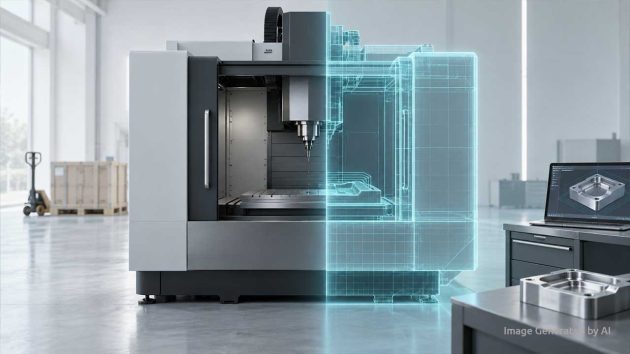
A simulation-first approach builds and validates the digital version of a factory before connecting it to real-world operations. The approach means developing AI-driven systems in a digital environment first, ensuring the digital twin had the intended behavior, then connecting it to live factory data. The method saves time in planning, testing, and testing failure, and it minimizes risk and saves costs by confirming that systems behave as intended before connecting to real factory data.
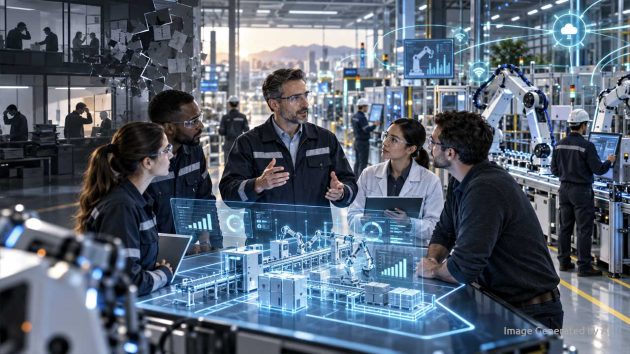
The factory is a flagship project that combines speed and precision, both sustained by uninterrupted digital performance. GlobalLogic and Hitachi Digital Services are working together to unify capabilities across product engineering, cloud modernization, and AI, bridging the gap from chip to cloud and from edge to outcome. The Hitachi Rail facility is one result of that combined engineering effort.
Manufacturers across industries can look at this project and get inspiration from it, even outside rail manufacturing. The core principle is the same: validate the digital factory first, then connect to real operations.
Where Is Manufacturing AI Delivering Measurable ROI?
Manufacturing AI is delivering documented ROI in procurement, supply chain, and asset management. Procurement digitization offers one of the clearest dollar-denominated examples. By modernizing invoicing processes and aggregating procurement requests across an organization, one project delivered $5 million in annual savings.
In the supply chain, AI applies to several operational challenges. Repetitive manual tasks can be accelerated using AI agents. Data visibility and transparency across supply chain channels, a gap exposed during the pandemic, can be strengthened through digital solutions. Forecasting tools can deliver predictive recommendations and real-time cost recalculation, which matters in a geopolitical context where disruption is frequent. Knowing what is happening across the supply chain matters, and so does the ability to react to it with recalculated costs.
Asset management extends the ROI conversation further. Acquiring a machine starts a longer lifecycle that includes asset maintenance, tracking the outcomes those machines produce, managing software licenses, and integrating digital solutions across equipment operations. Cybersecurity runs through all of it, since everything needs to be very secure.
| Application | What Changes | Outcome |
| Factory digital twin | Validate intended behavior digitally before connecting to real data | Reduced risk, faster planning and testing |
| Procurement digitization | Modernize invoicing, aggregate requests | $5 million/year in savings |
| Supply chain AI | Forecasting, real-time cost recalculation, data visibility | Faster response to disruption |
| Asset management | Track machine outcomes, licenses, digital solutions | Better visibility into equipment lifecycle |
| Physical AI | Robots that perceive, understand, reason, and act | Automation of previously manual operations |
Physical AI was among the most discussed topics at Hannover Messe 2026. The concept refers to AI systems embedded in robots and physical machines that can perceive their environment, understand context, reason about what to do, and act on those decisions. These capabilities are now replacing some operations and tasks that were previously very manual. These capabilities are expanding the range of operations and tasks that can now be automated.
For manufacturers evaluating their digital transformation strategy, physical AI represents a category where finding a partner with relevant expertise matters, since the technology is new enough that guidance on what makes practical sense is part of the value.
How Should Manufacturers Approach the Shift to ROI?
Manufacturers moving from AI experimentation to measurable returns should evaluate three areas: technology awareness, organizational readiness, and partner selection. The first is staying curious about technology. Digital solutions can help optimize processes, KPIs, and factory operations.
The second is understanding where the organization currently stands in its digital journey. Manufacturers range from early stages to highly advanced, and the path forward depends on knowing the current state, the desired destination, the limitations in play, the investment required, and the expected return on investment. When asked about assessment tools for determining digital readiness, the answer was direct: The most effective assessment often begins with expert consultation. Understanding the state of a factory comes down to people and experienced judgment.
The third is finding a reliable digital partner. Each manufacturer’s journey is unique, and the capabilities a partner brings need to be matched by the reliability of the solutions they deliver. Everyone was experimenting until recently, but the requirement now is reliability and return on investment.
Sponsored by GlobalLogic, a Hitachi Group Company.
This article is based on a video interview with Roxana Moldovan, Director Industrial BU EMEA at GlobalLogic, a Hitachi Group Company, and Lucian Fogoros of IIoT World, recorded at Hannover Messe 2026. AI tools were used to help summarize and organize the content. Reviewed and edited by the IIoT World editorial team.
Frequently Asked Questions
1. How is AI being used in manufacturing operations?
AI in manufacturing spans several operational areas: factory digital twins for simulation-first validation, procurement digitization that reduces costs through process modernization, supply chain forecasting with real-time adjustment, asset lifecycle management, and physical AI where robots perceive, reason, and act in production environments. The common thread across these applications is a growing demand for reliability. Manufacturers need AI solutions that deliver consistent, measurable results rather than experimental demonstrations.
2. What is a simulation-first approach in manufacturing?
A simulation-first approach builds and validates a factory’s digital twin before connecting it to real-world operations. The digital factory is tested for intended behavior, including planning, testing, and testing failure, saving time and cost in the process. Once the digital version behaves as intended, it connects to live factory data, minimizing risk.
3. What is physical AI and how does it apply to manufacturing?
Physical AI refers to AI systems embedded in robots and machines that can perceive their environment, understand context, reason about decisions, and act on them. In manufacturing, this means automating operations that were previously performed manually. Physical AI was among the most discussed topics at Hannover Messe 2026, with capabilities that no one imagined until recently.