
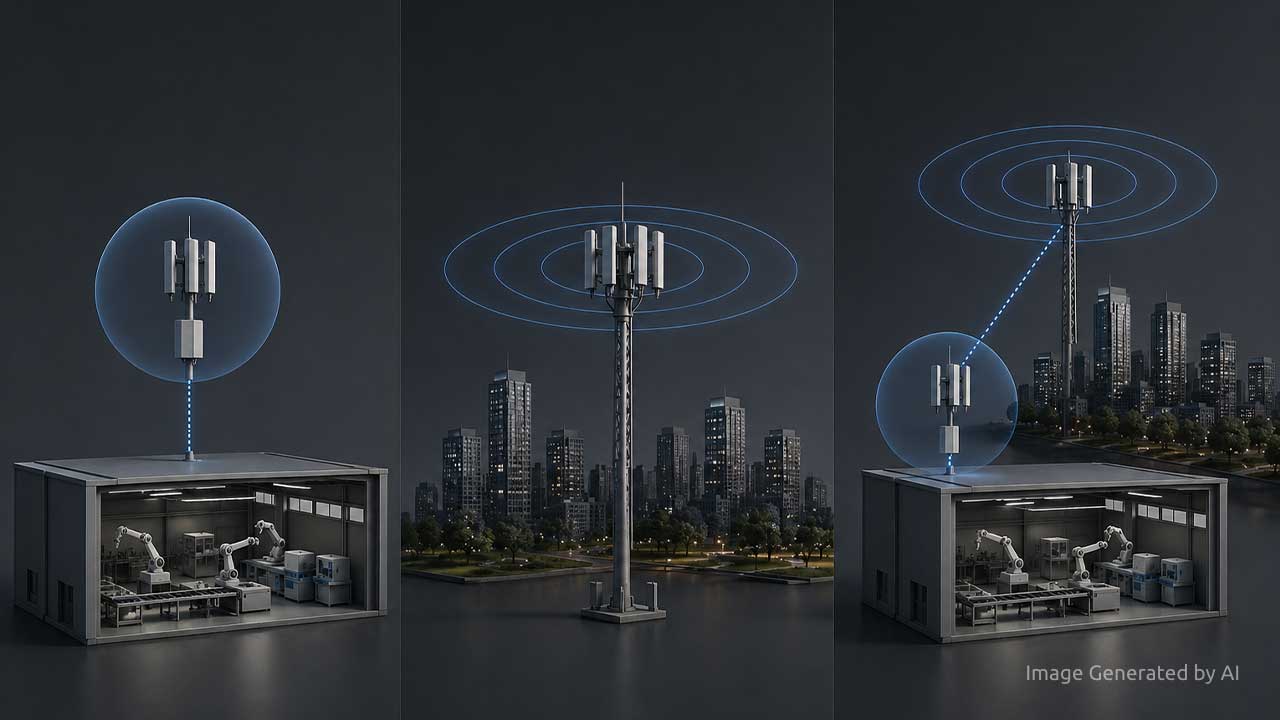
Choosing the right 5G network architecture is one of the most consequential connectivity decisions a manufacturer can make. Private 5G offers dedicated spectrum and ultra-low latency for mission-critical automation; public 5G provides broad coverage with minimal capital expenditure; and hybrid 5G combines both to balance performance, cost, and scalability. In this IIoT World guide, we compare these three deployment models across the dimensions that matter most for industrial operations: latency, reliability, data sovereignty, security, total cost of ownership, and integration with existing OT systems and edge AI workloads.
Manufacturers with large production sites face a connectivity question that did not exist five years ago: should AGVs, humanoid robots, tablets, and video cameras run on private 5G, public 5G, or a hybrid of both? This IIoT World article is based on a video interview recorded at Hannover Messe 2026. The answer depends on which devices need low latency, which data must stay on site, and how often the production layout changes. In an interview at Hannover Messe 2026, Sam Waes of Orange Business, a global integrator operating across 65 countries, explained how each option works in practice, what sovereign AI adds to the equation, and why one paper manufacturer used the combination to start selling energy back to the grid. This IIoT World article is based on a video interview recorded at Hannover Messe 2026 with Sam Waes (Head of Smart Industries Europe, Orange Business).
Three Types of 5G and When Each One Fits
Private 5G uses the same radio technology as the public 5G on consumer phones, but it runs on dedicated antennas installed at the factory site. The manufacturer owns the network and controls latency, coverage, and data routing. Public 5G relies on a carrier’s shared infrastructure with no direct control. Hybrid 5G combines both: time-critical operations run on the private network while non-critical traffic routes through the public carrier.
| Private 5G | Public 5G | Hybrid 5G | |
| Infrastructure | Dedicated antennas on factory site | Carrier network | Combined private + public |
| Network control | Full control by manufacturer | No direct control | Split by application priority |
| Latency | Ultra-low, configurable | Variable | Low on private path, variable on public |
| Devices served | AGVs, humanoids, tablets, video cameras | Phones, consumer devices | Both industrial and consumer |
| Data path | Stays on site | Routes through carrier | Sensitive data stays on site |
| Best for | Time-critical manufacturing applications | Employee browsing, non-critical traffic | Manufacturers that need both |
The distinction matters because factory devices are not phones. AGVs navigating a warehouse floor, humanoid robots on an assembly line, and video cameras running real-time quality detection all require industrial-grade connectivity with consistent low latency. Wi-Fi can handle office traffic, but it struggles to guarantee the reliability these devices demand across a large production facility.
Hybrid is where most manufacturers land in practice. Emergency calls and real-time AGV control stay on the private network. Employee browsing and non-production traffic go through the public carrier. The result is performance where it counts and cost savings where it does not.
How to Get Started Without a Full Deployment
One barrier to private 5G adoption is the perception that it requires a massive upfront investment across every facility. Orange Business and Nokia addressed this with a 5G starter pack: a single antenna, connected to the factory network, that lets manufacturers test applications before committing to a full rollout. The approach gets a factory from zero to a working private 5G network quickly, without the cost of deploying across all 50 or more locations at once.
Orange Business operates as a partner-agnostic integrator, working with multiple equipment vendors rather than locking customers into a single supplier. Nokia is one of their key 5G partners, but the integration spans from the device to the AI model. Their typical customers are multinational manufacturers in sectors including logistics, pharmaceutical, oil and gas, fast-moving consumer goods, and food and beverage, operating across dozens of countries.
A practical benefit that gets overlooked: private 5G eliminates the need to pull cables when rearranging production layouts. When competitive pressure demands faster line changeovers, equipment moves without rewiring the facility. For manufacturers evaluating how industrial AI generates measurable operational value, this physical agility compounds the gains from smarter connectivity.
Why Sovereign AI Matters Once the Network Is in Place
Once a manufacturer deploys private 5G and connects factory devices, the next question is what to do with the data those devices generate. Increasingly, the answer involves AI. But when employees start querying large language models with production data, recipes, or quality specifications, a new risk emerges: sensitive information leaking through public AI services.
Sovereign AI solves this by deploying LLMs on private or sovereign clouds within the company’s own infrastructure. Orange Business offers a solution called Live Intelligence that runs multiple models, including Claude, Mistral, and GPT, so employees can choose the right tool for the task. Every query and every response stays inside company walls. No production data routes through public servers.
The distinction is binary for manufacturers handling proprietary information. Either the data stays in your environment or it does not. If employees use public ChatGPT and upload a spreadsheet with production parameters, that data leaves the company’s control. Sovereign AI gives the same LLM capability without the exposure.
This is where private 5G and sovereign AI reinforce each other. Private 5G keeps device data on site. Sovereign AI keeps employee queries on site. Together, they create an environment where both the connectivity layer and the intelligence layer operate within the manufacturer’s perimeter, an approach that aligns with growing regulatory requirements for connected industrial devices.
When AI Changes the Business Model: A Paper Manufacturer Case Study
The combination of connectivity and AI can do more than optimize existing operations. One paper manufacturer that produces its own energy on site used AI-driven analysis to discover something unexpected: it was sometimes more profitable to produce energy for the grid than to continue running production.
Before AI, decisions about when to run production lines were based on manufacturing schedules. After deploying analytics, the company started optimizing the timing of production itself, when to produce, when to stop, and when to sell surplus energy back to the grid. The shift moved the company from a single-revenue manufacturer to a company that also operates as an energy trader.
This case shows what becomes possible when manufacturers combine real-time connectivity (private 5G providing the data flow) with AI analytics (processing that data for decisions that were previously invisible). The paper manufacturer did not just reduce costs. It found an entirely new revenue stream.
For manufacturers exploring industrial AI use cases across production and maintenance, this is a useful reminder that the highest-value AI applications sometimes change the business model rather than just improving the process.
5G connectivity is a key enabler of AIoT at scale, read about how AIoT is transforming manufacturing and energy operations.
This article is based on a video interview with Sam Waes, Head of Smart Industries Europe, B2B Enterprise Division at Orange Business, and Lucian Fogoros of IIoT World, recorded at Hannover Messe 2026. AI tools were used to help summarize and organize the content. Reviewed and edited by the IIoT World editorial team.
Watch the full interview on YouTube.
FAQ
1. What is the difference between private 5G and public 5G for manufacturing?
Private 5G uses the same radio technology as public 5G but runs on dedicated antennas installed at the factory site. The manufacturer owns the network and controls latency, coverage, and data routing. Public 5G relies on a carrier’s shared infrastructure with no direct control. Hybrid 5G combines both: time-critical operations run on the private network while non-critical traffic routes through the public carrier.
2. When should a manufacturer choose hybrid 5G over a fully private network?
Hybrid 5G is the right model when a manufacturer needs low-latency connectivity on the production floor served by a private network, but also requires connectivity for assets and operations that extend beyond the factory walls. Hybrid models keep sensitive OT data on-premises while routing less critical traffic through the public carrier.
3. How does 5G connectivity support Industrial IoT in smart factories?
The choice between private, public, and hybrid 5G depends on which devices need low latency, which data must stay on site, and how often the production layout changes. Private 5G eliminates wiring constraints while giving the manufacturer full control over the network. Sam Waes of Orange Business explained how each option works in practice and why one paper manufacturer used the combination to start selling energy back to the grid.
Related from IIoT World
About the author