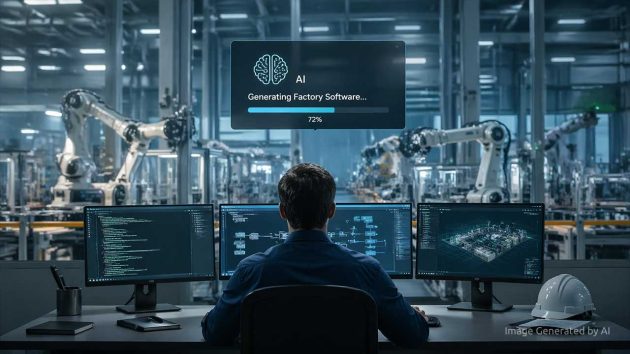
Someone responsible solely for operating a CNC machine or an extruder can now generate a production-ready application through a prompt. In this IIoT World interview recorded with Lucian Fogoros at Hannover Messe 2026, Peter Sorowka (CEO, Cybus) describes how enterprise manufacturers are already experimenting with this. At Hannover Messe 2026, Cybus CEO Peter Sorowka described enterprise manufacturers already experimenting with this: generating applications and bringing them into production within a single week. The expected result is a “tsunami” of AI-generated factory applications, because the cost of creating new software this way is so low that the traditional model of buying a standard system and customizing it over months begins to give way. Three months ago, the answer to every question about manufacturing software would have been different. That is how fast this shift is moving. For the broader ethical context behind industrial AI governance, read IIoT World’s analysis of AI ethics: the good, the bad, and the ugly.
How Did Operators Become Software Builders?
Manufacturing software progressed through three technology phases until any machine operator could generate production applications through a natural language prompt. First, systems that traditionally ran on the shop floor migrated to the cloud, giving IT teams faster deployments and fewer operational headaches. Second, the software became modular, shifting from large monolithic systems toward smaller specialized applications. The third phase, driven by AI capabilities, means anyone responsible for operating a machine can generate software through a prompt.
These first experiments are appearing in enterprise manufacturing companies, described as early signs with the full wave still ahead. The traditional manufacturing software model works on a two-step purchase: buy a standard package, then pay again to customize it. AI-generated software offers a path where applications are bespoke from day one. The same vendors who sell MES systems today could offer this as a service, but the front-end layer, dashboards and tablet interfaces, becomes modular. The lasting value shifts toward the work process, data handling, and back-end architecture.
What Does This Mean for Manufacturing Software Vendors?
Customers build features with AI faster than asking their vendor twice, flipping the make-versus-buy equation toward self-generation. When software vendors cannot deliver a feature quickly enough, customers generate it with AI tools rather than submitting a second request.
For the next three to five years, two parallel – competing and conflicting – speed tracks will coexist.
Track one: current Requests for Proposal from manufacturing companies are planned long-term and do not yet mention AI. Writing the tender takes a year. Selecting the vendor takes another year. Implementation fills the year after that. Manufacturing companies will continue buying MES systems the way they have for the past decade.
Track two moves at a different speed. The manufacturing software company’s value shifts toward end-to-end system and ecosystem integration, consulting, 24/7 support and delivering a performant, resilient software backbone. With an integration and governance layer customers can build their own applications and AI agents within hours, as they build on a stable, trusted foundation to run on. What they deploy on top becomes a decision they own and increase manufacturers innovation speed and independence significantly.
Such a full-service reliability layer is what remains difficult to replicate.
What Governance Does This Require?
Factory AI governance is the infrastructure foundation AI-generated applications run on. Controlling which applications reach production machines, validating outputs, and maintaining human override are safety issues with immediate consequences for people working alongside the equipment. The cost of generating new applications is so low, and the speed so high, that dozens of operators prompt-generating code creates a “tsunami” of AI-generated applications entering the production environment. The infrastructure underneath determines whether that tsunami delivers value or causes harm.
Cybus Connectware provides this foundation. It sits between the shop floor and the IT/AI layer, serving as the trust and control infrastructure that AI-generated applications rely on. The governance framework built into Connectware has three components: a structure establishing which AI-generated applications can interact with which machines, a trust layer validating outputs before they reach production, and the infrastructure itself through which the organization retains override capability.
AI’s ability to handle unstructured data reinforces why governance, rather than data preparation, is the primary challenge. A simple illustration: photograph a child’s handwritten homework, total chaos on the page, and ask an AI to explain it. No metadata, no schema required. The 90% of data science project effort that historically went to cleaning and preparation is diminishing as a barrier. The bottleneck shifted to controlling what AI-generated applications do once they reach physical equipment.
| Dimension | Before AI-Generated Software | With AI-Generated Software |
| Who builds applications | Vendor development teams | Any machine operator with prompt access |
| Time to production | Months to years (buy + customize) | One week (bespoke from day one) |
| Data preparation needed | 90% of project effort on cleaning | AI handles unstructured data directly |
| Primary risk | Inaccurate predictions | Physical safety (machine control) |
| Control mechanism | Procurement approval cycle | Infrastructure layer between shop floor and AI (governance built in) |
| Vendor value | Features | Integration, governance, technological neutrality, ecosystem |
| Pace of change | Stable (10-year procurement cycles) | Three months between paradigm shifts |
Cybus exhibits at Hannover Messe 2026 in Hall 15.
This article is based on a video interview with Peter Sorowka, CEO of Cybus, recorded with Lucian Fogoros of IIoT World at Hannover Messe 2026. AI tools were used to help summarize and organize the content. Reviewed and edited by the IIoT World editorial team.
Editorially independent. Sponsored by Cybus.
Related coverage:
Frequently Asked Questions
1. What is factory AI governance?
Factory AI governance is the infrastructure foundation AI-generated applications run on. Cybus Connectware provides this by sitting between the shop floor and the IT/AI layer, controlling which applications can interact with production equipment, validating outputs before deployment, and maintaining human override capability. This addresses the safety risks created when operators generate software through prompts that can directly control physical machines.
2. What replaced data cleaning as the primary barrier to manufacturing AI?
AI systems now interpret unstructured data, including free-text logs, handwritten notes, and unlabeled sensor streams, without requiring the structured preparation that historically consumed 90% of data science project effort. Cybus CEO Peter Sorowka describes this shift as having occurred within the past three months, making governance the new primary prerequisite.
3. How quickly can manufacturers build AI-generated software?
Enterprise manufacturing companies are experimenting with generating production-ready applications within a single week. The traditional model of buying standard software and customizing it takes months to years. AI-assisted code generation makes it inexpensive to produce bespoke applications, creating a “tsunami” of new factory applications.
4. What value do manufacturing software companies provide when AI writes the code?
When customers can generate features faster than asking a vendor twice, the value of manufacturing software companies shifts from source code to end-to-end system knowledge, ecosystem integration, consulting expertise, and 24/7 support. Future offerings center on AI agents with defined skill sets that customers can rely on as validated, supported systems.
About the author