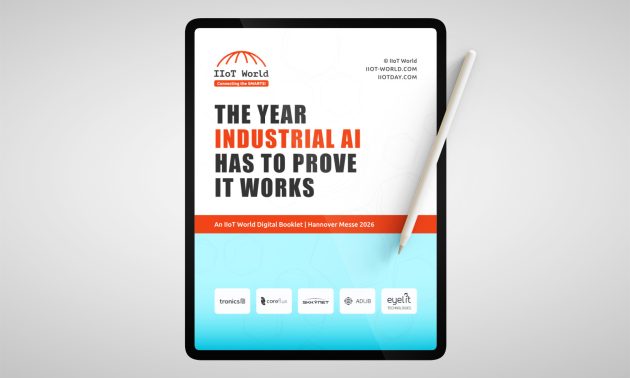
After years of pilot programs and proofs of concept, manufacturers want one thing from Industrial AI in 2026: proof that it works in production. Hannover Messe 2026 (April 20 to 24, Hannover, Germany) runs under the theme “Think Tech Forward.” Industrial AI and Physical AI sit at the center of this year’s program, and the organizers put it bluntly: “Out of theory. Into application.”
This IIoT World pre-event Hannover Messe 2026 booklet brings together five interviews with CEOs and CTOs who are building that proof across five different parts of the industrial stack. Each conversation was tailored to what the company builds and the specific factory problem it solves. Together, they cover MEMS vibration sensing, factory integration, OT cybersecurity, AI output validation, and production planning and execution.
What You Will Find Inside
Dr. Antoine Filipe, CTO, Tronics Microsystems (a TDK Group Company) on replacing 70-year-old analog piezoelectric vibration sensors with MEMS technology. The VIBO sensor produces digital-native data, connects directly to PLC field buses, and performs edge processing. A 2-month pilot path with sub-1-year ROI for predictive maintenance.
Hugo Vaz, CEO, Coreflux on an AI-native MQTT broker that replaces entire middleware stacks. Manufacturers define automations in LoT (Language of Things), a near-English syntax, and deploy integrations from templates in minutes. Member of the Open Industry 4.0 Alliance. Hall 14, Stand L66.
Gary Tillery, CEO, Skkynet Cloud Systems on securing OT data in transit using outbound-only architecture. Cogent DataHub keeps all inbound firewall ports closed across 30,000+ installations in 86 countries, used by ABB, Siemens, and Schneider Electric. A CA$2.6M government-funded initiative is extending this architecture specifically for AI workloads. Hall 27, Stand A12 (Canada Pavilion).
Chris Huff, CEO, Adlib Software on validating AI outputs before they reach operations. The Accuracy and Trust Layer compares results across multiple LLMs, assigns a TrustScore through voting algorithms, and reduces exception queues by 40 to 60%. Huff calls 2026 “make-or-break” for Industrial AI ROI.
Joe Bellini, CEO, Eyelit Technologies on unifying demand planning, production scheduling, and shop-floor execution on a single MES platform. AI-driven pattern matching tests demand adjustments against production schedules, even within frozen periods. Customers report 15% inventory reduction and 12% better capacity utilization. Hall 15, Stand C02.
Five companies, five different parts of the industrial stack, and a shared sense of urgency about making Industrial AI deliver in 2026. These conversations are meant to help manufacturers arrive at Hannover Messe with sharper questions and clearer criteria for evaluating the technologies on display.
Some of the companies featured in this booklet have a commercial relationship with IIoT World. All interviews were conducted and edited independently.
Frequently Asked Questions
1. What is the IIoT World Hannover Messe 2026 Digital Booklet?
The IIoT World pre-event Hannover Messe 2026 booklet is a collection of five CEO/CTO interviews covering Industrial AI and Physical AI solutions: MEMS vibration sensing for predictive maintenance (TDK Tronics), MQTT-based factory integration (Coreflux), OT cybersecurity with outbound-only architecture (Skkynet), AI output validation with TrustScores (Adlib Software), and MES-based production execution (Eyelit Technologies). Each interview includes deployment data and ROI timelines.
2. Which companies are at Hannover Messe 2026 in this booklet?
Four companies are exhibiting at Hannover Messe 2026: Tronics Microsystems, a TDK Group Company; Coreflux (Hall 14, Stand L66); Skkynet Cloud Systems (Hall 27, Stand A12, Canada Pavilion); and Eyelit Technologies (Hall 15, Stand C02).
3. What Industrial AI ROI data is in the booklet?
2-month pilot with sub-1-year ROI for predictive maintenance (Tronics), 40 to 60% fewer exception queues and 30 to 50% faster document cycle times (Adlib), 15% inventory reduction and 12% better capacity utilization (Eyelit), 268% subscription revenue growth in FY2025 (Skkynet), and factory integrations deployed in minutes from a template library (Coreflux).