
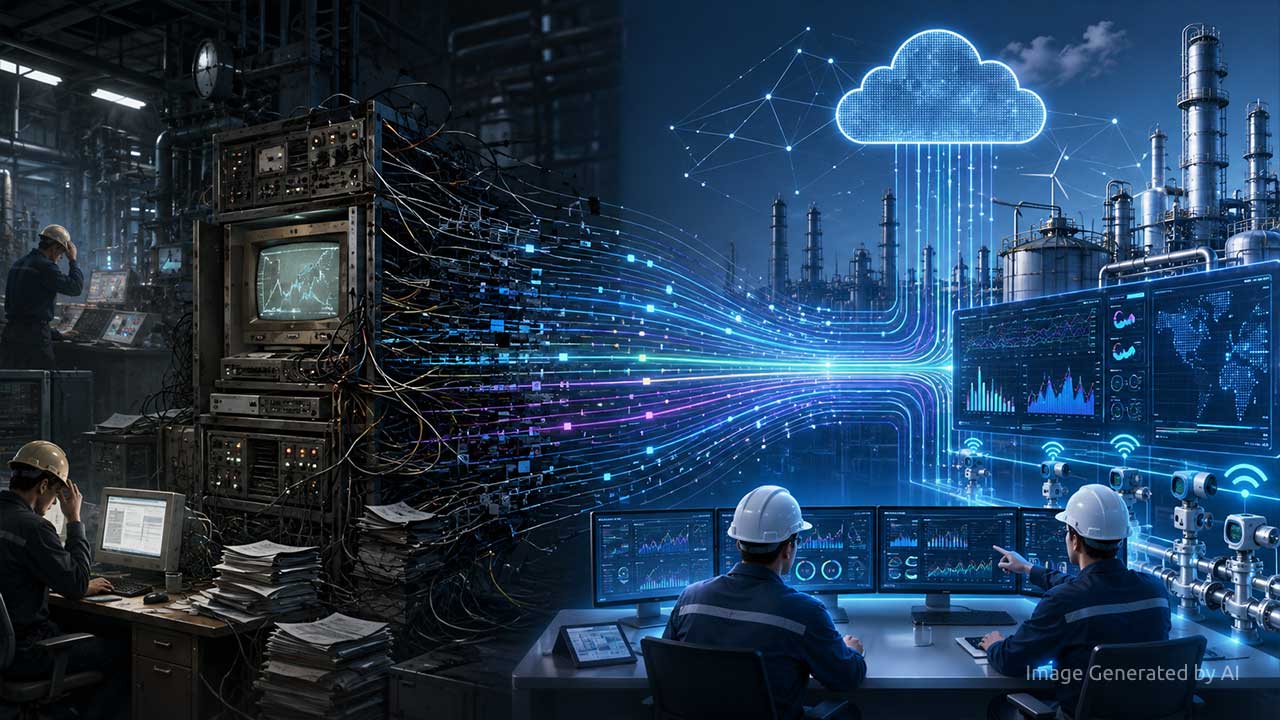
Historian renewal notices show up as a procurement line item, usually larger than the previous year, and most teams sign and move on. Ryan Nelson, Director of Product Marketing at InfluxData, explains that the renewal moment is worth using to ask whether the current architecture can carry what the business needs over the next three years.
Rising Costs, More Tags, Less Value
Per-tag pricing made sense when the historian was first deployed, but as instrumentation expands, the economics invert. AVEVA PI customers have seen pricing increase 20-40% over the last 18 months, creating a backward incentive: collect less data, sample less often, or pay more. Deprecated tags from decommissioned equipment, retired sensors, and replaced instrumentation still count toward the license, and the pricing model does not distinguish between a tag collecting at 1Hz and one that has been dark for two years.
Data Scientists Still Waiting for the Export
PI Vision and PI DataLink were not built for Python, pandas, or Databricks. Getting data out requires proprietary connectors, manual exports, or PI Web API integrations that take weeks to stand up, and by the time data reaches the ML pipeline, it is stale, downsampled, or stripped of context. Historians were built to store industrial tags mapped to an ISA-95 hierarchy, not to treat metadata as a first-class citizen alongside telemetry, so every export produces a one-dimensional analysis: what happened, not why.
New Workloads Getting Rejected
Cell-level battery energy storage monitoring at 1Hz runs into historian defaults of 5-15 minute polling intervals; vibration analysis on rotating equipment requires sub-second resolution; real-time anomaly detection needs data before the dashboard refresh cycle. Greenfield facilities are now being planned with cloud-connected infrastructure as the baseline assumption. When the answer to a business request becomes “the historian can’t do that at that frequency,” the workloads have outpaced the platform. Industry 4.0 use cases including predictive maintenance and asset warranty tracking need years of high-frequency stored data, not rolling windows with costs that compound against the data strategy.
The remaining three signs, plus the full breakdown of what to do before signing and how Terega cut their OSI PI costs while collecting 20 times more data, are in the full article on InfluxData.
Sponsored by InfluxData.
Frequently Asked Questions
1. When should a manufacturer consider modernizing rather than renewing a data historian?
When per-tag pricing has grown significantly without new capability, when data science teams cannot access plant data without weeks of proprietary integration work, or when historian limitations appear on the risk log of every digital transformation initiative. Ryan Nelson’s post for InfluxData identifies six specific signals worth evaluating before signing the next renewal contract.
2. Can InfluxDB be deployed without removing an existing historian?
Yes. Keeping the existing historian for legacy SCADA historization, GxP data, and established PI Vision workflows, while InfluxDB handles new workloads including high-frequency monitoring, ML pipelines, greenfield sites, and cross-site fleet analytics. Terega and SP Energy Networks both deployed this way. For complete replacements, InfluxDB pairs with Litmus Edge or Highbyte for industrial connectivity and asset modeling.
3. Why is per-tag historian pricing a problem for industrial AI workloads?
Per-tag pricing charges for every sensor tag, including deprecated ones from decommissioned equipment. AVEVA PI customers have seen pricing increase 20-40% over 18 months. As AI workloads require more sensors and higher sampling rates, costs scale against the data strategy, pushing teams to collect less data or sample less often, which is the opposite of what predictive maintenance and high-frequency monitoring require.