Servitization, the shift from selling equipment to delivering ongoing outcomes, is redefining manufacturing competition. Service contracts can deliver margins of 25% or more, compared to roughly 10% on new equipment sales. According to McKinsey, OEMs with strong service offerings achieve total shareholder return twice that of their peers.
Why Is Manufacturing Changing Now?
Manufacturing is changing because technology now rewrites customer expectations, competitive dynamics, and regulatory demands faster than most organizations can adapt. Cost and quality remain essential, but two companies producing equally good machines at similar prices will split on a single factor: which one can guarantee uptime, predict failures, and continuously improve performance.
Technology is rewriting the rules of manufacturing faster than organizational structures, supply chains, and budgets can adapt. Every wave of innovation changes what customers expect, how rivals compete, and what regulators demand. Yet it also opens new doors for those who can adapt first.
The old levers of cost and quality are still essential, but they no longer guarantee leadership. Two companies can produce equally good machines at similar prices, but the one that guarantees uptime, predicts failures before they happen, and continuously improves performance will win the next contract — and the one after that.
Today’s advantage comes from understanding where technology truly pays back, which signals to trust, and how to turn one successful project into a repeatable system that scales across products, plants, and markets.
What Is the New Competitive Edge?
The new competitive edge in manufacturing is the ability to stand behind performance, manage risk across the product lifecycle, and learn from field data faster than rivals. Buyers now evaluate suppliers on uptime guarantees, lifecycle cost control, supply resilience, verified sustainability, and speed of incremental improvement, not on purchase price alone.
The manufacturing business model has undergone a fundamental shift. Customers no longer want to simply buy equipment — they want outcomes. They expect predictable uptime, stable costs, and measurable value long after delivery.
Meanwhile, manufacturers face pressure on all sides: tougher SLAs, environmental targets, supply disruptions, and global competition that punishes inefficiency. Success now depends on new differentiators:
- Reliability is part of the offer. Performance in the field is the new benchmark. Manufacturers are expected to guarantee uptime and deliver rapid resolution when issues occur.
- Lifecycle cost and risk control. Buyers look beyond purchase price, valuing partners who can minimize cost-to-serve and warranty leakage over time.
- Operational resilience. Disruptions are no longer rare. Companies that can quickly adapt their supply and service networks maintain customer trust when others falter.
- Verified sustainability and compliance. Environmental and security claims must now be proven, not assumed. Traceability, data integrity, and audit readiness are part of the brand.
- Adaptation speed. Fast, incremental improvement — using real data from the field — separates the leaders from those who rely on annual planning cycles.
At the core of these shifts is a new definition of value: standing behind performance, managing risk throughout the lifecycle, and learning faster than competitors.
What Is Servitization in Manufacturing?
Servitization is the shift from selling equipment to delivering ongoing outcomes, where each product becomes the start of a relationship rather than the end of a sale. Service contracts bundle uptime, maintenance, and performance guarantees. According to McKinsey, OEMs with strong service offerings achieve total shareholder return twice that of their peers, with service margins of 25% or more versus roughly 10% on new equipment.
One of the most profound transformations reshaping manufacturing is servitization—the shift from selling equipment to delivering ongoing outcomes.
This approach treats each product not as the end of a sale but as the start of a relationship. Contracts increasingly bundle uptime, maintenance, and performance guarantees. The reward is clear: while new equipment sales typically carry margins of around 10%, service contracts can deliver margins of 25% or more. McKinsey reports that OEMs with strong service offerings achieve a total shareholder return twice that of their peers.
Servitization offers tangible strategic advantages:
- Recurring, predictable revenue that smooths cash flow and reduces dependency on volatile sales cycles.
- Stronger customer retention, as long-term service contracts make relationships deeper and harder to replace.
- Higher operational efficiency, driven by proactive maintenance and real-time monitoring.
- Sharper differentiation, as demonstrated by proven performance under contract, builds trust and provides margin protection.
But this shift also changes what manufacturers bring to market. The product is no longer a standalone machine; it is a connected platform that continually evolves.
How Do Connected Products Support Servitization?
Connected products support servitization by streaming operational data to the cloud so manufacturers can monitor performance in real time, predict maintenance needs, and deliver remote updates. In this model, value resides in the data loop between the customer, the product, and the service team. Each connected device functions as both a feedback channel and a recurring revenue stream.
Connected products lie at the heart of this evolution. Machines that stream operational data to the cloud enable manufacturers to monitor performance in real-time, predict maintenance needs, deliver remote updates, and continuously improve.
In this model, value is not locked in the hardware but in the data loop between the customer, product, and service team. Each connected device becomes both a feedback channel and a revenue stream.
Most manufacturers take a phased approach. They start with one product line where the service-based model has clear potential, prove it in partnership with customers, and scale from there. As connected systems expand across the portfolio, they establish a foundation for recurring revenue and more in-depth, data-driven customer relationships.
How Does AI Improve Manufacturing Operations?
AI improves manufacturing operations by increasing daily reliability, quality, and production speed rather than replacing workers with robots. Predictive maintenance can cut unplanned downtime by 10 to 20% and reduce maintenance costs by up to 15%. AI-driven inspection can lower defect rates by up to 30%. ASML and General Electric have each reported measurable results from applying AI to machine and turbine data.
Artificial intelligence often sits at the top of every innovation agenda — and for good reason. In manufacturing, AI isn’t about futuristic automation; it’s about improving daily reliability, quality, and speed.
AI is transforming maintenance, quality control, and production planning. Predictive maintenance can cut unplanned downtime by 10–20% and reduce maintenance costs by up to 15%. AI-driven inspection can lower defect rates by up to 30%.
Leading companies are already realizing measurable results. ASML used AI to analyze photolithography machine data, achieving a tenfold performance boost and a 40% reduction in time-to-market within six months. General Electric applied AI to turbine data, cutting downtime by 30% and maintenance costs by 15%.
When done right, AI becomes a profit lever. It predicts failures, identifies bottlenecks, automates repetitive tasks, and improves resource efficiency across plants. But success depends on the ecosystem around it: unified data, clear governance, and disciplined scaling.
Organizations that treat AI as both an infrastructure and a capability — investing in master data management, setting use-case frameworks, and integrating insights into operations — are the ones turning pilots into everyday practice.
From Smart Factories to Smarter Businesses
The smart factory concept extends this logic further. It’s not about isolated automation but connected collaboration between humans and machines.
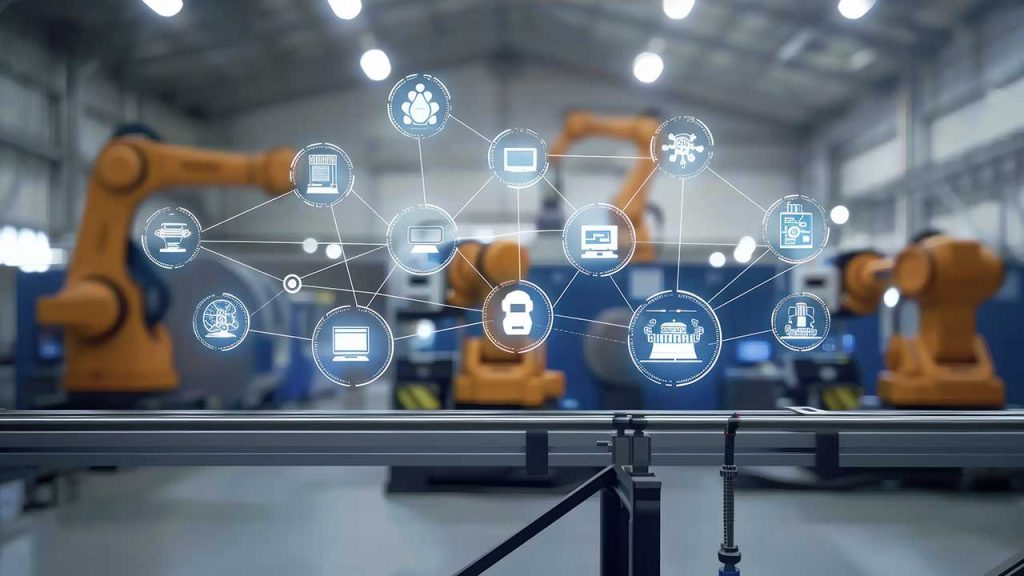
Sensors capture live data from production lines and feed it into ERP, MES, and SCADA systems. AI tools analyze the data in real time, generating insights and alerts for workers to act upon. This closed loop allows teams to spot issues early, optimize workflows, and continuously refine operations.
When implemented strategically, smart factories don’t just lower costs — they make the entire organization faster, more flexible, and more resilient.
Yet success depends on organizational readiness. Many companies fall into “pilot purgatory,” where prototypes never scale because they fail to align with existing business processes. The solution often lies in partnerships with technology experts who understand both manufacturing operations and enterprise-scale deployment.
The next phase of industrial leadership will belong to companies that combine these capabilities — connected products, AI-powered operations, and smart factories — into a cohesive system. But as manufacturers become more data-driven, one more ingredient becomes essential: trust. And that’s where the next transformation begins.
About the author
 This article was written by Natalya Zheltukhina, Partner Network Manager at Sigma Software Group, DACH Region. Natalya is responsible for growing Sigma Software Group’s business on the DACH market, with a dedicated focus on the Automotive, Logistics, and Industrial Manufacturing Sectors.
FAQ
1. What is servitization in manufacturing?
Servitization is the shift from selling equipment to delivering ongoing outcomes. Instead of a one-time transaction, manufacturers bundle uptime guarantees, maintenance, and performance contracts with their products. According to McKinsey, OEMs with strong service offerings achieve total shareholder return twice that of peers, and service contracts can carry margins of 25% or more compared to roughly 10% on equipment sales.
2. How does AI reduce unplanned downtime in manufacturing?
AI reduces unplanned downtime through predictive maintenance, which analyzes machine data to flag failures before they occur. The article cites a reduction in unplanned downtime of 10 to 20% and maintenance cost reductions of up to 15%. General Electric applied AI to turbine data and cut downtime by 30% while reducing maintenance costs by 15%. AI-driven quality inspection can also lower defect rates by up to 30%.
3. How do service contract margins compare to equipment sale margins?
Service contracts deliver significantly higher margins than equipment sales. New equipment sales typically carry margins of around 10%, while service contracts can deliver margins of 25% or more. This margin gap is a primary reason manufacturers are shifting toward servitization: recurring, predictable revenue from service agreements smooths cash flow and reduces dependency on volatile equipment sales cycles.
4. What results did ASML achieve by applying AI to manufacturing data?
ASML applied AI to analyze photolithography machine data and achieved a tenfold performance boost alongside a 40% reduction in time-to-market within six months. This example illustrates how AI functions as a measurable operational tool in manufacturing, improving output speed and machine performance when supported by unified data, clear governance, and disciplined scaling practices.
Related Reading
How to Scale AI in Manufacturing
Why Predictive Maintenance Programs Stall After the First Win