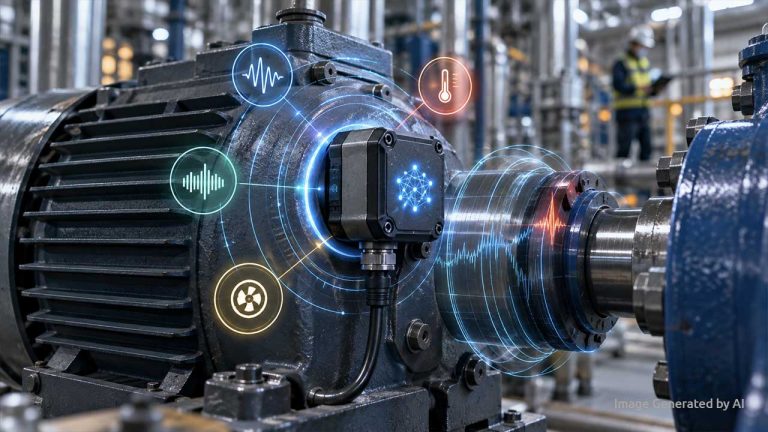
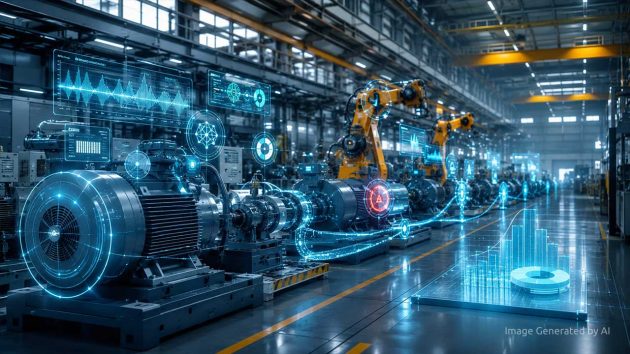
Predictive maintenance (PdM) delivers measurable returns, but building a credible ROI case requires more than vendor estimates. IIoT World created this executive guide to help plant leaders, operations directors, and CFOs quantify the financial impact of condition-based monitoring programs. From avoided downtime costs and spare parts optimization to labor efficiency and insurance premium reductions, this framework covers every line item that belongs in a PdM business case. Whether you are justifying a pilot or scaling an enterprise rollout, the methodology below translates sensor data into boardroom language.
To respond, leaders are turning to artificial intelligence. The path to a smart factory, however, requires more than installing new sensors. To achieve industrial AI use cases with measurable ROI, manufacturers must shift how they interact with their data, their legacy equipment, and their frontline workforce.
Why Prediction Alone Falls Short
Historically, the manufacturing sector relied on reactive or scheduled maintenance. The introduction of basic predictive maintenance was a step forward, but industry leaders at IIoT World’s AI Manufacturing Day 2026 warned that prediction alone does not deliver business outcomes. Knowing a machine might fail does not guarantee that anyone acts in time or in the right way.
The real value is realized when AI shifts from predictive to prescriptive. A mature AI system does more than trigger a dashboard alert. It provides a precise prescription: what is wrong, exactly what actions need to be taken, and a clear timeline. By providing explainable, evidence-based recommendations, AI stops being a “black box” and becomes an expert system that guides operators toward immediate corrective actions.
Karthikeyan Natarajan, Co-CEO of Infinite Uptime, described this shift during the panel: prescriptive AI must tell the operator which bearing is degrading, which failure mode is developing, and what to do about it before the next shift ends.
How Much Does Predictive Maintenance Save Manufacturers?
When evaluating the bottom line, executives need to examine the delta between planned and unplanned downtime. Any mechanical rotating equipment will eventually fail depending on operating conditions, but intervening during a planned shutdown versus suffering an unexpected catastrophic failure is where the financial return is generated.
The financial metrics from scaled deployments are significant:
- Rapid payback: Successful prescriptive AI deployments are guaranteeing a complete return on investment in 3 to 6 months.
- Massive downtime reductions: Facilities transitioning to AI-driven maintenance report a 90% to 95% reduction in unplanned downtime.
- Enterprise scaling: An initial proof of value typically takes 6 to 8 weeks to demonstrate results. From there, organizations are scaling up to over 10,000 monitoring points in a single plant within 6 to 12 months, and achieving multi-site enterprise ROI in 12 to 18 months.
These outcomes save direct maintenance resource costs, reduce spare part inventory requirements, and protect overall production capacity.
How Does AI Reduce Unplanned Downtime in Manufacturing?
The secret to eliminating unexpected equipment failure lies in establishing what panelists called the “99% trust loop.” If an AI system hallucinates, produces high rates of false positives, or makes recommendations that cannot be acted upon, the workforce will quickly lose faith and ignore the system.
How does AI reduce unplanned downtime sustainably? It requires achieving 98% to 99% accuracy in its prescriptions. To reach this, the AI must rely on “human-in-the-loop” verification, combining physics-based engineering with explainable AI.
Alec Glenn, VP of Reliability at JSW Steel USA, explained what this looks like in practice: when an operator can look at an AI platform and transparently audit its history, seeing the true positives, false positives, and the exact reasons behind a recommendation, they trust the technology enough to act. When operators validate warnings ahead of time and intervene, it builds immense credibility for the system and permanently prevents the downtime event.
How to Implement Predictive Maintenance in a Factory Without Replacing Existing Equipment
A major concern for executives is the fear of disrupting current operations or abandoning legacy equipment. Manufacturers have made significant CAPEX investments over the last decade across their IT and OT environments, and protecting those investments is critical.
Successful industrial AI solutions today operate on a flexible OPEX model and are entirely sensor-agnostic. They ingest process data across highly heterogeneous equipment vintages and multi-vendor ecosystems without requiring a “rip and replace” of existing hardware.
Rajneesh Ojha, Fibers Global MTC Lead Digital at Indorama Ventures, described deploying prescriptive AI directly into brownfield facilities by pulling in contextual data: process conditions, operator actions, maintenance history, and plant-specific constraints. The system works with what the plant already has, without introducing cybersecurity threats or disrupting daily operations.
Change Management on the Shop Floor
The success of prescriptive AI depends on the people using it. The technology must bridge the gap between AI algorithms and operators who have 20-plus years of domain experience dealing with dynamic, real-world plant situations.
Scaling AI requires strong governance backed by disciplined change management. Workflows that were done manually for decades may need to be entirely redesigned to take advantage of the AI’s capabilities. Forced protocols generate resistance. If operators feel a system is being imposed by people who do not understand the floor, adoption fails.
When the AI acts as an expert knowledge base that captures retiring tribal knowledge and makes the operator’s daily job easier, adoption scales exponentially. The panel emphasized this repeatedly: the goal is not lights-out manufacturing overnight. It is a journey from reactive to predictive to prescriptive to semi-autonomous, and each step requires the operators to lead the transition.
FAQ Section
1. Why does prediction alone fall short of delivering predictive maintenance ROI?
Knowing a machine might fail does not guarantee that anyone acts in time or in the right way. Industry leaders at IIoT World’s AI Manufacturing Day 2026 warned that real value is realized when AI shifts from predictive to prescriptive , providing a precise prescription of what is wrong, exactly what actions need to be taken, and a clear timeline, rather than simply triggering a dashboard alert.
2. What is prescriptive AI in the context of predictive maintenance?
A mature prescriptive AI system does more than trigger a dashboard alert. It provides explainable, evidence-based recommendations that guide operators toward immediate corrective actions. Karthikeyan Natarajan, Co-CEO of Infinite Uptime, described this as AI that tells the operator which bearing is degrading, which failure mode is developing, and what to do about it before the next shift ends.
3. What must manufacturers do before deploying AI for predictive maintenance?
Manufacturers must shift how they interact with their data, their legacy equipment, and their frontline workforce. The path to measurable ROI requires addressing data infrastructure and OT/IT integration before layering AI on top, rather than simply installing new sensors.