Gil Silva, Partnership, Learning & Development Manager at Coreflux, walked through a live demo at Hannover Messe 2026 where a Raspberry Pi running the company’s Language of Things processed factory data, managed energy systems, and communicated with machines in real time. The Porto-based startup has built a system that lets someone automate a factory floor in plain English instead of code, and it runs on hardware that costs $35.
How Does Plain English Replace Factory Programming?
Coreflux built Language of Things (LoT), a language where operators and engineers write what they want the system to do in plain English rather than in a proprietary programming syntax. When a manufacturing team adopts a new technology that requires a specific programming structure, the learning curve extends the time to deployment. A plain language interface compresses that timeline because anyone who can describe an outcome can operate the system.
The approach works in two directions. AI understands plain English well and also knows programming languages, so when Coreflux fits these two worlds together, the platform brings people from IT departments and from outside technical roles into factory systems who would otherwise need months of training on vendor-specific code. The difference comes down to a single comparison: saying “turn the lights on” versus programming it.
What Can a $35 Raspberry Pi Do for a Small Manufacturer?
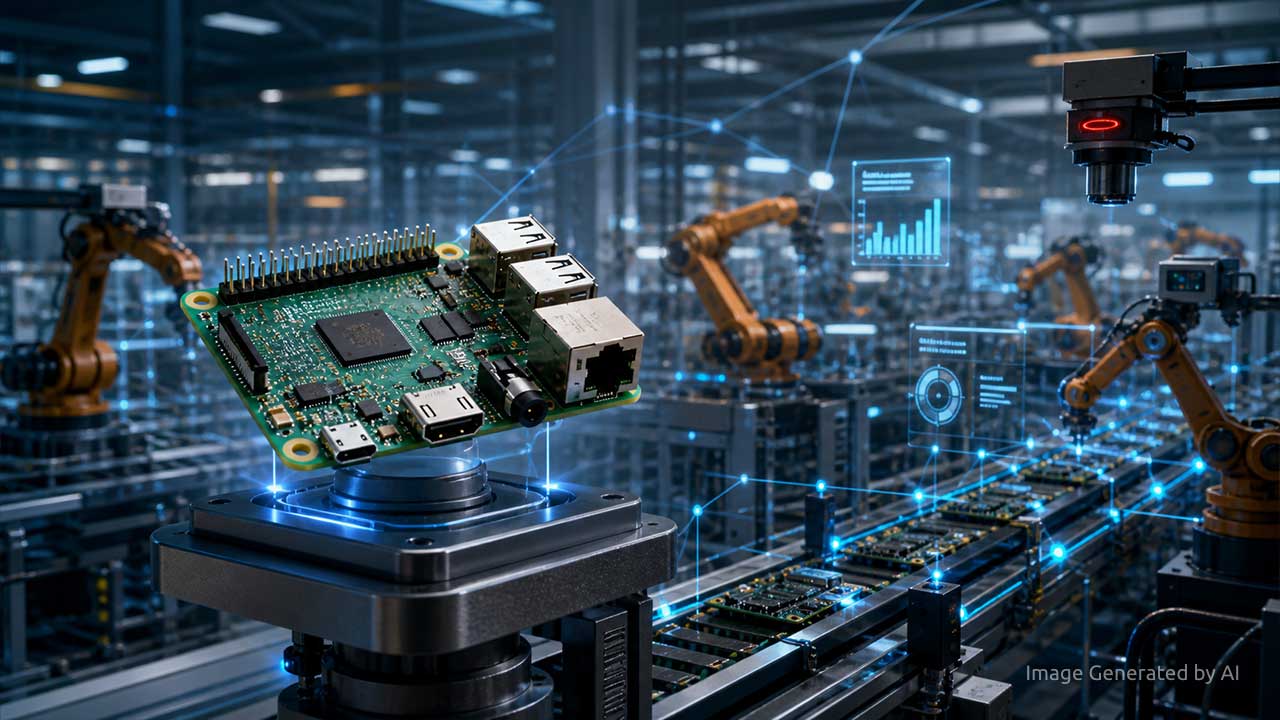
A $35 Raspberry Pi running Coreflux and Language of Things provides PLC-like features including models, actions, and data routes without requiring industrial-grade hardware. Paired with IO-Link devices for low-cost sensorization, this becomes the first layer of digital transformation for manufacturers who have no IT budget.
The target is the company where the CEO may also serve as the CTO, where there is no dedicated engineering team, and where digital transformation has meant something that takes too much time, too much effort, and too many resources. A Raspberry Pi with Coreflux and a few IO-Link sensors gives that company a working proof of concept. From there, the system scales to bigger hardware and integration with larger PLC environments. Coreflux was built inside industrial IoT from its founding, and the features it ships reflect specific shop floor needs rather than generic capabilities.
What Happens When AI Talks Directly to Factory Machines?
Coreflux connects AI directly to factory equipment rather than limiting it to chatbots. CEO Hugo Vaz had this vision when he first assembled the team in 2017: machines talking to other machines, and eventually machines programming themselves. When the first large language models arrived five or six years later, the team recognized that the technology had caught up to the ambition. Connecting LLM services with the Coreflux broker, which already supports AI agents that interact directly with factory equipment, opened what the team describes as a new world.
At the Hannover Messe 2026 demo, visitors could ask a machine to reprogram itself, acquire exactly the data a manager needs rather than what an integrator assumed they needed, and generate real-time dashboards almost instantly. Deployment times shrank because anyone could build what previously required specialized engineering. The company started as a protocol translator and decoder for legacy machines. Today it reduces cloud costs, supports faster deployment across sites, and has expanded into energy management, education, and mining alongside its manufacturing base.
Why Did Coreflux Build an AI Academy?
Coreflux launched its own academy that incorporates AI tools into the curriculum. The program targets professionals who need to reskill as automation reshapes their roles, not just students entering the workforce for the first time. The company’s position is that the organizations building these systems carry a responsibility to the people who use them, and that means investing in lifelong learning rather than leaving workers to navigate the transition alone.
| Traditional approach | Coreflux + LoT | |
| Language | Vendor-specific PLC code | Plain English |
| Minimum hardware | Industrial PLC | Raspberry Pi ($35) |
| Who can deploy | Programmers, integrators | Anyone who writes English |
| Sensorization | Proprietary sensors | IO-Link (low cost) |
| AI deployment | Weeks of integration | Described in plain language |
Based on a video interview with Gil Silva, Partnership, Learning & Development Manager at Coreflux, recorded by Lucian Fogoros of IIoT World at Hannover Messe 2026.
Editorially independent. Coreflux is an IIoT World client.
Frequently Asked Questions
1. What is Coreflux?
Coreflux is an industrial IoT startup from Porto, Portugal, founded by CEO Hugo Vaz. The company builds an MQTT broker with a built-in domain-specific language called Language of Things (LoT) that allows factory automation through plain English commands. The platform runs on hardware as small as a $35 Raspberry Pi and scales to enterprise deployments.
2. What is Language of Things (LoT)?
Language of Things is a domain-specific language created by Coreflux that runs on its MQTT broker. Users define actions, models, and data routes using plain English rather than vendor-specific programming code, reducing the time and expertise needed to deploy industrial automation.
3. Can Coreflux run on a Raspberry Pi?
Yes. Coreflux runs on a $35 Raspberry Pi, providing PLC-like features including data acquisition models, actions, and routes to external systems. Combined with low-cost IO-Link sensors, this creates an entry point for small manufacturers who need to digitize operations without a dedicated IT budget.
4. What is the Coreflux Academy?
The Coreflux Academy is a training program that incorporates AI tools to help professionals reskill as automation changes their roles. The program targets career changers in addition to students, supporting lifelong learning across the Coreflux ecosystem.
How does AI simplify factory automation for small manufacturers?
Coreflux combines plain English commands through Language of Things with a $35 Raspberry Pi and low-cost IO-Link sensors, giving small manufacturers PLC-like automation features without vendor-specific programming, dedicated IT staff, or industrial-grade hardware. The system scales from a single proof of concept to integration with larger PLC environments.
About the author