Manufacturers pay ransomware demands at a relatively high rate, making production environments a persistent target for cybercriminals. During a panel at IIoT World’s Manufacturing Day 2025, Rod Locke of Fortinet, Carlos Buenano of Armis, and cybersecurity practitioners Mike Ehlers (then at Olin) and Steven Beasley of Olin explained how the pressure to resume production drives payment decisions, why OT security ownership is shifting from plant managers to CISOs, and what practical steps manufacturers can take to reduce their exposure without disrupting operations.
Why Do Manufacturers Pay Ransomware More Often?
FortiGuard Labs, Fortinet’s threat intelligence arm, regularly tracks cybercrime activity globally and has found that the rate at which manufacturers pay to restore operations remains relatively high. Production downtime creates pressure that attackers exploit, and the need to get operations back online drives payment decisions. The economics make manufacturing a repeat target, and the question of who inside the organization owns the response has changed in recent years.
Manufacturing remains a specific focus area for FortiGuard Labs’ research precisely because of the payment pattern. When a ransomware attack halts a production line, the financial pressure to pay and restore starts immediately. The panel explored how organizations can address this vulnerability through network segmentation, asset visibility, structured security frameworks, and operational partnerships between IT and OT teams.
How Is OT Security Ownership Changing in Manufacturing?
Fortinet’s annual survey of OT cybersecurity practitioners shows a consistent trend: responsibility for OT security has migrated from plant managers and operational leaders toward the CISO and the executive suite. A live poll during the session showed the same pattern, with the majority of attendees reporting that OT cybersecurity strategy now sits with the CISO.
Plant staff focus on keeping equipment running and product shipping. Cybersecurity strategy, standards development, and vendor coordination require a different skill set and organizational position. A CISO can advocate for OT security funding at the executive level, present risk in business terms, and coordinate across multiple sites.
Shifting ownership to the CISO does not remove the need for partnership with plant teams. OT staff understand equipment constraints, maintenance windows, and process dependencies that the cybersecurity team cannot replicate on its own. The model that works, according to the panel, places strategy with the security organization and execution through collaboration with OT personnel.
| Aspect | OT-Led Model | CISO-Led Model |
| Strategy ownership | Plant manager or operations leader | CISO with executive reporting |
| Funding mechanism | Site-level budgets, often competing with production | Enterprise security budget with board visibility |
| Standards development | Ad hoc, varies by site | Centralized framework applied across facilities |
| Vendor coordination | Individual site relationships | Consolidated vendor management |
| Risk reporting | Operational language, stays at plant level | Business risk language, reaches executive suite |
| Cross-site consistency | Low; each facility develops its own approach | High; single framework adapted per site |
What Cultural Barriers Block OT Cybersecurity Programs?
OT teams have built and maintained production environments for decades, often from the ground up. Introducing IT-originated security controls into that environment requires more than technical competence. IT security teams that approach OT staff with mandates meet resistance, while those that lead with partnership gain traction.
The most effective starting point, according to the panel, is finding a change agent on the OT side who understands both the operational constraints and the security objectives, and positioning that person as a liaison for building an OT security program.
Framing cybersecurity as a safety issue also proved effective. OT teams already understand safety as the highest operational priority. A threat actor inside the control network poses risks comparable to a valve failure or chemical release. When the security conversation shifts to operational safety language, OT teams engage. Terminology creates an additional barrier: OT staff work with vendors like Emerson, Siemens, Yokogawa, and Honeywell on systems most IT teams have never configured.
How Can Security Teams Offer OT Operational Value?
The panel recommended providing OT teams with tools that improve their daily work alongside security posture. A security tool that also delivers an up-to-date device inventory, automatic CMDB updates, obsolescence tracking, and IP address management gives OT teams immediate practical value.
The panel described a common scenario in manufacturing plants: IP address tracking maintained on spreadsheets that fall out of date when one engineer installs a device and forgets to record the address. The next engineer discovers the conflict during commissioning. A visibility tool that identifies every device on the network, tracks installation dates, and records IP allocations solves an operational pain point while simultaneously establishing the asset inventory needed for vulnerability management.
Process integrity monitoring offers another operational benefit. Tracking when someone makes changes to PLC configurations serves both the security team and the operations team. For the security team, that means change detection and an audit trail; for operations, it means configuration management and troubleshooting data. Tools and cultural buy-in create the conditions for security, but the technical foundation starts with how the network itself is structured.
Why Is the Purdue Model the Starting Point for OT Security?
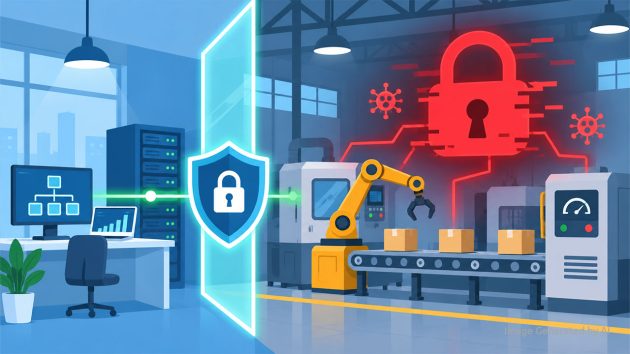
Every panelist named network segmentation through the Purdue model as the most important security control for manufacturing environments. The Purdue model separates the OT production network from the IT business network across multiple levels, preventing threats on the business side from reaching production systems.
One rule underpins the entire model: the business network should never initiate connections into the OT network. Data flows from the higher-security production environment to the lower-security business network, never the reverse. Allowing the business network to initiate connections into OT opens pathways for ransomware and unauthorized access to reach production systems.
Most ransomware and virus infections enter through email. Keeping email access off the machines that program PLCs is a high-impact step that segmentation achieves. An operator should not be checking email from the same workstation used to program industrial controllers.
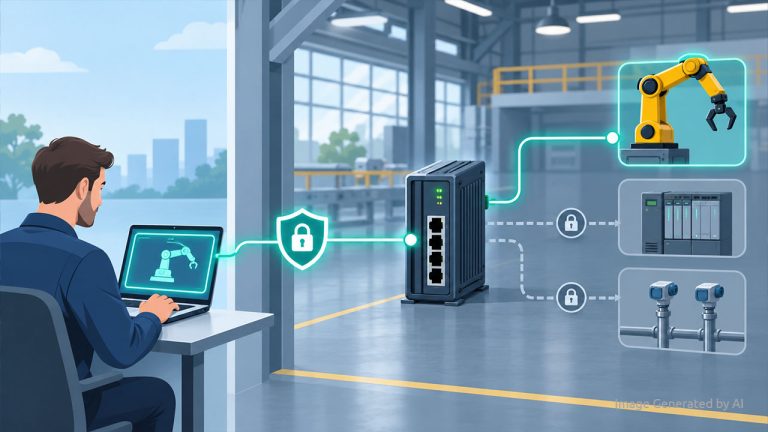
For remote access, the recommended approach uses layered authentication: VPN entry at the perimeter with two-factor authentication, followed by a second set of two-factor authentication at the ICS or OT cluster of firewalls separating the business network from production. Segmentation controls traffic flow, but the devices inside those segments still run software with known vulnerabilities that cannot always be patched on IT timelines.
What Happens When OT Systems Cannot Be Patched for Years?
IT environments follow patching cycles of 30, 60, or 90 days based on vulnerability severity. OT environments often cannot patch until a scheduled maintenance shutdown, sometimes three years apart. The panel described this timing mismatch as a key difference between IT and OT security management.
When a patch exists but the system cannot accept it for three years, the organization must document a security exception. The panel drew a distinction between an exception and an acceptance. An acceptance implies the issue has been addressed and closed. An exception acknowledges the risk, documents the justification, sets a review date, and creates a recurring reminder to revisit the vulnerability at the next maintenance window.
Documentation protects both the organization and the individuals who approved the exception. If a security incident exploits a known but unpatched vulnerability, the question will be why the risk was accepted without remediation. A documented exception with business justification, compensating controls such as increased monitoring or network isolation of the affected system, and a scheduled review date demonstrates that the business understood and owned the risk. Managing these exceptions at scale across dozens of facilities requires a structured program, and the panel referenced several frameworks designed for that purpose.
Which Frameworks Guide OT Cybersecurity Program Design?
On the IT side, NIST Cybersecurity Framework with CIS Controls provides a widely adopted structure. For OT-specific guidance, the session recommended NISTIR 8183 as a starting point and NIST SP 800-82 for more detailed implementation guidance.
One panelist described implementing a security program across an energy company with 60,000 devices and 20 facilities. The framework guided how to separate wells from gas plants, water treatment facilities, and vendor access so Rockwell, Siemens, Yokogawa, and Honeywell technicians each reached only the systems they needed.
The panel advised manufacturers to select a framework, follow its structure, and mature into its requirements over time. The Armis-Fortinet integration was cited as an example of how vendor partnerships make the transition to security policies easier.
“I can’t protect what I can’t see,” said Steven Beasley, then Manager of OT Cybersecurity at Olin (now Manager of Cybersecurity Engineering and Operations). Asset visibility and inventory come next after segmentation, because prioritizing vulnerability remediation requires knowing which assets exist on the network and what their criticality is.
This article is based on a panel discussion at IIoT World’s Manufacturing Day 2025, featuring Rod Locke of Fortinet, Carlos Buenano of Armis, Mike Ehlers (then at Olin) and Steven Beasley of Olin, moderated by Lucian Fogoros of IIoT World. The session was sponsored by Fortinet. AI tools were used to help summarize and organize the content. Reviewed and edited by the IIoT World editorial team.
Related from IIoT World
- AI Ransomware Hits Manufacturing Hardest
- OT Cybersecurity for Manufacturers: 2026 Guide
- Defensible OT Architecture for AI-Connected Manufacturing
- Expert Insights on ICS Cybersecurity
- 89% More Breaches: How Manufacturers Are Fighting Back
Additional Sources
- NISTIR 8183: Cybersecurity Framework Manufacturing Profile — NIST, 2017
- NIST SP 800-82 Rev. 3: Guide to OT Security — NIST, 2023
- Fortinet 2025 State of OT Cybersecurity Report — Fortinet/FortiGuard Labs, 2025