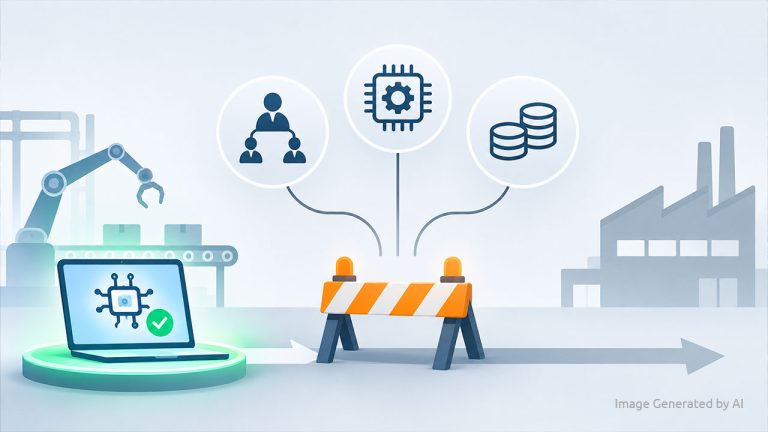
A bearing signature in an industrial compressor can predict failure within milliseconds, but only if the AI processing it sits at the edge. Sending that signal to the cloud introduces a round trip that safety-critical equipment cannot afford. Gaspard Duthilleul of Galyos, Sanjay Mahato of Amazon Web Services, Ian Clark of InfluxData, and Tauseef Ahmed of Grayhawk Consulting Group discussed the decision framework at the Industrial AI Summit 2026: where intelligence should run, what autonomous systems must prove before they act, and why physical AI creates new cybersecurity risks.
When Should AI Process Data at the Edge vs the Cloud?
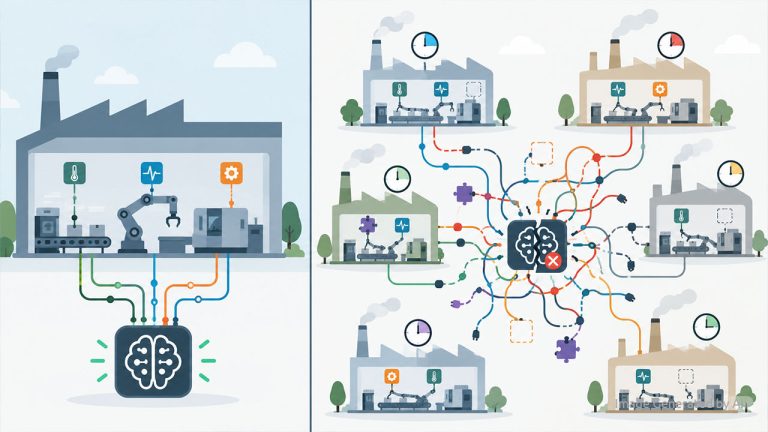
Safety-critical decisions, quality defect detection, and anything requiring sub-second response belong at the edge. Cross-plant pattern recognition, model training on pooled failure data, and energy consumption analysis that requires visibility across multiple sites belong in the cloud. The panelists described this as “physical AI that acts locally and learns globally.”
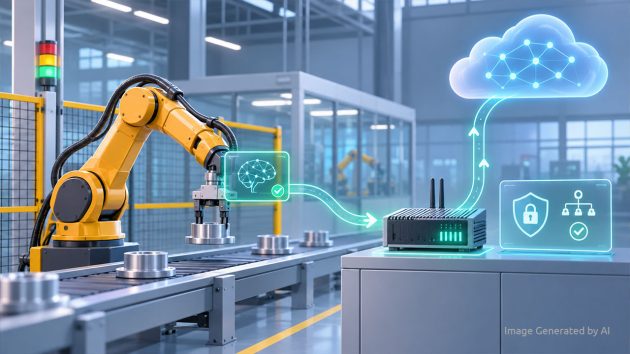
Siemens Energy applies this three-tier framework across its manufacturing operations. The company uses AWS IoT SiteWise Edge to run condition monitoring and energy optimization locally at each factory. When a bearing signature indicates impending failure, the edge model acts in milliseconds with no round trip to the cloud. A 200-millisecond latency delay means the difference between a safe shutdown and a safety incident, a quality defect, or a line stoppage. Siemens Energy connects 10 different protocol types, including Modbus, OPC UA, and legacy Siemens S7, into this edge layer.
Cloud processing handles what individual plants cannot see on their own. By pooling failure data from multiple factories, Siemens Energy trains predictive maintenance models that identify patterns invisible at the individual plant level. Cross-site energy consumption benchmarks reveal optimization opportunities that no single factory discovers in isolation.
A hybrid tier combines both. Agentic workflows detect anomalies at the edge, then traverse maintenance records, equipment manuals, and parts inventories in the cloud to generate work orders and spare part requests before passing the action back to the edge for execution.
Cost reinforces this architecture: collecting raw telemetry locally for five days to a month and shipping only the relevant subsets to the cloud can reduce storage costs to a tenth of what full cloud ingestion would require. Edge devices must still function when the network drops. A water meter or a robot arm cannot stop making decisions because connectivity fails.
| Decision Factor | Edge | Cloud |
| Latency tolerance | Sub-second (< 200 ms) | Seconds to minutes |
| Use cases | Safety shutdowns, anomaly detection, quality inspection | Cross-plant benchmarking, model training, energy pattern analysis |
| Data type | Raw time series, high-frequency signals | Aggregated, contextualized data |
| Network dependency | Must function during outages | Requires connectivity |
| Cost structure | Compute-constrained, avoids round-trip cost | Scales with storage, cheaper per query |
| AI role | Local inference, immediate action | Pooled learning, agentic workflows |
What Guardrails Does Autonomous AI Need on the Shop Floor?
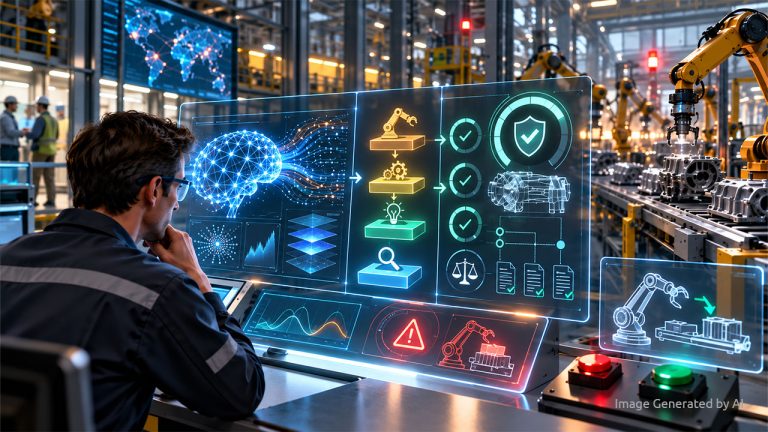
AI systems recommending that a floor technician perform an inspection carry fundamentally different consequences than AI systems autonomously changing a critical process parameter. Governance must match the consequence: risk-based autonomy requires four confidence checks before any autonomous action proceeds:
- The underlying data is current and reliable
- The operating conditions fall within the model’s trained range
- The scope of authorized actions is clearly specified
- The system has a defined path for handling exceptions when output falls outside expected parameters
The first check requires its own infrastructure. A unified namespace and tag ontology catches naming drift, clock skew, and schema changes, such as an integer shifting to a float, before corrupted inputs reach AI models. Back-testing against historical patterns adds a second verification layer: when new sensors or data sources come online, their output is compared against the existing ontology to detect inconsistencies before they propagate into model training. Schema drift, where the structure or data types of incoming telemetry change without notification, causes silent model degradation that often goes undetected until predictions fail. Data protection requires attention at three separate states:
- Data at rest needs encryption and access controls
- Data in transit between edge and cloud needs secure channels
- Data at the point of consumption, where AI models and human operators access it, needs its own protection mechanisms
Once data trust is established, autonomy increases through four stages:
- Observation: AI monitors without acting
- Recommendation: the system suggests actions for human approval
- Pattern-based decisions: AI acts on proven, reversible outcomes
- Full autonomous action: earned only after consistent performance at every prior stage
Every stage requires explainability: if an AI system decides to shut down a compressor at 2 a.m., the operations team must be able to trace the reasoning and the data that triggered it. Escalation paths ensure that beyond a certain risk threshold, the AI passes judgment to a human operator. Domain boundaries prevent a model trained for one facility from applying its learned behavior to a different facility where equipment, processes, and operating knowledge differ.
Why Does Physical AI Create New Cybersecurity Risks?
A physical robot on the shop floor that interacts with both a warehouse management system and an MES crosses security boundaries that the ISA 95 model was designed to keep separate. Model poisoning and prompt engineering attacks at the edge can traverse the entire hierarchy upward, reaching systems that legacy security architectures assumed were isolated.
An adversary who poisons a model running on an edge device can influence decisions that propagate through the agentic workflow layer into the cloud, affecting work orders and maintenance scheduling across multiple sites. Defending against these threats requires merging IT and OT security disciplines. Security operations centers are beginning to use AI to scale autonomous threat detection and response.
Edge hardware adds a separate physical constraint. Memory limitations restrict model sizes, and compute-intensive inference generates heat that factory environments, unlike climate-controlled data centers, struggle to dissipate. Inference times increase by 30 milliseconds in summer months due to thermal throttling of edge processors, a measurable degradation for safety-critical applications that depend on sub-second response.
Manufacturers entering physical AI start with bounded projects that define clear scope, success criteria, and authorized actions. Once the architecture proves reliable at one site, the deployment pattern, the governance rules, and the security controls become repeatable across facilities without rebuilding from scratch.
Sources
- Physical AI in Production: The Data Infrastructure Gap, Industrial AI Summit 2026, hosted by IIoT World
Related from IIoT World
This article is based on a panel discussion with Gaspard Duthilleul of Galyos, Sanjay Mahato of Amazon Web Services, Ian Clark of InfluxData, and Tauseef Ahmed of Grayhawk Consulting Group, recorded at the Industrial AI Summit 2026 hosted by IIoT World. AI tools were used to help summarize and organize the content. Reviewed and edited by the IIoT World editorial team. Sponsored by InfluxData.