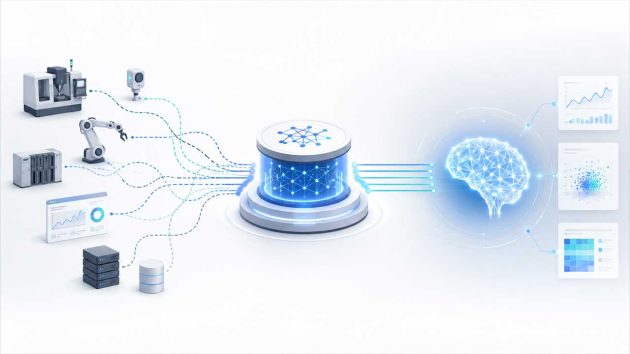
Fifty-seven percent of manufacturing executives report that inadequate data quality hampers AI use-case development, according to MIT Technology Review. Meanwhile, 85% of digital transformation projects fail to deliver ROI due to integration issues (ServiceNow CEO Bill McDermott), and more than 70% remain stuck in the pilot phase (McKinsey). The common thread across these failures is the data layer underneath. Unified Namespace (UNS) is the architectural pattern that solves this problem by replacing thousands of brittle point-to-point connections with a single, real-time data hub where every system in the plant publishes and subscribes to contextualized information.
IIoT World has published detailed explainers on what UNS is and how it works. This article takes a different angle: why UNS is the prerequisite for factory AI, digital twins, and agentic AI to function at production scale.
The N-Squared Problem That Kills AI Projects
Consider a manufacturing plant running 50 software systems: PLCs, SCADA, MES, ERP, CMMS, quality management, energy monitoring, and more. In a traditional ISA-95 architecture, connecting these systems requires point-to-point integrations. For 50 systems, that means up to 2,450 individual links, each with its own protocol translation, data mapping, and maintenance burden (IIoT World).
When a manufacturer deploys an AI model for predictive maintenance or a digital twin for process optimization, the model needs clean, contextualized, real-time data from multiple systems simultaneously. Without a unified data layer, each AI project starts with a lengthy data integration effort before any model training begins.
UNS replaces the N-squared architecture with a hub-and-spoke model built on MQTT. HiveMQ describes the architecture: data producers and consumers communicate through a central hub rather than direct connections, and a single broker can support millions of connected nodes. Every system publishes data using a standardized hierarchical namespace (Company/Site/Area/Line/Asset). Those same 50 systems need only 50 connections instead of 2,450.
As Arlen Nipper, co-inventor of MQTT, has explained, UNS creates a “single source of truth” for the entire operation. Every system publishes to and subscribes from the same broker, so data context is maintained from the point of origin through to the consuming application.
Measured Results From Production Deployments
UNS has moved past the conference-circuit concept stage. Several organizations have published production data.
UNS Deployment Outcomes
| Organization | Metric | Result | Source |
| HighByte customers | Three-year ROI | 448% | HighByte / IIoT World |
| HighByte customers | Integration speed | 4x faster than traditional | HighByte |
| Enterprise deployments | Integration effort reduction | 40-70% | Anexee |
| DFW Airport | Energy reduction | 20% | HiveMQ |
| DFW Airport | Workforce efficiency gain | 25% | HiveMQ |
| DFW Airport | Water loss | Cut from 25% to 10% | HiveMQ |
| DFW Airport | Communication interval | 6 hours reduced to 15 minutes | HiveMQ |
The DFW Airport deployment is particularly instructive. According to HiveMQ’s case study, the airport needed reliable real-time communication across five legacy control systems. After deploying HiveMQ’s MQTT platform, the operations team standardized data streaming between the digital twin, remote devices, and controls, cutting communication intervals from 6 hours to 15 minutes and reducing energy consumption by 20%.
Why AI Agents Cannot Work Without UNS
The 2026 shift toward agentic AI in manufacturing increases the urgency of UNS adoption. UNS is increasingly positioned as essential infrastructure for agentic AI deployment in smart factories. An AI agent that monitors equipment health, triggers maintenance orders, and adjusts production parameters needs three things from the data layer:
- Real-time access to sensor readings, production counts, and machine states
- Contextual metadata that tells the agent what a value means (engineering units, scaling, asset hierarchy)
- Discoverability so the agent can find new data sources without manual configuration
Traditional architectures lack these capabilities. UNS decouples data producers from consumers. Data producers publish once, and any consumer (AI agent, MES, ERP) subscribes to what it needs without custom integrations for each new use case.
Data published to the UNS broker carries its full context in the topic path and payload structure. An edge AI model running predictive maintenance subscribes to the exact machine topics it monitors. When a new sensor comes online, it publishes to the namespace and becomes available to every connected system.
Walker Reynolds, who introduced UNS as a solution to the traditional point-to-point integration model, described it in a masterclass interview as “the structure of the business and all of the events in the business,” where data talks “right and left” through a common structure rather than “up and down” between layers (4.0 Solutions).
Implementation: 8-14 Weeks to First Plant
One common objection to UNS is that it sounds like another multi-year IT infrastructure project. Production data tells a different story.
According to Anexee, which has deployed UNS at Vedanta, Indian Oil, BPCL, Hindustan Zinc, JK Tyre, JCB, NHPC, and CGPL (Tata Power), first-plant deployment takes 8-14 weeks. Subsequent plants take 4-8 weeks each when replicating the namespace model. A full multi-site federated UNS deployment runs 6-18 months.
Anexee reports the largest effort is hierarchical asset modeling, which represents 40-60% of the implementation work. Once the asset hierarchy is defined, the technical deployment (MQTT broker, Sparkplug B protocol layer, edge connectors) follows established patterns.
HiveMQ has published case studies on infrastructure operators, including DFW Airport.
FAQ
1. Does UNS replace our existing MES or ERP systems?
No. UNS sits alongside existing systems as a data communication layer. MES, ERP, SCADA, and other systems publish to and subscribe from the UNS broker. Nothing gets ripped out. The 448% ROI reported by HighByte customers comes from reducing integration effort between existing systems, not replacing them (IIoT World).
2. How does UNS handle data security across OT and IT networks?
UNS implementations typically use broker-level access controls to manage which systems can publish or subscribe to specific namespace topics. Because data flows through the broker rather than through direct system-to-system connections, security policies are applied at a single point rather than across hundreds of individual links.
3. What is the difference between UNS and a traditional data lake or historian?
A data lake or historian stores historical data for batch analysis. UNS provides real-time, event-driven data distribution with full context. AI models for predictive maintenance or digital twins need both: UNS for live operational state, and a historian or lake for training data and trend analysis. The two are complementary.
4. What protocols does UNS support beyond MQTT?
MQTT with Sparkplug B is the most common UNS protocol stack. However, UNS is an architectural pattern, not a single protocol. Implementations also use OPC UA aggregation servers. The Sparkplug 3.0 specification, hosted by the Eclipse Foundation, adds standardized topic namespaces, Protobuf-encoded payloads, and birth/death certificates to MQTT for industrial reliability.
5. How long does a UNS deployment take for a single manufacturing plant?
Based on enterprise deployment data from Anexee across heavy industry operations in India and globally, first-plant deployment takes 8-14 weeks. Hierarchical asset modeling accounts for 40-60% of that timeline. Subsequent plants that replicate the namespace model deploy in 4-8 weeks. Full multi-site federation runs 6-18 months.
Related from IIoT World
- Edge AI and Industrial Data Context
- Where to Put Intelligence: Edge AI for Factory Maintenance
- AI Predictive Maintenance in 2026
Sources
- What is Unified Namespace (UNS) and Why Does it Matter? (HiveMQ)
- The Business Value of Unified Namespace (HiveMQ)
- What Is a Unified Namespace and How Does It Work in Manufacturing? (IIoT World)
- UNS Architecture: The Definitive 2026 Guide for Industrial Data (Anexee)
- Transforming Factory Operations with Digital Twins Powered by MQTT and UNS (HiveMQ)
- Top Smart Factory Technologies 2026: Agentic AI & UNS (IIoT World)
- Unified Namespace for Industrial IoT: The Masterclass (Walker Reynolds / Intellic Integration)
- Sparkplug 3.0 Specification (Eclipse Foundation)
AI tools were used to help research and organize the content. Reviewed and edited by the IIoT World editorial team.