The Stellantis plant in Goiana, Pernambuco, developed a scalable industrial data architecture that now supports more than thirty AI applications. Building on its existing Siemens infrastructure, the team standardized how industrial data is collected, contextualized, and shared, reducing integration timelines from months to weeks. Aron Semle, Chief Techology Officer at HighByte, and Denis Leite, Director of Digital Transformation at Mekatronik described the approach during the “From Months to Days: Accelerate Industrial AI with a Modern Data Architecture” session at the Industrial AI Summit 2026.
How Can PLC Connectivity Evolve to Support Industrial AI?
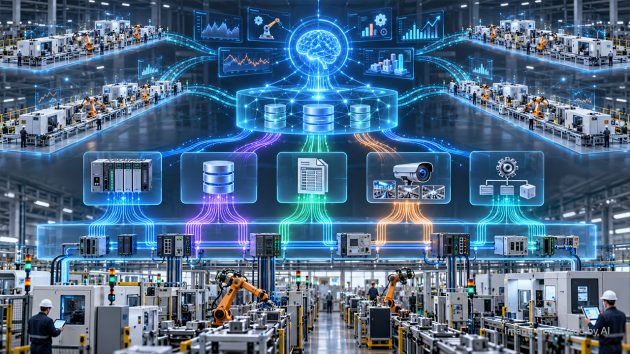
While PLC data already supported dashboards and operational analytics like OEE, newer applications such as machine learning and digital twins introduced requirements for integrating additional data sources, including SQL databases, CSV files, images, and video. Supporting these applications across hundreds of machines required a more standardized approach to managing industrial data, one that could accommodate different data sources while building on the plant’s existing infrastructure.
| Dashboard Architecture | AI-Ready Architecture | |
| Primary data sources | PLC tags | PLC tags, SQL, CSV, images, video |
| Calculation model | Application-specific calculations | Raw data contextualized once, consumed by all |
| New application effort | Application-specific integration | Replicate standardized model to new lines |
| Scale path | Manual integration per line, per plant | Model once, propagate across lines and plants |
What Does Building That Data Foundation Involve?
Industrial DataOps handles roughly eighty percent of the work in preparing industrial data for AI, including connecting to data sources on the shop floor and adding context so the information can be understood and used beyond the factory floor. Once contextualized, that data can be published through a Unified Namespace (UNS), allowing multiple applications to access and reuse it without repeating the work of connecting to individual sources.
As Aron Semle explained, organizations define UNS differently. Some build it in an MQTT broker, others in a data lake, a historian, or an OPC UA server. Regardless of the technology, the common element is making contextualized industrial data available in a consistent way. A raw tag value leaving the factory floor means little to someone who cannot identify the machine, production line, or product being produced.
How Does a Two-Layer Model Scale Across Production Lines?
At Goiana, the team divided the DataOps layer into two levels to manage data across the plant. The lower level handles the specific protocols and formats used by each machine, while the upper level organizes that data into a common model. This ensures machines performing the same function on different production lines produce consistent data structures. Once the upper model works for one production line, bringing it to the next line is much faster.
For the team building the implementation, the upper model took the most effort. In a process industry, as Denis explained, modeling often means binding raw tags to their meaning: this tag is speed; that tag is product. Discrete manufacturing at Stellantis required something different: transforming raw data into groups of information that represent parts moving through the production line. Operations, sequences, and materials arriving from different paths all had to be captured in a model designed for replication across lines. While developing that model required careful planning, it also needed to be flexible enough to accommodate changes over time.
Beyond the model itself, the team integrated data from across the shop floor. “While PLC data accounts for eighty percent of the data volume, additional information such as bill of materials, product details, and cycle data provides important context. By bringing these sources together, the team could build on the plant’s existing infrastructure while accommodating equipment with different data formats.
How Long Does Deploying a Unified Namespace Take?
The two-layer model helps accelerate UNS deployment timelines, but implementation schedules vary based on each facility’s existing processes, systems, and documentation. During the session, two other deployments were shared. At a plastics factory, it took one week to connect machines and have statistical process control running. At another process industry site with thousands of existing tags on a different system, the first applications were running within a few weeks, with full migration completed in a few months.
Much of that work involves understanding how the plant’s equipment and processes operate and organizing that information so the data is useful. But by starting small and building on what works, teams can see early results and keep improving their approach over time.
In 2021, the experience gap between teams just beginning to build an industrial data foundation and those leading the way could have been years. Today, as more organizations gain experience implementing these architectures and share what they’ve learned, that gap has narrowed to months.
HighByte Intelligence Hub, the software behind the DataOps layer, now runs at more than 400 deployed sites across 25 countries. Among them, food manufacturer Gousto increased mechanical availability from 70% to 95% within six months of deploying the architecture.
This article is based on the “From Months to Days: Accelerate Industrial AI with a Modern Data Architecture” session at the Industrial AI Summit 2026 and deployment data from HighByte. Speakers: Aron Semle of HighByte and Denis Leite of Mekatronik. Moderated by Hamish Mackenzie of IIoT World. The session was sponsored by HighByte.
Related from IIoT World