What Is Unified Namespace (UNS) and the i3X Standard?
· Smart Manufacturing

What Is Unified Namespace (UNS) and the i3X Standard?

Industrial environments have been built one use case at a time, leaving most large manufacturers with fragmented IT and OT infrastructure. A manufacturer with 10 sites might run four different home-grown MES platforms, three different ERPs, and entirely custom data connections between them. As organizations deploy artificial intelligence, that absence of standardized data architecture has […]

Read more →
How Much Should Factory AI Do on Its Own?
· Smart Manufacturing

How Much Should Factory AI Do on Its Own?

Agentic AI will bring thousands, potentially tens of thousands, of AI agents to the factory floor. Every one of them will need data, and not all data. Agents do not perform well when exposed to massive amounts. They need focused, usable data scoped to their task. So, how much should manufacturers let them do without […]

Read more →
How Is Industrial AI Performing in Production?
· Artificial Intelligence

How Is Industrial AI Performing in Production?

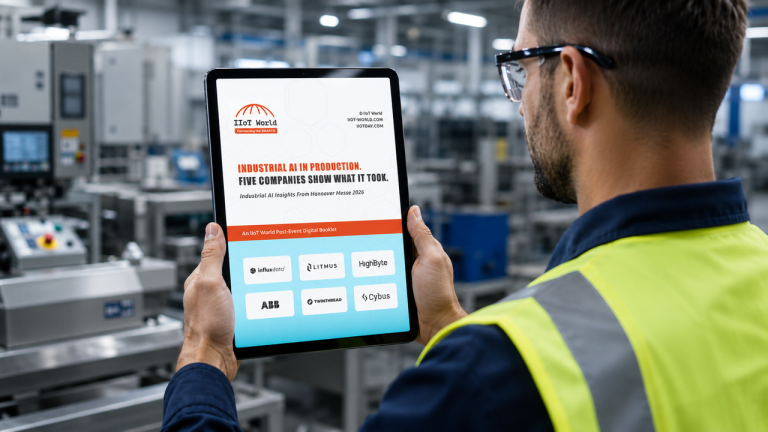
ABB resolves 80% of measurement device faults through an AI copilot, without a support call. HighByte compressed Alcon’s one-year plant-wide digital transformation to less than one month. InfluxData and Litmus take manufacturers from three sites to 300, with positive ROI in 60 to 90 days. Cybus reports 9% less downtime and 23% lower cloud costs […]

Read more →
Data Context Decides Industrial AI Results
· Smart Manufacturing

Data Context Decides Industrial AI Results

For two decades, manufacturers have tried to make analytics, machine learning, and AI work with industrial data, and for most of that time the bottleneck had nothing to do with the technology itself. It was the data layer. This IIoT World article, based on a pre-Hannover Messe 2026 interview with Torey Penrod-Cambra (VP Marketing, HighByte), […]

Read more →
How Agentic AI Changes Factory Data Requirements
· Artificial Intelligence & ML

How Agentic AI Changes Factory Data Requirements

Most factory data architectures today serve between 10 and 50 consuming systems. Agentic AI will push that number into the thousands, a 100x increase in edge-based data consumers. The ISA-95 layer-by-layer model was not designed for this volume, and manufacturers need to rethink their data infrastructure before scaling AI agents. IDC reports that 56.6% of […]

Read more →
Top Smart Factory Technologies 2026: The Agentic AI and UNS Revolution
· Artificial Intelligence & ML

Top Smart Factory Technologies 2026: The Agentic AI and UNS Revolution

The manufacturing industry has reached a critical inflection point. The era of “pilot purgatory” is over. Based on the insights from IIoT World Days 2025, the next phase of industrial transformation is defined by three core pillars: Agentic AI, Unified Namespaces (UNS), and Industrial DataOps.While these three form the structural “backbone,” a total of six […]

Read more →
Scaling GxP Innovation with Industrial DataOps
· Connected Industry

Scaling GxP Innovation with Industrial DataOps

Life sciences manufacturers operate in environments where innovation and compliance must coexist. But how is that possible in practice, and what use cases are emerging across the industry?In a recent webinar hosted by IIoT World,  “Adapting GxP Operations for Modern Compliance with Regeneron,” industry leaders explored how regulated manufacturers can modernize operations, adopt new technologies, and maintain […]

Read more →
The Connected Factory Playbook: Actionable Insights for C-Level Manufacturing Leaders
· Discrete Manufacturing

The Connected Factory Playbook: Actionable Insights for C-Level Manufacturing Leaders

Modern manufacturers face a paradox: despite generating more data than ever, as much as 80–95% of valuable operational data remains unused. The result? Missed opportunities, fragmented visibility, and stalled digital transformation efforts.Our new executive booklet, based on the expert panel “The Connected Factory Playbook: Actionable Insights for C-Level Manufacturing Leaders,” delivers critical insights for manufacturing leaders looking to […]

Read more →
Edge AI + Intelligence Hub: A Match in the Making
· Hybrid Manufacturing

Edge AI + Intelligence Hub: A Match in the Making

The convergence of edge AI and centralized intelligence hubs is creating a new operational architecture for manufacturers seeking real-time decision-making without sacrificing data governance or scalability. In this article, IIoT World examines how pairing local inference at the machine level with a cloud or on-premises intelligence hub delivers the best of both worlds: sub-millisecond response […]

Read more →
Why C-Level Leaders Must Rethink Industrial Data Modeling Now
· Discrete Manufacturing

Why C-Level Leaders Must Rethink Industrial Data Modeling Now

Industrial AI initiatives fail far more often from poor data foundations than from flawed algorithms. For C-level leaders overseeing digital transformation, the strategic question is not which AI platform to buy but whether their organization’s data architecture can support the models they plan to deploy. In this IIoT World guide, we explore why industrial data […]

Read more →
Industrial AI Needs a Backbone—And That Backbone Is DataOps
· Discrete Manufacturing

Industrial AI Needs a Backbone—And That Backbone Is DataOps

At Hannover Messe 2025, John Harrington of HighByte offered a timely reminder: as AI races ahead in the industrial sector, the infrastructure supporting it—specifically, DataOps—needs to keep up.While AI dominates the headlines, its power is fundamentally limited without access to the right data. Harrington put it bluntly: “Data is the oxygen for AI.” But not just any data—clean, […]

Read more →
[Booklet] Manufacturing at the Crossroads 2025: Real-World Lessons from Industrial Leaders
· Discrete Manufacturing

[Booklet] Manufacturing at the Crossroads 2025: Real-World Lessons from Industrial Leaders

What does it take to make digital transformation stick—beyond pilots, platforms, and buzzwords?At Hannover Messe 2025, the conversation around industrial transformation reached a new level of clarity—and urgency. From AI and agentic automation to modular MES platforms and resilient supply chains, one message was consistent: transformation is no longer a long-term goal. It’s a right-now […]

Read more →