
How should a manufacturer decide whether an AI use case carries acceptable risk before deployment? Benson Chan of Strategy of Things answers an audience question on risk classification with a four-quadrant framework that maps decision severity against automation level. The question was asked during the “From Industrial AI Ambition to Operational Reality: Choosing the Right Use Cases” session at the Industrial AI Summit 2026.
How Should Manufacturers Classify Risk in AI Decisions?
Benson Chan, Chief Operating Officer of Strategy of Things:
Despite the transformational benefits that AI provides, its use is not without risk. One recurring risk with the use of AI-enabled products and services is “What if AI gets it wrong?” A related risk is “why does AI work sometimes and doesn’t work in other times?”
While it’s not possible to completely remove AI risk, careful planning can minimize some of the risks. One approach is to examine the AI use case for your specific application and see where it falls into the risk classification model below.
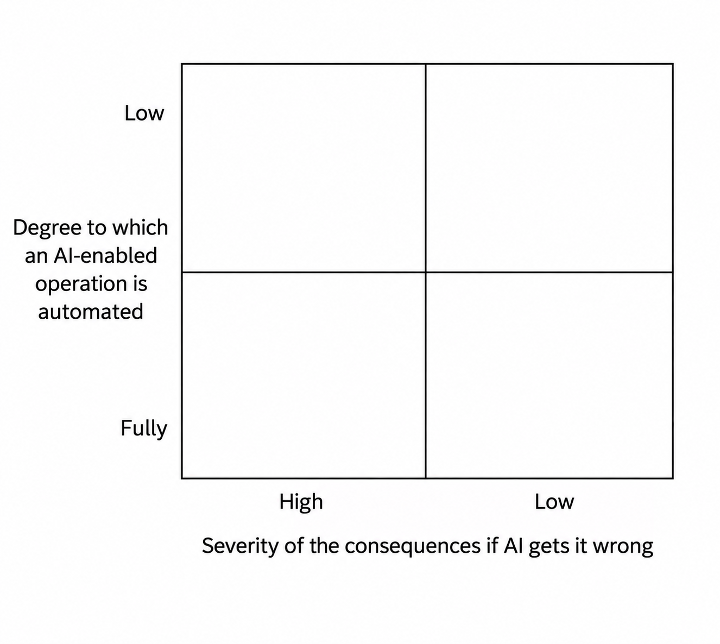
AI use cases will fall into one of the four risk quadrants. This is one way to classify risk with AI use cases, but not the only way.
An example of high severity high automation (bottom left quadrant) use case is where an AI system autonomously controls a safety-critical manufacturing process by adjusting variables such as temperature, pressure, and flow rates without human approval. If the AI makes the wrong decision, the result could be equipment damage, a hazardous release, worker injury, or a plant shutdown.
On the other hand, an example of a low severity low automation (top right) AI use case is where the AI analyzes equipment data and recommends when routine maintenance should be performed, but requires human reviews and approves the action. If the AI recommendation is wrong, the likely consequence is minor inefficiency, unnecessary maintenance, or some avoidable downtime rather than a serious safety or production event.
The model does not say you shouldn’t do high risk use cases. What it does say is that once you know where your specific use case falls for your specific application, you should put into place plans and actions to minimize some of that risk.
For example, if you are considering a use case that fits into the high risk quadrant, understand what could cause the AI to make an incorrect decision. For example, an AI model could make the wrong decision if it wasn’t trained properly, or used outside of conditions it was trained on. It could make the wrong decision if it doesn’t have access to the right data in a timely manner, as well as access to good quality data. The model itself could “drift” if it is not checked and retrained periodically.
Adopters should implement plans to verify that the models are properly trained, and used within its intended application. They should check and test the model periodically to detect drift and bias. They should verify and confirm that the data sources the model uses are reliable, consistent and are fully available.
If the adopter is not able to do this, then this particular use case may not be a good fit if they are risk averse.
This question was submitted by an attendee of the “From Industrial AI Ambition to Operational Reality: Choosing the Right Use Cases” session at the Industrial AI Summit 2026. Answer provided by Benson Chan of Strategy of Things. The session also featured Jonathan Weiss of Cumulocity, Flemming Kongsberg of Siemens, and Maddie Zheng of Nyotta AI, and it was moderated by Yash Titus of Strategy of Things.