A Practical Guide to Historian Augmentation
Sponsored by InfluxData
Data historians have served automotive manufacturing for decades, capturing signals from PLCs, robots, weld cells, and test stands across body shop, paint, stamping, and final assembly. The data volumes generated by a modern vehicle assembly line now exceed what these systems were designed to handle: per-tag licensing turns every new sensor into a cost decision, proprietary architectures trap quality data inside plant-level silos, and batch-export workflows stall the real-time analytics that predictive maintenance requires.
Ripping and replacing is the obvious move, but in automotive a single line stoppage can cascade into missed takt, JIT penalties, and downstream OEM shutdowns within hours.
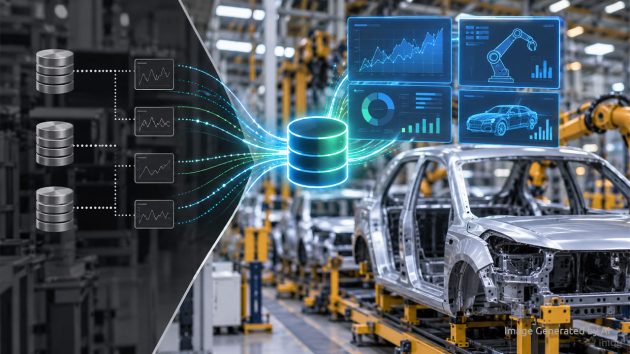
InfluxData’s 22-page guide lays out how to augment the historian rather than replace it. InfluxDB adds a time series layer alongside existing infrastructure. Production keeps running. New data capabilities come online in parallel.
What the guide covers
Two deployment approaches. The parallel feed model uses Telegraf, an open-source data collector with hundreds of plugins for OPC-UA, MQTT, and Modbus, to stream new sensor data into InfluxDB alongside the existing historian. New instrumentation, robots, and launch programs bypass per-tag licensing entirely. The historian consolidation model unifies data from multiple disconnected historians into a single queryable layer for cross-plant benchmarking and warranty investigations.
Automotive-specific architecture. The guide maps data flows for each major production area: stamping presses (tonnage monitors, die temperatures, vibration), body shop (KUKA/FANUC joint data, spot weld current), paint shop (E-Coat tank levels, oven temperatures, HVAC), and final assembly (Atlas Copco DC torque guns, AGV routes, end-of-line dyno testing).
Integration with existing platforms. PTC embeds InfluxDB as the persistence layer in ThingWorx. Kepware streams OPC data into InfluxDB 3 to connect legacy weld and stamping assets. Rockwell Automation sends Allen-Bradley PLC data through FactoryTalk Optix and View SE. Litmus Edge handles tag mapping and asset context standardization across multiple sites.
Natural language access to production data. The InfluxDB MCP Server connects time series data to AI tools through natural language. Engineers can query production metrics without writing SQL or managing schema.
Case studies inside
Toyo Tires started with 100 machines at a single plant in Serbia and scaled to as many as 1,000 machines across multiple locations, running real-time anomaly detection and quality analysis with 20-year data retention for audit compliance.
Gotion, a top-10 global EV battery manufacturer, chose InfluxDB for its data compression and a query language its data science team could adopt quickly, powering analytics and machine learning across battery cell production.
American Axle & Manufacturing (AAM), a Tier 1 supplier with nearly 85 facilities across 18 countries, runs InfluxDB, Telegraf, and Grafana across its enterprise data infrastructure.
Who this guide is for
Plant engineers, launch managers, quality leaders, and IT/OT architects evaluating how to modernize data infrastructure for AI and advanced analytics without disrupting validated, IATF 16949-certified production lines.