This is part two of three articles based on unanswered audience questions from the “From Data Streaming to Autonomous Action” session at the Industrial AI Summit 2026. Where part one covered the data and context foundations, this article focuses on the technical architecture: how do you actually connect an LLM to a factory, what platforms are manufacturers running, where do standards help and where are they missing, and what role does the LLM play in the stack? Peter Sorowka, CEO of Cybus, answered six questions on MCP servers, platform choices, standards gaps, the LLM as orchestrator, agent-to-agent identity, and whether AI should change manufacturing processes.
What Is the MCP Server Concept for Industrial AI?
Peter Sorowka, CEO of Cybus:
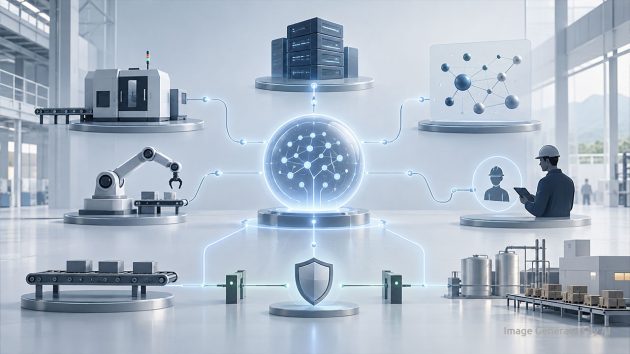
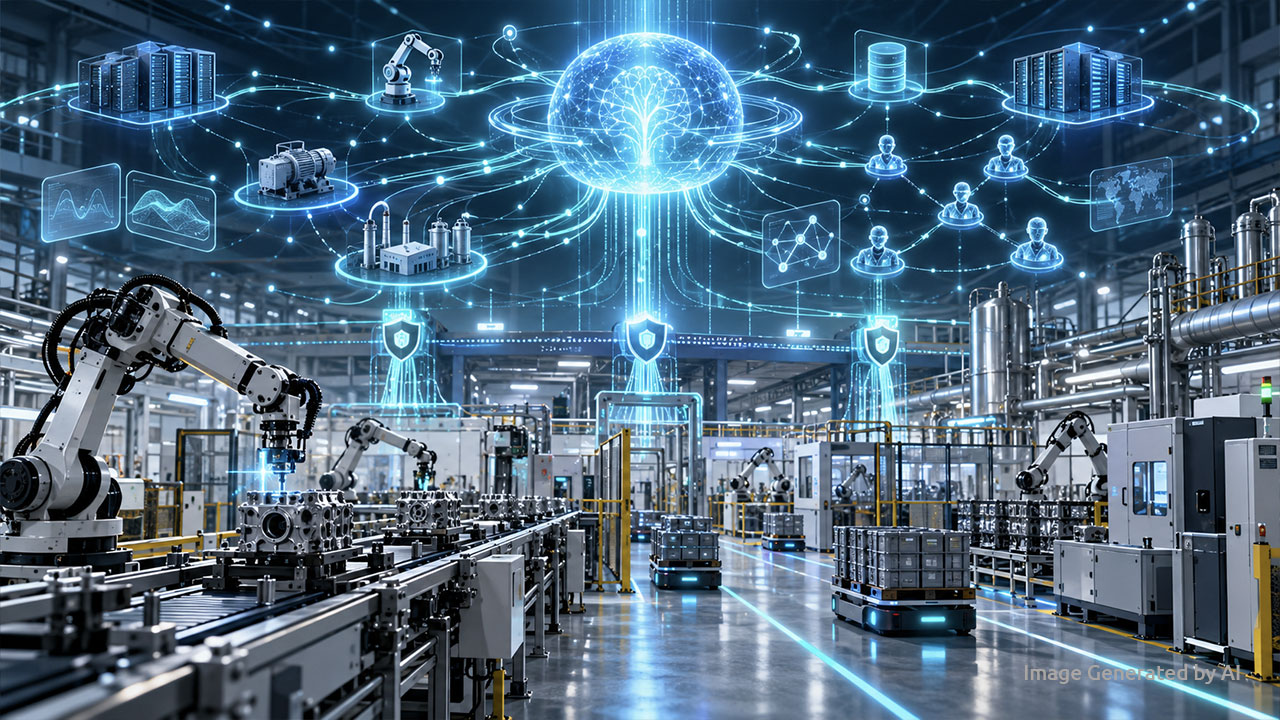
MCP is a standard way for an agent to discover and call tools. Applied to a factory, the tool is the factory model itself: namespaces, assets, live values, exposed with the same access rules that apply to people. The design point is that this is an entry into the plant, which allows any LLM – if chat based or agentic – to understand the available data, its relations, its context, its meaning and both read and act on it.
What AI Platforms Are Industrial Companies Using?
Peter Sorowka, CEO of Cybus:
Cybus does not run the models. On the customer side we see three patterns: hosted assistants such as Copilot Studio reaching in over an API key, in-house GPT front ends over OpenAI, Anthropic and Google models, and self-hosted models where the data has to stay in the plant. Our own product and engineering work uses Claude and Copilot. The design commitment is that Connectware behaves the same whichever model sits on the other end.
How Will Standards on Connectivity and Governance Help Scale Industrial AI?
Peter Sorowka, CEO of Cybus:
Connectivity is largely solved — OPC UA, MQTT get data off the machine. Contextualization is not: AAS, i3X and UNS conventions compete, and most plants model differently per site. For the human-AI relationship and governance there is no industrial standard yet; MCP is the first widely adopted piece and it covers the call, not the permission. Scaling needs a portable way to express who may read and who may act. Our practical advice: declare your model in a form you can project to AAS or i3X later, rather than waiting for one standard to win.
Is the LLM the Decision Layer or the Interface?
Peter Sorowka, CEO of Cybus:
Today it is the interface and the orchestrator. The industrial value still comes from models built for the job, anomaly detection, time-series forecasting, optimization, and those do not become obsolete. What the LLM adds is reach: it can pull the factory context, call those models, and explain the result in one loop, which is what made them accessible to people who are not data scientists. We expect it to stay the coordinator. Decisions with physical consequence should be bound by declared rules and interlocks, so the model proposes and the policy layer decides what is allowed to happen.
Do You Support Agent-to-Agent Interactions?
Peter Sorowka, CEO of Cybus:
It is on our roadmap direction, and today our scope is narrower. Right now an assistant reaches Connectware over the MCP server with a key that acts on behalf of a named person. Agent-to-agent chains sharpen the identity question rather than changing it: when the caller is another agent, “on behalf of a person” stops being enough, which is why an agent identity with its own accountable owner is a separate roadmap item. Our position is that the governed side belongs at the factory boundary, whatever protocol the agents use among themselves.
Should AI Change the Process or Just the Tools?
The original question drew a parallel to the transition from steam to electricity: factories swapped the power source without realizing that electricity could power individual components.
Peter Sorowka, CEO of Cybus:
Yes, and most projects today are still doing the steam-to-electricity swap: an agent replacing a dashboard inside an unchanged process. The real gain comes when the decision loop shrinks, which means fewer handoffs, not a faster report. We will see hybrid org charts in organizations, where humans report to agents and vice versa. A crucial technical question will be how security and approval flows will stay under control; the governance framework for the closed loop agentic manufacturing should not be underestimated.
These questions were submitted by attendees of the “From Data Streaming to Autonomous Action” session, at the Industrial AI Summit 2026. Answers provided by Peter Sorowka of Cybus. The session also featured Kudzai Manditereza of HiveMQ, David Puron of Barbara, Jonathan Alexander of Albemarle, and Hamish Mackenzie of IIoT World. Session sponsored by Cybus, Barbara, and HiveMQ.
Related from IIoT World