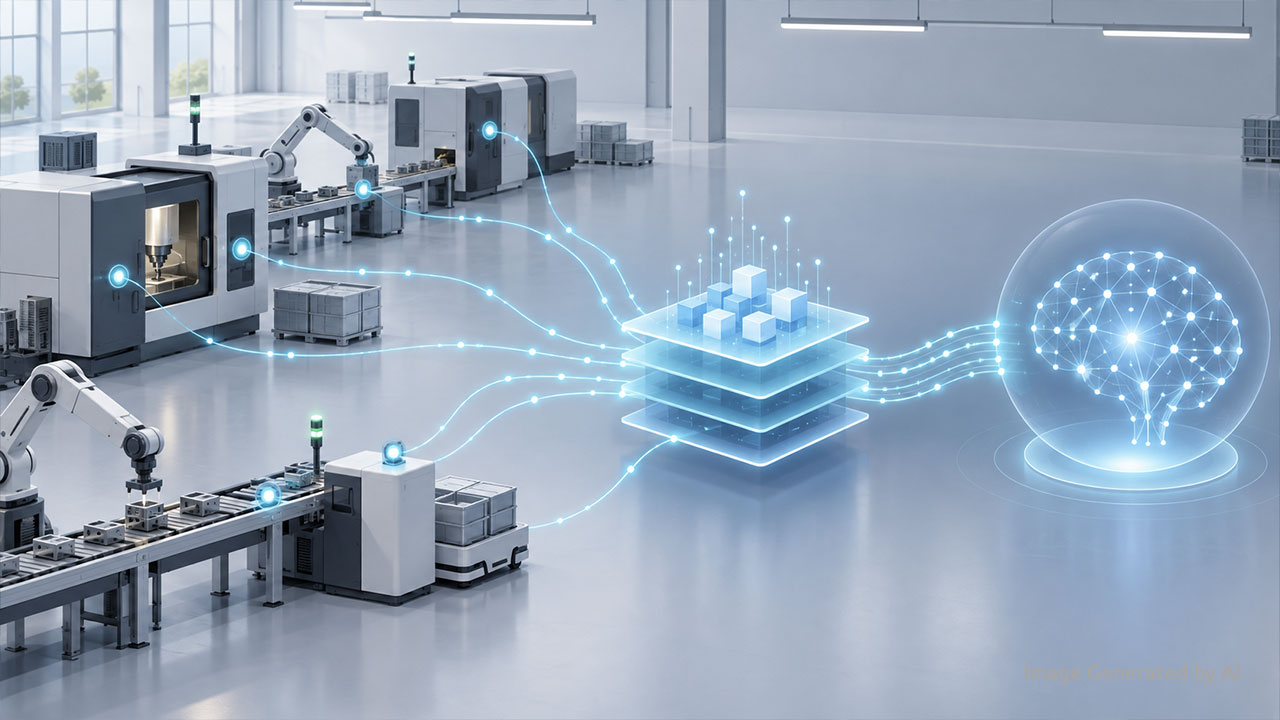
HiveMQ launched HiveMQ Platform, expanding the MQTT infrastructure it has operated in mission-critical environments for more than 12 years into an industrial data platform that prepares operational data for agentic AI. The platform moves beyond data streaming into four capabilities: connecting across OT and IT systems, contextualizing with consistent governance rules, analyzing in real time close to the source, and governing action through human-supervised workflows. Enterprise manufacturers including BMW, Mercedes-Benz, Ford, Eli Lilly, and Unilever already use HiveMQ, reporting new AI use cases deploying in two weeks instead of six months.
Why Is Most Factory Data Not AI-Ready?
Plant floors generate continuous signals from machines, sensors, and systems, but that data arrives fragmented, inconsistent, and without the context that identifies which asset produced it, which process or shift it relates to, and whether the reading is valid. When manufacturers deploy AI on that foundation, every insight and recommendation inherits the weaknesses in the underlying data. An industry survey found that 84% of companies say data access slows them down.
What Does AI-Ready Factory Data Require?
AI-ready factory data requires capabilities that are defined once and applied across every plant without rebuilding for each site or use case. Governance rules, data models, and KPI calculations follow the data from the edge to the cloud, so a proven approach at one facility replicates to the next.
| Capability | Function | Operational Impact |
| Connect | Creates a real-time backbone across existing OT and IT systems from edge to cloud | New plants and use cases come online with less integration work |
| Contextualize | Defines data models and governance rules once and applies them across plants | Less time preparing data; proven use cases replicate across facilities |
| Analyze | Calculates KPIs close to the source and surfaces deviations during live operations | Teams diagnose problems and act before downtime, energy use, or scrap grows |
| Act | Puts intelligence into human-supervised workflows | Faster response, preserved expert knowledge, repeatable decisions across shifts |
“Manufacturers are not going to jump from dashboards to autonomous operations overnight, and they shouldn’t. They need to understand what is happening, diagnose why and determine the right response before they automate it,” said Magnus McCune, CTO of HiveMQ.
What Results Does HiveMQ Platform Deliver?
Manufacturers operating on HiveMQ infrastructure report measurable results across uptime, energy, and operational scale. One implementation saved $83 million by increasing factory uptime from 99.99% to 99.999%. Another reduced annual energy costs by $35 million through a 20% reduction in consumption. Centralized monitoring across 513 plants saved $98 million in operational costs.
Do Manufacturers Need to Model All Data First?
Manufacturers do not need to model their entire industrial data estate before starting. Teams begin with one operational problem, contextualize the data needed to solve it, and replicate the proven approach across additional plants. Target operational questions include diagnosing why a production line’s performance dropped, whether a quality deviation requires immediate intervention, or how to prevent an equipment fault from becoming prolonged downtime.
HiveMQ Platform is available to experience for free. The full announcement includes additional enterprise customer references and platform architecture details.
Sponsored by HiveMQ.