Physical AI systems that interpret sensor telemetry, predict equipment behavior, and trigger automated responses require two data capabilities that traditional historians were not designed to provide: high-resolution historical datasets for model training and continuous real-time telemetry for inference. In a new article, Conrad Chuang of InfluxData identifies four specific gaps between what historians deliver and what Physical AI demands, and describes how a distributed time-series architecture can extend existing historian investments without replacing them.
What Are the Four Gaps Between Historians and Physical AI?
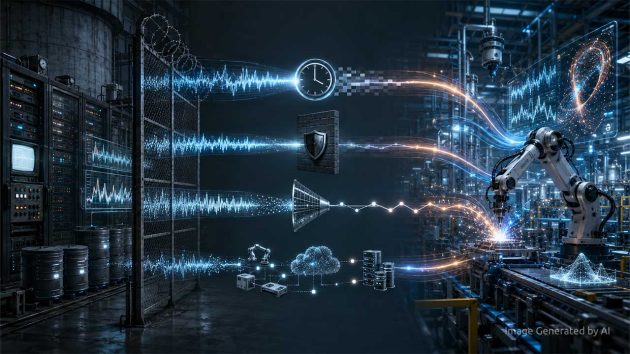
Data historians were designed for record-keeping, troubleshooting, and compliance. Physical AI introduces requirements that fall outside that original scope.
- Real-time access: Historian data stays trapped in OT environments behind network segmentation and proprietary interfaces, adding latency that Physical AI inference cannot tolerate.
- Signal fidelity: Deadbands, compression, and downsampling strip the high-resolution patterns AI models need to recognize operating states and predict outcomes.
- IT/OT fragmentation: Telemetry interpretation requires context from ERP, MES, and CMMS systems that sit outside the historian.
- Site-centric architecture: Per-plant historian deployments create data silos that prevent the multi-site training Physical AI requires.
How Does Data Compression Degrade AI Model Training?
“Data historians were built for, well, historical data. The data requirements of Physical AI are different,” Conrad Chuang writes.
Legacy compression preserves trends visible to human operators but strips the fine-grained patterns that machine learning models require. A model trained on downsampled data may fail to distinguish between normal operating variation and early equipment degradation. The subtle behavioral distinctions that separate a healthy asset from one approaching failure exist in the high-frequency detail that compression removes.
Training datasets also increasingly incorporate multimodal inputs including images, video, audio, and LiDAR that require time-aligned integration with telemetry. Historians were not designed to store or synchronize these data types.
What Architecture Extends Historians for Physical AI?
InfluxDB 3 provides a distributed time-series layer that works alongside existing historians. Historians preserve operational records while InfluxDB handles ingestion, processing, consolidation, and distribution of telemetry across edge, cloud, and enterprise environments.
At the edge, time-series services positioned at data sources provide live telemetry processing and low-latency queries for inference. Data flows to InfluxDB Cloud, creating a time-aligned layer combining operational history from multiple sources for model training and enterprise analysis.
The architecture uses Apache Arrow and DataFusion with SQL support for fast queries across large time-stamped data volumes. A Python Processing Engine runs signal processing, feature extraction, and anomaly detection at the point of ingestion, supporting real-time Physical AI inference on current operating conditions.
Read the full article on InfluxData.com.
Related from IIoT World:
- InfluxDB 3: Turning Industrial Data into Real-Time Action with Less Complexity
- Unified Namespace and InfluxDB: Streamlining IIoT Operations for Industry 4.0
Sponsored by InfluxData.
Frequently Asked Questions
1. What is Physical AI in industrial operations?
Physical AI refers to AI systems that interact with the material world, interpreting sensor telemetry through physical laws rather than processing numbers or generating content. Industrial applications rely on continuous sensor telemetry, machine states, and process conditions for real-time interpretation and automated action, requiring both historical datasets for model training and live telemetry for inference.
2. Why can’t data historians serve real-time AI inference?
Historian data typically remains confined within OT environments due to network segmentation, security protocols, and proprietary interfaces. Accessing this data for AI applications requires gateways, scheduled queries, or export pipelines, each introducing latency that prevents Physical AI systems from evaluating conditions while there is still time to respond.
3. How does historian data compression affect AI model training?
Historians employ deadbands, exception processing, compression, and downsampling to reduce data volume. These techniques preserve trends for human reporting but remove the high-resolution patterns AI models need to recognize operating states, predict outcomes, and distinguish between normal operating variation and early equipment degradation.
4. What is a distributed time-series architecture for Physical AI?
A distributed time-series architecture extends existing historian investments with a layer that handles ingestion, processing, and distribution of telemetry across edge, cloud, and enterprise environments. Edge services provide low-latency inference, cloud consolidation supports multi-site model training, and SQL-based querying with Apache Arrow and DataFusion provides fast access to time-stamped data.