Manufacturing knowledge is fragmented and mostly unused
European manufacturers collectively hold decades of deep production knowledge: how materials behave, how machines are tuned, how quality issues emerge, how processes fail and recover. Yet this knowledge remains locked inside individual companies, plants, and teams. It is applied locally, rarely reused, and almost never scaled.
At the same time, AI systems are advancing rapidly. General-purpose models are trained on public text, images, and code, but they lack industrial context. They do not understand manufacturing constraints, process tradeoffs, or the realities of production environments. This gap points to a new opportunity: industrial foundation models built on real manufacturing knowledge.
What makes industrial foundation models different
Unlike general AI models, industrial foundation models are trained on domain-specific data: production signals, process behavior, operational patterns, and engineering context. Their value does not come from size alone, but from relevance.
Such models could support tasks like:
- Identifying process deviations earlier
- Recommending parameter adjustments based on historical behavior
- Supporting planning and optimization decisions
- Transferring know-how across sites and organizations
The key distinction is that these models would encode how manufacturing actually works, not just how to generate text or predictions.
Why no single manufacturer can build them alone
The challenge is scale. Individual companies rarely generate enough diverse, high-quality data to train robust foundation models on their own. Even large manufacturers operate within specific product, process, or industry niches.
This is why collaboration becomes essential. Shared models trained across multiple contributors can capture a broader range of scenarios, variations, and best practices. The combined value exceeds what any participant could achieve independently.
The difficulty, of course, lies in doing this without exposing sensitive information or eroding competitive advantage.
Sovereign collaboration as an enabler
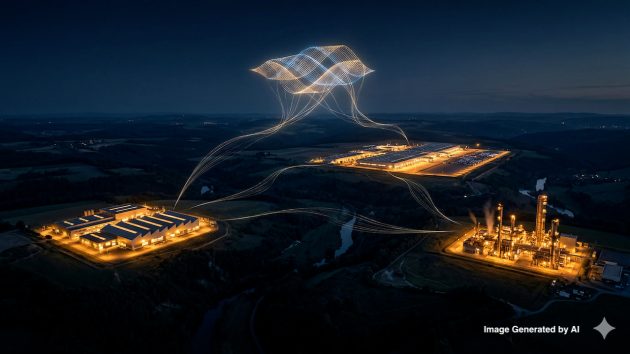
Collaboration does not require full data sharing. With the right architectures, companies can contribute insights, patterns, or derived representations rather than raw operational data.
This enables a model where:
- Contributors retain control over what they provide
- Sensitive details remain protected
- Shared models improve without centralizing all data.
Such an approach allows manufacturers to participate in collective intelligence while preserving autonomy. The model improves for everyone, while each participant decides how and when to engage.
New business models emerge from shared intelligence
Industrial foundation models also open new commercial possibilities. Instead of selling isolated software features, companies could:
- Co-develop shared models
- License access to industry-trained intelligence
- Participate in revenue-sharing structures tied to model usage
For Europe in particular, this represents a strategic opportunity. Manufacturing expertise is one of its strongest assets. Turning that expertise into shared, AI-enabled capability could rebalance competition with regions that dominate general-purpose AI platforms.
Why timing matters
The foundations for this shift are already forming. Data architectures are improving. AI capabilities are maturing. The remaining barrier is organizational: agreeing on how to collaborate without losing control.
Manufacturers that engage early help shape how these models are built, governed, and applied. Those who wait may find themselves consuming externally developed intelligence rather than contributing to and benefiting from their creation.
The long-term advantage will not come from who adopts AI first, but from who trains AI on real manufacturing knowledge.
This article reflects insights shared during an IIoT World Manufacturing Day discussion on data sovereignty, collaboration, and the future of industrial AI. The session was sponsored by Cybus.
Contributors included Peter Sorowka (Cybus), Marc Jäckle (MaibornWolff), Martin May (SCHUNK), Aleksandar Hudic (Schwarz Digits), with moderation by Lara Ludwigs (Cybus).
Sponsored by Cybus.
Frequently Asked Questions
1. What is an industrial foundation model?
It is an AI system trained specifically on domain-specific manufacturing data, such as production signals and process behavior, rather than public text. This allows the AI to understand real-world manufacturing constraints and tradeoffs.
2. Why do manufacturers need to collaborate to build AI models?
Individual companies rarely generate enough diverse data to train robust foundation models alone. Collaborating allows manufacturers to train shared models that capture a broader range of scenarios, achieving a scale of intelligence no single company could build independently.
3. How can manufacturers share AI data securely?
Through sovereign collaboration architectures, manufacturers contribute insights or derived patterns instead of raw operational data. This ensures sensitive details remain protected and contributors retain control over their data without requiring a centralized data lake.
4. Why are industrial foundation models important for Europe?
Europe holds decades of deep, localized production knowledge. By turning this expertise into shared AI capabilities, European manufacturers can create new business models and rebalance competition against regions that dominate general-purpose AI platforms.