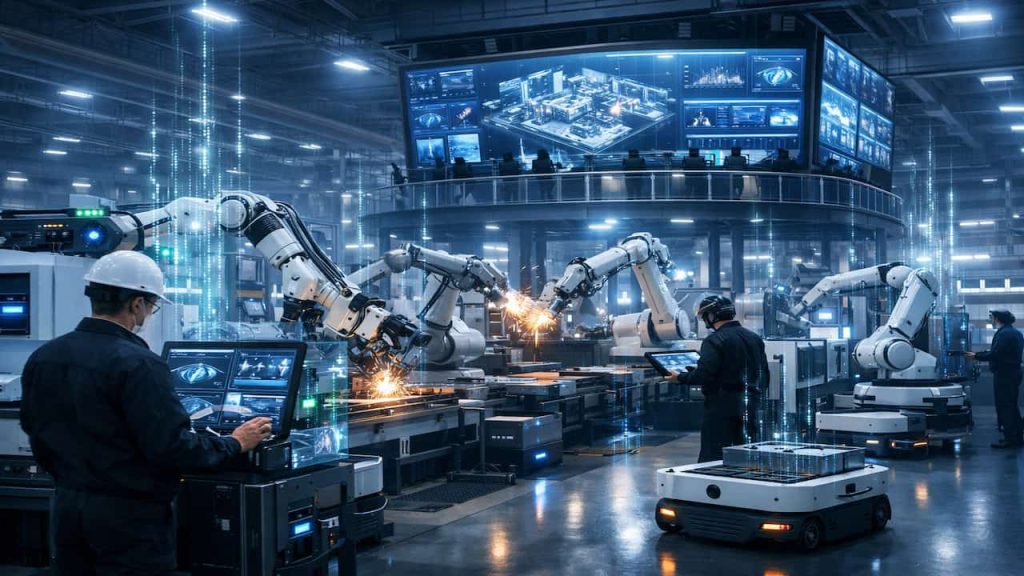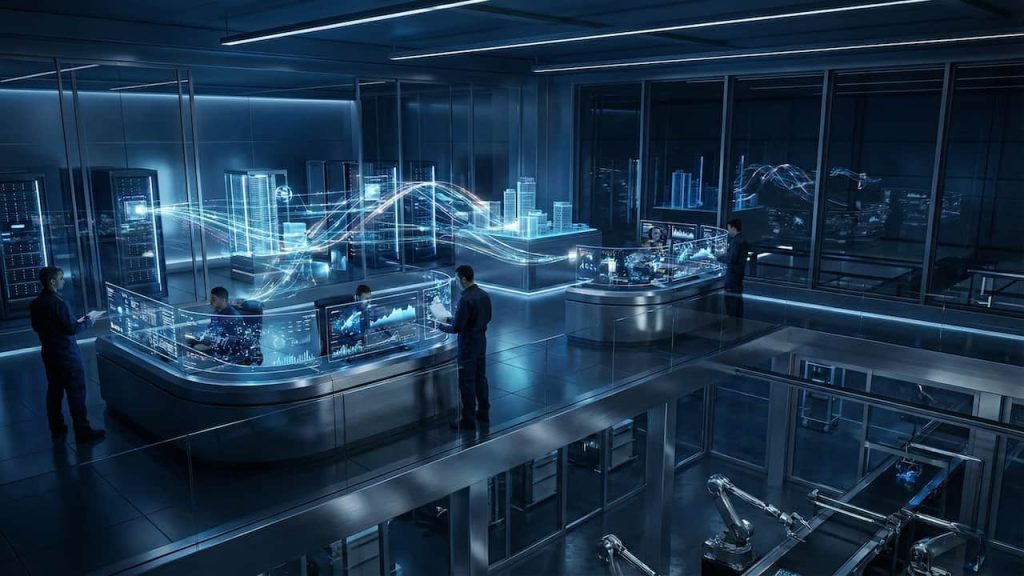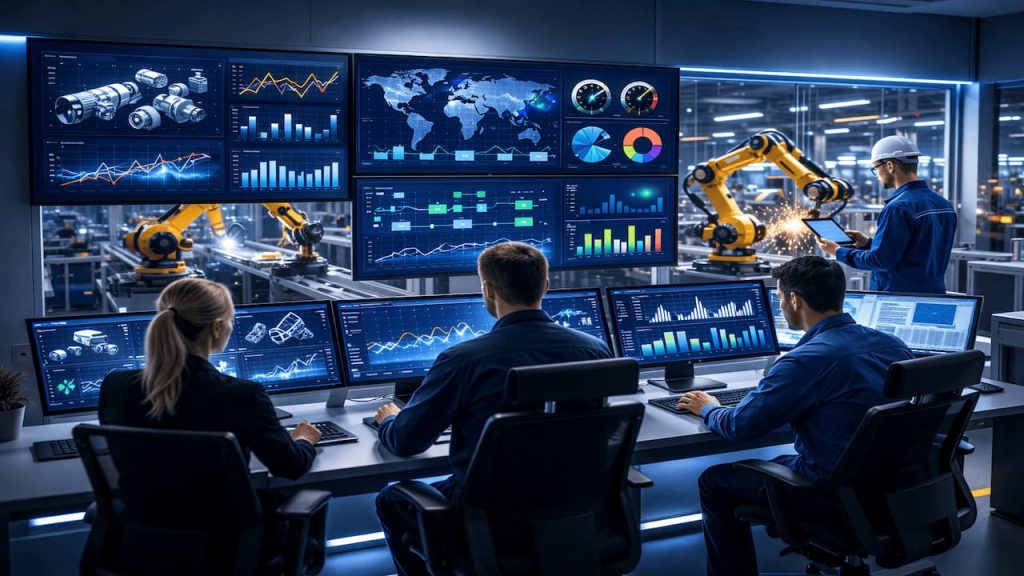
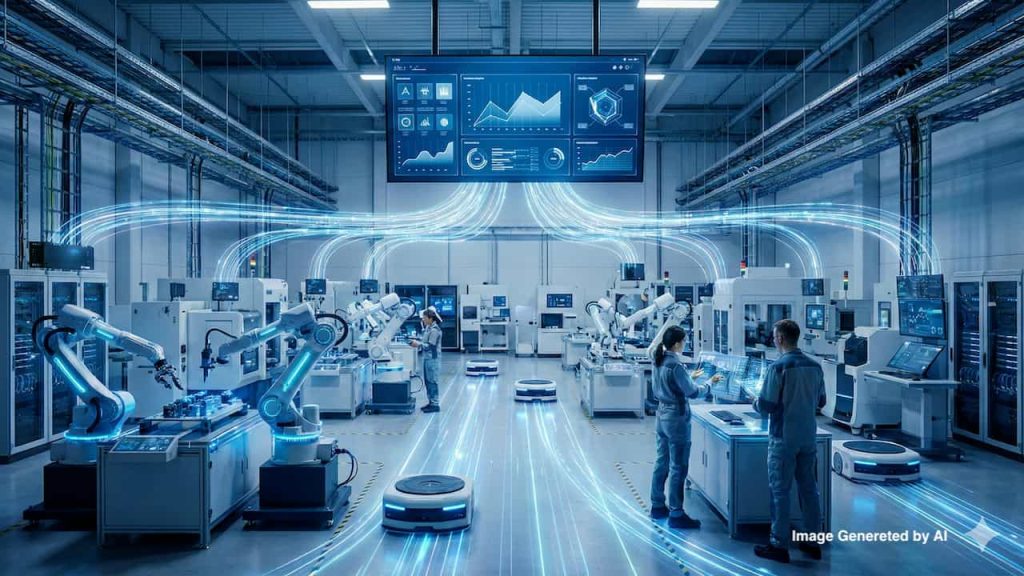
The manufacturing industry has reached a critical inflection point. The era of “pilot purgatory” is over. Based on the insights from IIoT World Days 2025, the next phase of industrial transformation is defined by three core pillars: Agentic AI, Unified Namespaces (UNS), and Industrial DataOps.
While these three form the structural “backbone,” a total of six technologies are defining the top smart factory implementations for 2026. Based on the 2025 IIoT World Manufacturing Day insights, here is the comprehensive guide to the top smart factory technologies and architectural shifts defining the industrial landscape in 2026.
1. Agentic AI: From “Chatbot” to “Digital Co-Worker”
The buzzword of 2024 and 2025 was Generative AI; the reality of 2026 is Agentic AI. While a Co-pilot waits for a human to ask a question, an AI Agent proactively observes, reasons, and acts.
- The Shift: As noted by Frost & Sullivan, “A Co-pilot gives you answers; an Agent gives you outcomes.”
- Actionable Intelligence: Instead of just flagging a temperature spike, an Agent checks the production schedule, determines the likely cause, adjusts the machine to a safe level, and generates a maintenance work order automatically.
- Key Enabler (MCP): By utilizing Model Context Protocol (MCP), manufacturers move from expensive, custom-coded integrations to a zero-code universal protocol, allowing AI agents to “plug and play” with existing MES and ERP systems instantly.
- Case Study: Infinite Uptime is already deploying prescriptive agents that reportedly save clients over 125,000 hours of downtime by prescribing specific mechanical fixes rather than just identifying anomalies.
| 2026 Tech Pillar | Legacy State (2024-25) | 2026 Smart Factory Standard | Primary Benefit |
|---|---|---|---|
| Artificial Intelligence | Co-pilots (Reactive) | Agentic AI (Proactive) | Proactive outcomes & automated work orders |
| Data Architecture | Point-to-Point APIs | Unified Namespace (UNS) | Single source of truth; decoupled devices |
| Integration Standard | Custom Code | Model Context Protocol (MCP) | Universal AI-to-machine interaction |
| Data Quality | Raw Sensor Tags | Industrial DataOps | Contextualized data; prevents AI hallucinations |
2. The Unified Namespace (UNS) Architecture
To achieve global scalability, factories are moving away from “spaghetti mess” integrations toward a Unified Namespace (UNS). This architecture allows data producers to publish data once, while any consumer (AI, MES, ERP) can subscribe to it.
- The Technology: This is powered primarily by MQTT with Sparkplug B, which decouples devices from applications.
- Why It Matters: As Arlen Nipper, co-inventor of MQTT, explains, UNS creates a “single source of truth.” Data is defined once at the edge, with its engineering units and scaling context, and is automatically discoverable by cloud platforms like Snowflake or AWS.
3. Industrial DataOps & Contextualization
AI models are useless without context; a raw sensor value like 4001: 45.2 means nothing to an algorithm. Industrial DataOps platforms sit between the edge and the cloud to model and contextualize data.
- HighByte: Recognized for closing the “context gap,” it models data at the edge to ensure downstream applications receive structured, usable payloads.
- Data Foundation: Different platforms act as the “data foundation,” connecting to legacy assets (even 1970s-era PLCs) to normalize data at the source, solving the “garbage in, garbage out” problem.
Why this matters for AI Reliability:
Industrial DataOps platforms like HighByte serve as the essential reliability layer. Without this foundation to provide context, Agentic AI is prone to hallucinations or prescribing incorrect mechanical fixes.
4. Generative AI for “Tribal Knowledge” Capture
As the “Silver Tsunami” of retirements hits manufacturing, companies are losing decades of experiential knowledge. In 2026, Generative AI is the primary tool for digitizing this “tribal knowledge.”
- The Application: AI tools ingest video of an expert performing a task and automatically generate Standard Operating Procedures (SOPs) or guided actions.
- The Result: This “deskills” complex tasks, allowing a new operator to receive real-time guidance via computer vision and AI overlays.
5. Secure OT Data Transfer & Device Identity
With the “air gap” security model effectively dead in a connected factory, the 2026 focus has shifted to Zero Trust and Identity.
- Sanitized Media: Solutions like Opswat scan and sanitize USBs before they touch the OT network.
- Data Diodes: For high-security environments, hardware-enforced data diodes ensure physically one-way data flow, allowing data to leave for analysis without creating an entry path for hackers.
- PKI & Identity: Keyfactor emphasizes that every device must have a managed identity, as “trust” should not apply to unverified machines.
6. Energy Digital Twins & Virtual Power Plants (VPP)
Digital twins are moving beyond simple machine monitoring to encompass the entire factory’s energy footprint.
- The Concept: By aggregating digital twins of distributed energy resources (solar, batteries, HVAC), companies create a Virtual Power Plant.
- Real-Time Optimization: High-frequency databases like InfluxDB handle the kilohertz-level data required to make split-second energy trading and grid-balancing decisions.
2026 Smart Factory: Technical FAQ
1: How does the Model Context Protocol (MCP) differ from traditional API integrations in a factory?
Traditional API integrations in a factory are often “point-to-point,” requiring custom code for every new connection. The Model Context Protocol (MCP) replaces this with a universal standard, allowing an AI agent to “plug into” a factory’s data ecosystem once and immediately understand how to interact with different tools without new code.
2: Why is “Industrial DataOps” required before deploying Agentic AI?
Agentic AI relies on reasoning but cannot reason with raw, messy data. Industrial DataOps (using platforms like HighByte) provides the necessary contextualization. It maps raw tags into a “Digital Twin” format that tells the AI the info it needs. Without this DataOps layer, the AI will likely “hallucinate” or provide incorrect fixes.
3: What are “Data Diodes,” and are they better than Firewalls for OT security?
While firewalls use software to block traffic, Data Diodes are hardware-enforced devices that physically only allow data to flow in one direction (out of the factory). In 2026, they are preferred because they ensure it is physically impossible for an attacker to send a command back into the factory’s control network.
4: How do Energy Digital Twins contribute to “Virtual Power Plants” (VPP)?
An Energy Digital Twin simulates the entire plant’s energy flexibility. When multiple factories connect these twins, they form a Virtual Power Plant (VPP). This allows a manufacturer to act like a utility company, selling excess battery or solar power back to the grid or shifting production to times when energy is cheapest, turning the factory into a profit center.
Disclosure Note: Most of the companies listed above were official sponsors of IIoT World Days 2025. The technologies were featured via expert speakers during panel discussions. AI tools were utilized to synthesize and consolidate insights from multiple event sessions to curate this article. Information was verified and edited by our editorial team.
This article was written by Carolina Rudinschi, Co-founder of IIoT World
IIoT World Days 2026 Calendar
Thursday, March 19, 2026: IIoT World Energy Day
Tuesday, May 12, 2026: IIoT World Manufacturing Day/Frontline Operations
September 9 – 10, 2026: Industrial AI 2026 Summit
Smart. Scalable. Secure. Part of IIoT World Days Series.
Wednesday, October 14, 2026: IIoT World ICS Cybersecurity Day
December 8 – 9, 2026: IIoT World Manufacturing & Supply Chain Day
About the author