
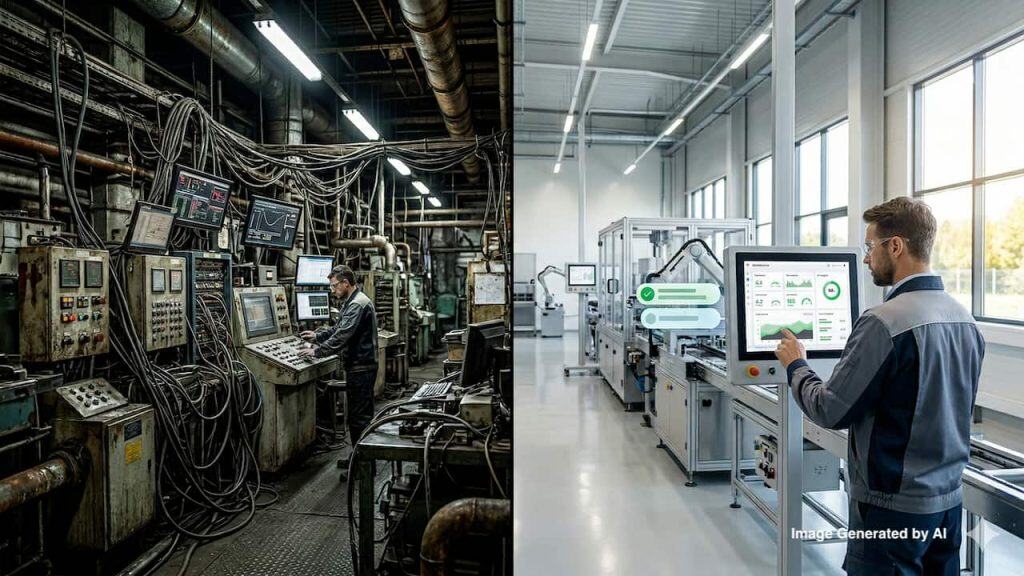
There is a prevailing assumption in manufacturing that advanced AI is a “big company game.” Global enterprises have the deep pockets, dedicated data scientists, and massive datasets required to make AI work. However, evidence from the shop floor suggests a surprising inversion. While the largest organizations are spending more, Small and Medium Manufacturers (SMMs) are often more “data-ready” to realize immediate value.
The Agility Gap: Big Budgets vs. Clean Data
A stark contrast exists in how company size impacts AI readiness. While $10B+ companies lead in deployment volume, with nearly 77% already implementing use cases, they struggle significantly with data usability.
Large enterprises are often “data-handicapped” by decades of legacy systems, fragmented global infrastructures, and inconsistent naming conventions across dozens of sites. In contrast, smaller manufacturers typically operate with more homogeneous settings and simpler software stacks. This streamlined environment means SMMs can normalize and contextualize their data with a fraction of the effort required by a global giant.
| Organization Size | AI Deployment Status | Data Usability (High Readiness) |
|---|---|---|
| Large Enterprise ($10B+) | ~77% (High Deployment) | Low (Fragmented Legacy Silos) |
| SMM ($100M–$500M) | ~4% (Emerging) | High (Simplified/Normalized) |
Democratizing the Lighthouse Standard
For years, “Lighthouse” factories, representing the world’s most advanced digital plants, seemed reserved for the Fortune 100. However, scale is no longer a prerequisite for sophistication. One of the earliest designated Lighthouse sites was a small Italian manufacturer with only 200 employees.
The barrier to entry has shifted from ownership to access. The transition from heavy CAPEX investments to subscription-based OPEX models means a mid-sized shop can now access the same prescriptive algorithms as an aerospace leader. By leveraging Software-as-a-Service (SaaS), smaller organizations can bypass the need for an in-house team of data scientists and pilot specific use cases, such as computer vision for quality control, with an ROI realized in as little as three to six months.
The Performance Premium
Manufacturing stands out as the sector with the highest potential for both cost reduction and revenue increase via AI. According to industry data, manufacturing reported more instances of 20% or higher cost reductions than any other sector.
For an SMM, these gains are transformative. Because smaller manufacturers are often closer to their production data and have fewer layers of bureaucracy, they can pivot their operations based on AI prescriptions much faster than a large corporation. While the giants are still trying to connect their global “data monsters,” small manufacturers have the clean, localized data needed to turn on prescriptive tools today.
The Reality: Industrial AI isn’t about the size of the company; it’s about the quality of the data and the speed of the decision-loop. In this race, agility often beats scale.
Strategic Advantages for the SMM
To capitalize on this data readiness, smaller manufacturers should focus on three specific areas:
- Focus on High-Value Use Cases: Target areas like Computer Vision for defect detection, which requires less historical data to begin generating value.
- Embrace “As-a-Service” Models: Use platforms that provide a “layered intelligent stack”, from advanced sensing to LLM-enabled prescriptions, without the upfront license fees.
- Codify Tribal Knowledge: Use AI as a digital backbone to capture the expertise of retiring veterans, ensuring that “how the machine runs” is stored in the system, not just in a single employee’s head.
Thank you to the experts who shared their insights during the “Prescriptive AI in the Factory: Accessible for SMEs or Enterprise-Only?” session at IIoT World Manufacturing Day:
- Karthikeyan Natarajan, Co-CEO, Infinite Uptime Inc.
- Jeff Winter, Vice President of Business Strategy, Critical Manufacturing.
- Carl March, Manufacturing Transformation Leader, Ernst & Young.
- Michael O’Donnell, Chief Operating Officer, MAGNET.
Sponsored by Infinite Uptime Inc.
FAQ: AI & Data Readiness for SMMs
1. What is the data readiness paradox in manufacturing?
It is the surprising reality where Small and Medium Manufacturers (SMMs) are often more “data-ready” to realize immediate value from AI than large global enterprises. While big companies spend more, smaller manufacturers benefit from simpler, less fragmented data environments.
2. Why do large manufacturing enterprises struggle with AI data usability?
Despite high deployment volumes and large budgets, large enterprises are often “data-handicapped” by decades of legacy systems. They frequently deal with fragmented global infrastructures and inconsistent naming conventions across multiple sites, making data normalization highly difficult.
3. How can Small and Medium Manufacturers (SMMs) afford advanced industrial AI?
SMMs can access advanced AI by shifting from heavy CAPEX investments to subscription-based OPEX models. By leveraging Software-as-a-Service (SaaS) platforms, smaller shops can bypass the need for an expensive in-house team of data scientists and deploy prescriptive algorithms quickly.
4. What are the best early AI use cases for smaller manufacturers?
Smaller manufacturers should target high-value use cases that require less historical data, such as using Computer Vision for defect detection. Additionally, using AI as a digital backbone to codify the “tribal knowledge” of retiring veterans ensures critical operational expertise is stored in the system rather than just in employees’ heads.
5. How fast can an SMM see ROI from an AI pilot?
By leveraging SaaS platforms for specific use cases like quality control, smaller organizations can realize a return on investment (ROI) in as little as three to six months.
About the author