
Industrial AI learns from history — but in most plants, that history is a mess.
Behind every AI pilot, there’s a decade of process data, maintenance logs, and scanned reports that were never designed to work together. (Explore what document-first RAG means from Adlib.) These systems contain the experience of the plant — what failed, what worked, what changed — but much of it is incomplete, unstructured, or forgotten.
The Danger of Dirty Data
Every manufacturer wants predictive intelligence — AI that can anticipate breakdowns, optimize setpoints, or spot inefficiencies. But when the historical data behind those predictions is flawed, the results can mislead rather than guide.
AI models don’t just analyze past data — they inherit its imperfections. Gaps in historical data, inconsistent logging, and unverified inputs can bias algorithms before they ever reach the field.
That’s why data discipline must come before deployment. Good AI doesn’t start with a model; it starts with a method — procedures to clean, validate, and structure information before it ever touches an algorithm.
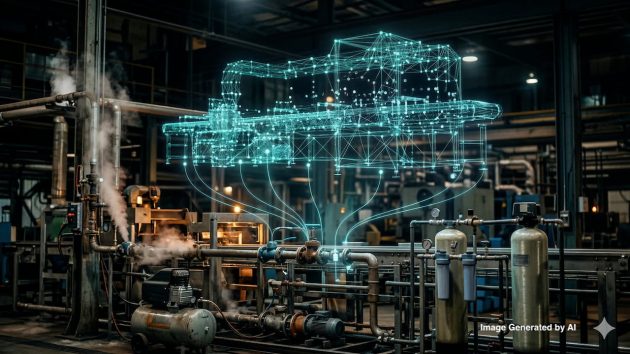
Without that discipline, the plant’s “digital twin” starts to drift from reality.
Turning Forgotten Data into Useful Insight
Industrial operations don’t lack data; they lack usable data.
Over decades of automation, manufacturers have accumulated a patchwork of documents: engineering drawings, maintenance records, supplier manuals, inspection sheets — most of them trapped in PDFs or scanned images. This unstructured content holds valuable context about plant behavior but remains invisible to AI systems that rely only on numerical inputs.
That’s where Adlib comes in. Erikjan Franssen, the company’s General Manager for International Markets, explained in a recent interview that one of the most overlooked sources of value in industrial AI lies inside those unstructured archives.
“No matter how digitized your own factory is,” he said, “you’re still working with external suppliers and vendors. Their documentation is part of your process, and if it’s not digitized, your AI can’t learn from it.”
Modern AI tools can now read and categorize that forgotten data, connecting human-written records with machine-generated signals. Instead of starting over, manufacturers can teach AI from their full operational history — giving it decades of context it never had before.
From Lab Model to Living System
Even with clean data, AI behaves differently in the real world.
Cesar Bravo, AI Solutions Director at Honeywell, described in the same interview the moment when lab-tested models meet the complexity of live production environments. Every plant has slight configuration changes, custom parameters, or undocumented modifications — differences that can derail a model trained in ideal conditions.
“Once you move from lab to field,” he said, “something is always different — a configuration, a parameter, something unrecorded.”
To prevent that mismatch, Honeywell applies the same rigor to AI deployment that engineers use for equipment commissioning. Every model is validated under real plant conditions before it’s trusted with operational decisions.
That extra step — testing before trusting — turns AI from a research project into a reliable operator companion.
The Next Frontier: Trustworthy AI
Industrial AI isn’t just about automation or analytics. It’s about trust — trust in the data, in the models, and in the decisions they inform.
The plants leading this new phase aren’t the ones buying the newest platforms. They’re the ones cleaning the oldest data. They’re converting static documents into structured knowledge. They’re validating models like they validate machinery.
AI doesn’t replace experience; it amplifies it.
But only when that experience is clean, complete, and ready to be learned from.
This article was written based on a video interview at the Honeywell User Group in The Hague, with Cesar Bravo, AI Solutions Director at Honeywell, and Erikjan Franssen, General Manager – International Markets at Adlib.
Sponsored by Adlib. Travel to the event was supported by Honeywell.
About the author
Lucian Fogoros is the Co-founder of IIoT World.