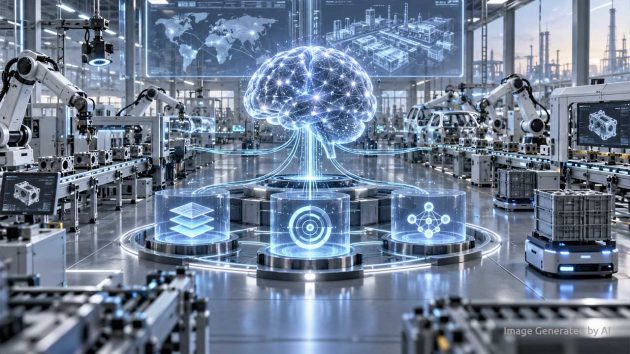
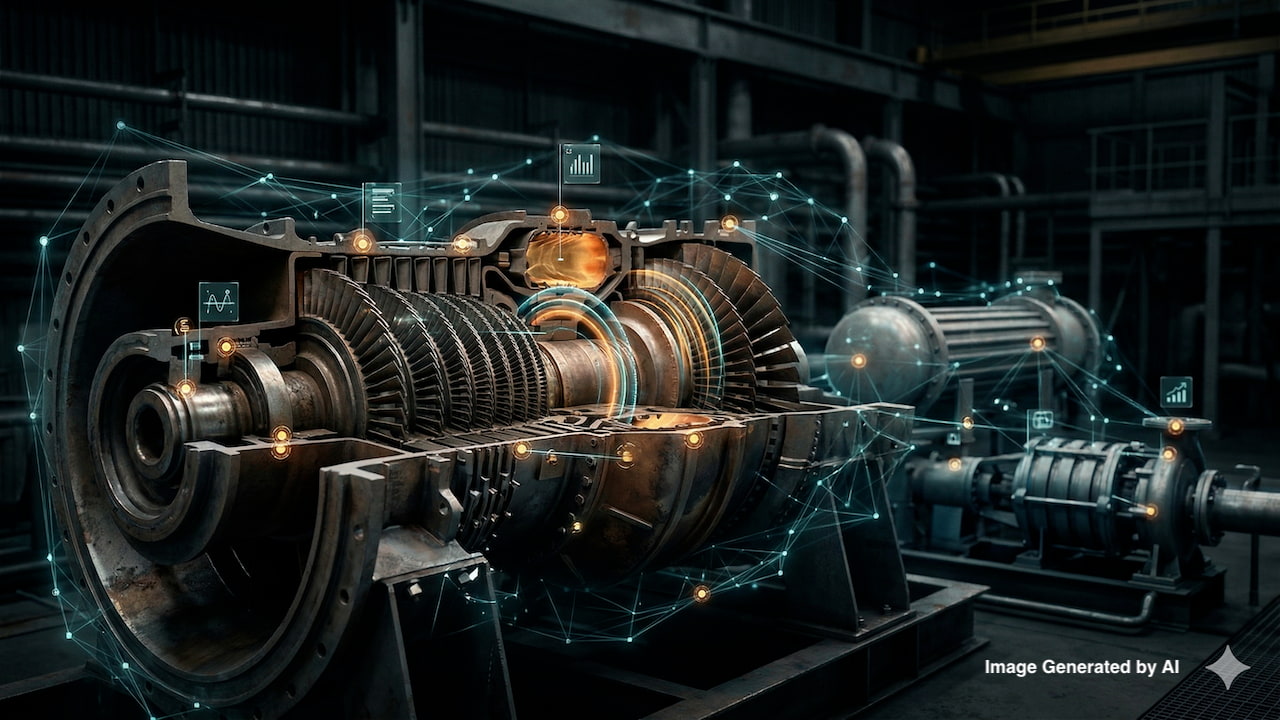
The industrial manufacturing sector is operating in an era of persistent volatility. To maintain global competitiveness,organizations are increasingly turning to the Artificial Intelligence of Things (AIoT). According to recent research from IDC: “71% use AIoT for predictive maintenance. Predictive maintenance is the most widely adopted use case across industries.”
The financial return is undeniable. Organizations that deeply employ AI in IoT are twice as likely to report benefits that significantly exceed expectations, with “63% reporting productivity and competitiveness gains.”
-
GenAI and RAG for Instant Root-Cause Diagnostics
Historically, traditional machine learning (ML) models have flagged anomalies but lacked context. This leads to severe operational bottlenecks. As noted by SAS and Pinnacle Solutions:
“Finding the right answers can be difficult, as over 80% of enterprise data is unstructured and not easily searchable… The alerts begin to pile up and go ignored as maintenance teams are bombarded with vague alerts that are difficult to prioritize.” (Source: SAS & Pinnacle Solutions)
The Problem: The OEM manual for a GE Frame 9F turbine runs over 6,000 pages. Identifying the root cause of a turbine trip manually takes 6 to 10 hours.
The AI Solution: Organizations are layering Generative AI (GenAI) and Retrieval-Augmented Generation (RAG) over ML tools. These AI agents instantly search manuals, logs, and forums to provide the probable cause and recommended action.
-
Physics-Based AI for Structural Performance Management (SPM)
In heavy industries, relying on historical failure patterns is dangerous. Akselos highlights that “80% of refinery assets are pressurized steel.”
The AI Solution: Structural Performance Management (SPM) combines physics-based AI with integrity data to create standard-compliant (API, ASME) structural twins. This allows teams to “safely expand the operating envelope and defer replacements by one or more turnarounds, unlocking incremental value and CAPEX savings in the tens of millions USD.”
-
Continuous Anomaly Detection and Autonomous Decision Support
While standard systems rely on rigid, predefined rules, true industrial AI utilizes self-learning algorithms. “Unlike rule-based systems that only detect known fault signatures when they occur, AI models can recognize the earlier warnings in subtle deviations from normal operation.” (Source: ABB)
The AI Solution: By processing data from vibration sensors, temperature readings, and process parameters, AI moves operations to condition-based maintenance, reducing unplanned downtime and extending asset life.
-
AI-Driven Enterprise Asset Performance Management (APM)
APM systems now incorporate AI-driven models to forecast failures across entire fleets. Radix points to a major petrochemical manufacturer that applied these programs to Furnaces, pumps, and heat exchangers.
Key Performance Impact (Source Data)
| Industrial Asset | Operational Impact | Financial Return (ROI) |
|---|---|---|
| Heat Exchangers | Optimized Maintenance | Up to 719% ROI (Source: Radix) |
| Furnaces | 13% extension in asset life | 8% energy reduction (Source: Radix) |
| Refinery Assets | Deferral of replacements | Tens of millions USD in CAPEX savings (Source: Akselos) |
| General Operations | Root-cause identification | Reduction from 6-10 hours to instant (Source: SAS) |
For more on industrial AI applications, see the IIoT World Events Calendar or register for AI Manufacturing Day 2026 on May 12.
Sources:
- How AIoT Is Reshaping Industrial Efficiency, Security, and Decision-Making (IDC InfoBrief) – Authors: Carlos Gonzalez, Kathy Lange, Andrew Gens (Sponsored by SAS)
- Predictive power-up: How adding a GenAI layer to predictive maintenance tools is changing what’s possible in industrial sectors – Company: SAS
- Solution Brief – Supercharge Maintenance Teams With an AI Assistant – Companies: SAS & Pinnacle Solutions
- Structural Performance Manag
- ement Conference Booklet 2025 – Company: Akselos
- The Roadmap to Autonomous Operations – Company: ABB
- Cross-Industry APM Energy Case Studies – Company: Radix
Note: We used AI tools to summarize and extract the data we needed for this article. Edited and verified by our editorial team.
Industrial AI & Predictive Maintenance FAQ
1. What is the most widely adopted use case for AIoT in industry?
As referenced in this IIoT World article, IDC data shows 71% of organizations use AIoT for predictive maintenance as their primary competitiveness strategy.
2. How does Generative AI reduce downtime in manufacturing?
GenAI and RAG technology solve “alert fatigue” by instantly analyzing unstructured data, such as 6,000-page OEM manuals, reducing the time to identify root causes from a 6-10 hour window to a nearly instantaneous response.
3. What are the financial benefits of Physics-Based AI (SPM)?
By using physics-based AI to create structural twins, companies can safely defer asset replacements by one or more turnarounds, unlocking CAPEX savings in the tens of millions of USD.
About the author