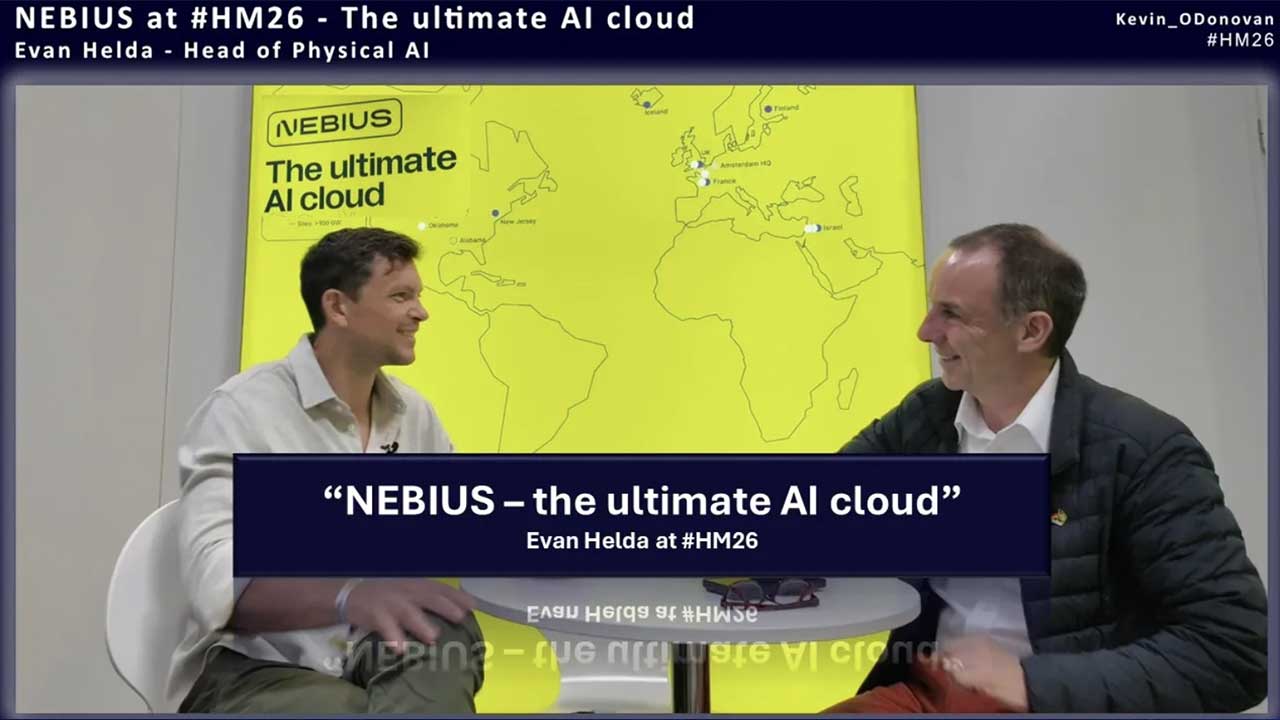
As physical AI moves from conference-stage ambition into real industrial experimentation, the infrastructure question is becoming harder to ignore. Robots, humanoids, autonomous systems and industrial AI workloads do not just need more compute. They need faster iteration, better data pipelines, scalable simulation, and a way to move from training to evaluation to deployment without stitching together a fragile collection of tools.
That was the central theme in a recent conversation with Evan Helda, Head of Physical AI at NEBIUS, during Hannover Messe. While many still think of NEBIUS as a newer cloud player or “neo-cloud,” Helda positioned the company differently: as an AI-native hyperscaler, built around the specific needs of modern AI workloads and, increasingly, the emerging world of physical AI.
From AI Cloud to AI-Native Hyperscaler
NEBIUS describes itself as one of the world’s leading AI clouds, but Helda was quick to point out that the company’s role is not limited to providing raw compute. Instead, NEBIUS offers a full-stack platform covering infrastructure, managed services, virtualization, containerization, Kubernetes, MLOps and AIOps tools for building pipelines and training models.
In Helda’s words, NEBIUS is “what AWS would be, if we started today.” The distinction matters. Rather than positioning itself as a narrow GPU provider, the company is aiming to operate as a true hyperscaler for AI workloads, with infrastructure and software layers designed for the current generation of model development, simulation and deployment.
There is also more history behind the company than some might assume. Helda explained that NEBIUS combines startup-style urgency with the maturity of a larger organization. The company has nearly 2,000 people, is public, and draws on almost two decades of experience building cloud software.
Why Physical AI Needs a Different Stack
For Helda, being an AI-native hyperscaler means optimizing every layer of the stack. At the compute layer, NEBIUS provides access to high-performance NVIDIA chips and InfiniBand networking. But compute is only one part of the picture. Storage, throughput, latency and orchestration all become critical when companies are running large-scale AI training and physical AI workflows.
That is especially true for robotics and embodied AI, where workloads span multiple environments. A physical AI team may need to train models in one environment, run simulations and evaluations in another, and then deploy inference workloads at the edge. Each stage can require different infrastructure, software pipelines and GPU configurations.
This is where complexity starts to slow companies down. Helda argued that developers should be spending their time building “robot brains,” not writing glue code and manually stitching together pipelines. NEBIUS is working with NVIDIA’s OSMO orchestration framework to simplify this process, helping teams build one pipeline instead of several and manage training, simulation and inference more coherently.
Speeding Up the Physical AI Flywheel
One of the key themes from the conversation was the data flywheel. In theory, physical AI improves through a continuous loop of data collection, model training, simulation, evaluation and deployment. In practice, that flywheel is often not spinning as quickly as companies would like.
Helda explained that iteration speed is shaped by several factors. The first is infrastructure performance. Companies often think in terms of GPU hours, but he suggested they should instead think in terms of completed training runs. If a model can move through training faster, it can move into evaluation, simulation and the next round of improvement faster as well.
He noted that training runs which may take around 100 hours on a general-purpose cloud can take roughly 70 to 80 hours on NEBIUS, depending on the cluster size and workload. Over repeated cycles, that difference compounds.
The second factor is the development process itself. Physical AI workflows often require separate pipelines for training, simulation, evaluation and edge deployment. By abstracting some of the differences between these environments, NEBIUS aims to reduce the manual work needed to keep the flywheel moving.
Synthetic Data, Simulation and Better Data Management
Helda also outlined how NEBIUS is building a broader physical AI platform around orchestration, synthetic data, simulation and data management. One major bottleneck is access to enough high-quality, varied data. Companies may have teleoperation data, camera feeds or simulation data, but they often lack the long-tail scenarios needed to train robust models.
To help address this, NEBIUS is working with NVIDIA technologies including Cosmos world models and Cosmos Reason. The goal is to take existing video data and augment it with new scenes, lighting conditions, backgrounds and variations, then check the quality of that generated data before using it for training.
Simulation is another core area. NEBIUS is forming partnerships to make it easier for companies to bring autonomy stacks into scalable simulation environments using tools such as Isaac Sim and Isaac Lab. At the data layer, the company is also partnering with Voxel51 to help teams find, label, evaluate and curate the right episodes and failure events from large visual and robotics datasets.
The immediate customer profile is companies building robot brains, particularly AI-native and physical AI-native startups. But many of the same challenges will eventually apply to enterprises deploying and managing robots in real operational environments.
Hannover Messe: Humanoids, Digital Twins and Integration
Reflecting on Hannover Messe, Helda pointed to the number of humanoids and automation demonstrations across the show floor. Many companies are still in an experimentation phase, but the level of activity suggests the industry is moving quickly from curiosity into practical learning.
He also highlighted the growing use of simulation and digital twins. More companies building automation software and OT-based systems are looking for ways to pipe operational data into environments such as NVIDIA Omniverse. What was once often treated as a buzzword is becoming more tangible.
The role of systems integrators also stood out. Bringing together OT data, IT data, robotics systems and enterprise workflows is difficult, and Helda noted that firms such as Accenture and EY are taking the space seriously. To make AI agents and robots useful in industrial environments, companies will need unified data layers, common data models and shared context that machines and humans can reason over together.
Final Reflections
NEBIUS’s positioning reflects a broader shift in the AI infrastructure market. As AI moves into robotics, factories, autonomous systems and industrial operations, the requirements are changing. It is no longer enough to provide access to chips. The next layer of value lies in helping companies move faster through data, training, simulation, evaluation, deployment and continuous improvement.
Physical AI is still early, and the tooling will continue to evolve. But the direction is clear. Companies building intelligent machines will need infrastructure that understands heterogeneous compute, synthetic data, simulation, edge deployment and operational complexity. That is where NEBIUS is trying to carve out its role: not just as another AI cloud provider, but as an AI-native hyperscaler built for the workloads that come next.
This interview with Evan Helda, Head of Physical AI at NEBIUS, was recorded at Hannover Messe in Hannover by Kevin O’Donovan, a member of IIoT World’s Board of Advisors.
Related from IIoT World
- Neura Robotics and the Rise of Physical AI in Manufacturing
- Agentic AI and Physical AI Are Converging in Manufacturing
- Subscribe to the IIoT World Newsletter
About the author