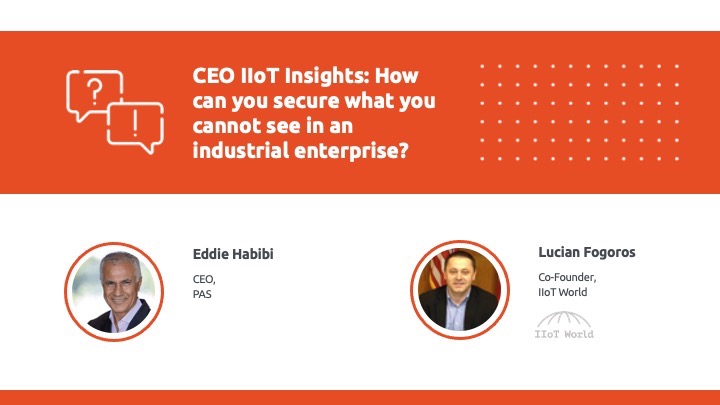
Industrial companies are flying blind on 80% of their cyber assets, according to Eddie Habibi, CEO of PAS. In this CEO IIoT Insights interview with IIoT World, Habibi outlines why most industrial organizations lack visibility into their control system assets and what that means for cybersecurity risk.
Lucian Fogoros: What Cybersecurity Risks Do Industrial Companies Face?
Eddie Habibi: Companies are flying blind when it comes to 80% of the cyber assets that exist within an industrial process facility. They lack sufficient visibility into what assets they have and how they are configured. Without this data, basic cybersecurity questions remain difficult to answer. For example, did an unauthorized change occur, where are my vulnerabilities, and can I recover quickly if the worst case scenario happens? What’s at risk? Production, safety, environment, brand reputation, and even personal liability are impacted if these systems are compromised.
Lucian Fogoros: Is the Insider Threat Greater Than the Outsider Threat?
Eddie Habibi: Most CISOs with whom we meet are as concerned with the insider threat as they are with the outsider one. Insiders have access to the systems that can negatively impact production, safety, and corporate brand as well as have the knowledge on how to inflict targeted damage. What is missing is the will and disposition. It unfortunately only takes one.
Lucian Fogoros: Are Industrial Organizations Reactive or Proactive on Security?
Eddie Habibi: We are encouraged by the proactive measures taken by our customers in power and process industries. Over the last three years, we have seen an increase in board-driven initiatives to identify and secure industrial control systems. The challenge, however, is that most still rely on perimeter-based approaches to keep the bad guys at bay, while entrusting security by obscurity to mitigate risk further. What we know is that this approach no longer works – perimeter-based security is one email away from being breached, and attackers are becoming more familiar with the complex systems in an industrial facility having performed reconnaissance on these systems for years now. To illustrate, APTs such as Havex and BlackEnergy, had infiltrated thousands of organizations for at least two years before being discovered in 2014 and both remain in play today. In fact, BlackEnergy was the APT that established the initial network presence during the Ukrainian power attack in 2015.
Lucian Fogoros: Where Do ICS Security Budgets Fall Short?
Eddie Habibi: There is definitely budget for ICS cybersecurity projects. The challenge organizations face is where to best allocate those dollars and focus attention. Clearly network segmentation is a good first step for many, but the cyber systems that draw the most spend tend to represent only 20% of the cyber assets that exist in a plant – namely the workstations, servers, routers, and switches. Organizations lack visibility into the remaining 80% with insufficient inventory capabilities to track assets and asset configurations. These systems include field instruments, I/O cards, PLCs, and other mission critical assets. How can you secure what you cannot see? Better automated inventory methods will give visibility into the systems most responsible for production and safety and will better support cybersecurity best practices, such as change, vulnerability, and compliance management.
Lucian Fogoros: How Do You Start Reducing ICS Cybersecurity Risk?
Eddie Habibi: Get a handle on all the assets in an industrial process facility – not just the IT-based ones, but also the highly complex, proprietary industrial control systems. With a complete inventory of all cyber assets, organizations can more appropriately take action to mitigate risk and at the same time improve operational efficiency. Further reading: Facility Managers Guide to Building Systems and Cybersecurity